
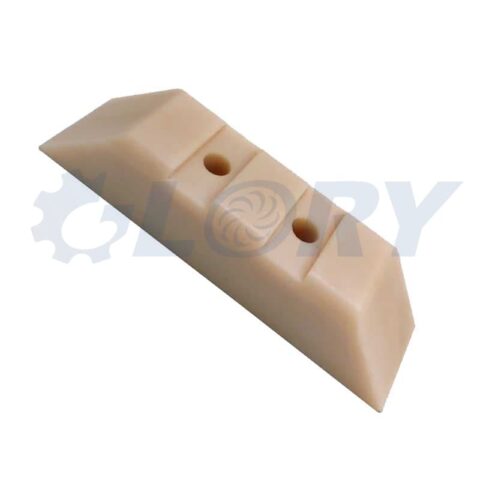
Custom Nylon Support Blocks | CNC-Machined Cast Nylon & Sliding Blocks from Drawings
Nylon support block, nylon support pad, cast nylon block, MC nylon pad, oil-filled nylon slider, glass-filled nylon block, nylon guide block, nylon limit block, nylon bearing block, nylon CNC machining
Custom Nylon Support Blocks | CNC-Machined Cast Nylon Pads & Sliding Blocks from Drawings or Samples
On automation lines, construction machinery, lifting equipment, and all kinds of jigs and fixtures, anywhere load bearing, leveling, limiting, cushioning, or guiding is required, you will find unassuming support parts — support blocks, pads, and sliding blocks. They carry the weight, impact, and repeated friction of equipment, and choosing the right material directly affects machine stability, noise levels, and service life.
Beyond traditional steel, bronze, and rubber, the nylon support block — commonly machined from MC cast nylon or oil-filled nylon — combines high load capacity, toughness, impact resistance, vibration damping, and corrosion resistance, making it an ideal replacement for metal pads, bronze sliders, and rubber cushions. We are a specialized CNC machining manufacturer focused on non-standard, custom-engineered plastic components. We routinely machine nylon support blocks, pads, guide blocks, limit blocks, and load-bearing seats. We work from drawings or samples, accept single pieces and small batches, require no tooling or mold, and offer fast lead times.
1. What Is a Nylon Support Block?
A nylon support block is a block-type component made from nylon (polyamide, PA) plate, rod, or cast stock, machined by CNC milling, turning, and drilling. Common forms include:
- Support pads / spacer blocks — for equipment leveling, load bearing, and isolation;
- Sliding blocks / guide blocks — traveling along guide rails in linear motion and carrying side loads;
- Limit blocks / locating blocks / stop blocks — for travel limiting and workpiece positioning;
- Support seats / bearing blocks — carrying shaft components, optionally with a pressed-in bushing;
- Load blocks / buffer blocks — bearing impact and alternating loads.
Common nylon materials include MC cast nylon, oil-filled nylon, PA6/PA66, glass-filled nylon, modified MC901 nylon, and food-grade nylon. MC cast nylon offers high crystallinity, low internal stress, and large cast sizes, making it the first choice for large support blocks and pads; oil-filled nylon is preferred for continuous sliding where lubrication is impractical.
2. Why Is Nylon a Popular Material for Support Blocks?
- High load and compression capacity. Nylon offers a tensile strength of approximately 70–100 MPa (MC cast nylon around 75–90 MPa), with strong load-bearing performance and minimal crushing or flattening under heavy loads; it can replace steel plates and bronze pads.
- Tough and impact resistant — no brittle fracture. This is nylon’s biggest advantage over rigid plastics such as POM: when loads drop, offset loads occur, or vibration is frequent, nylon absorbs impact through its toughness and does not snap, suiting heavy equipment and fixtures.
- Wear resistant and self-lubricating — protects guide rails. Oil-filled nylon has lubricant added during casting, substantially reducing the friction coefficient; sliding surfaces stay burr-free over long service and will not score metal rails, reducing equipment wear.
- Vibration damping and noise reduction. Nylon provides good damping, absorbing vibration energy and eliminating the noise of metal-to-metal contact for a noticeably better workshop environment.
- Protects mating surfaces. Moderately soft nylon will not scratch steel plates, workpieces, or painted surfaces, and is widely used on welding lines and lifting equipment.
- Lightweight and easy to replace. With a density of about 1.15 g/cm³ — roughly one seventh that of steel — even large pads are easy to carry and install, reducing labor intensity.
- Corrosion resistant and rust-free. Nylon resists alkalis, alcohols, ethers, hydrocarbons, weak acids, lubricating oils, detergents, and seawater; it does not rust, corrode, or age readily in wet, outdoor, dusty, or oily environments.
- Flexible machining. CNC can add mounting holes, counterbores, tapped holes, guide slots, oil grooves, tapers, and contoured surfaces, consolidating the function of multiple shims and adjustment plates into a single support block.
3. Nylon vs. Other Support Block Materials
| Material | Strengths | Limitations | Typical Application |
|---|---|---|---|
| MC cast nylon | High load capacity, tough, low internal stress, available in large sizes, damping and wear resistant | Some water absorption | Large pads, load blocks, support seats, gate sliders |
| Oil-filled nylon | Self-lubricating, low friction, maintenance-free, long sliding life | Slightly lower load rating than plain nylon | Continuously sliding blocks, guide blocks, rail pads |
| Glass-filled nylon | Greatly increased rigidity, strength, and temperature rating | Slightly more abrasive to mating parts | High-load, high-rigidity support points |
| POM (Acetal/Delrin) | Dimensionally stable, low water absorption, precise, low friction | Less tough and impact resistant than nylon | Precision locating, damp environments, medium/light loads |
| UHMWPE | Extremely wear resistant, self-lubricating, zero water absorption, impact resistant | Lower load capacity and rigidity than nylon | High-wear, low-load guides and wear faces |
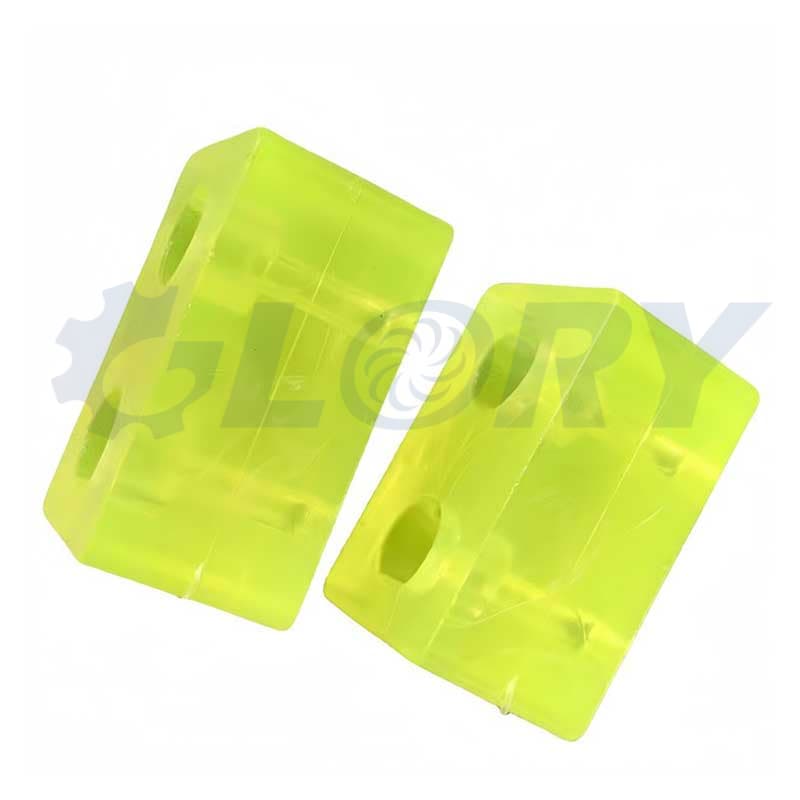
| Rubber / polyurethane | Cushioning, anti-slip, elastic | Poor load capacity, ages and deforms | Anti-vibration and anti-slip pads; not for heavy loads |
| Steel / bronze | High load capacity, heat resistant, traditionally reliable | Heavy, corrosive, noisy, costly, need lubrication | Extreme heavy loads/high temperature; bronze sliders can be replaced by nylon |
| PEEK | High strength, high temperature rating, excellent overall performance | High cost | High-end, high-temperature, high-purity applications |
Selection rule of thumb: for heavy loads, impact resistance, and vibration damping choose MC cast nylon; for continuous sliding without lubrication choose oil-filled nylon; for high load and rigidity choose glass-filled nylon; for damp environments and dimensional precision choose POM. Note that nylon absorbs water — for long-term wet service with very tight precision, increase fit allowances or switch to POM.
4. What Nylon Support Blocks Can We Customize?
With CNC machining centers, CNC lathes, and large milling equipment, we produce from drawings, samples, or reverse measurement:
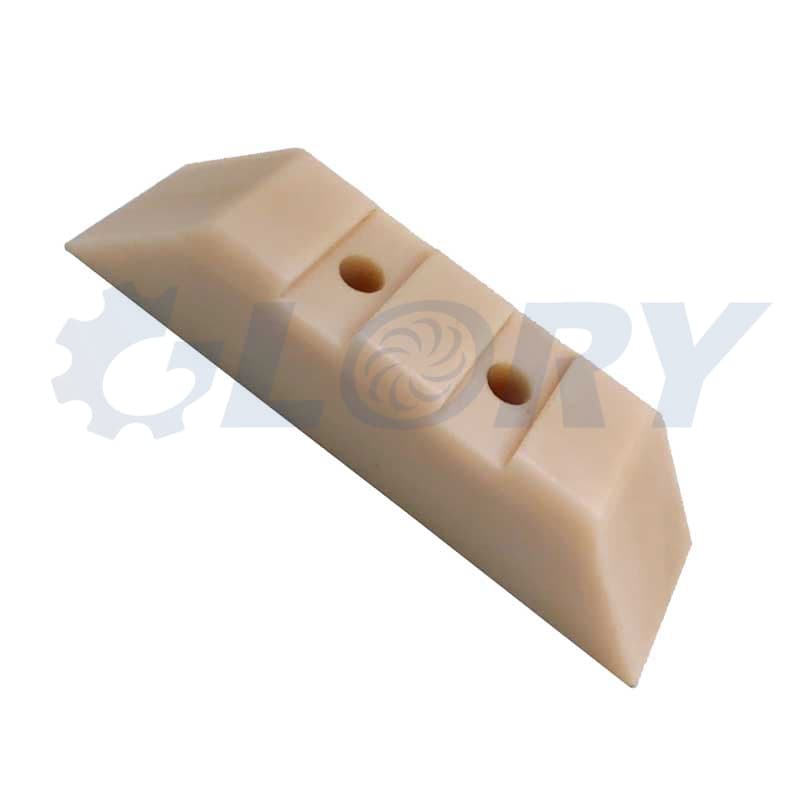
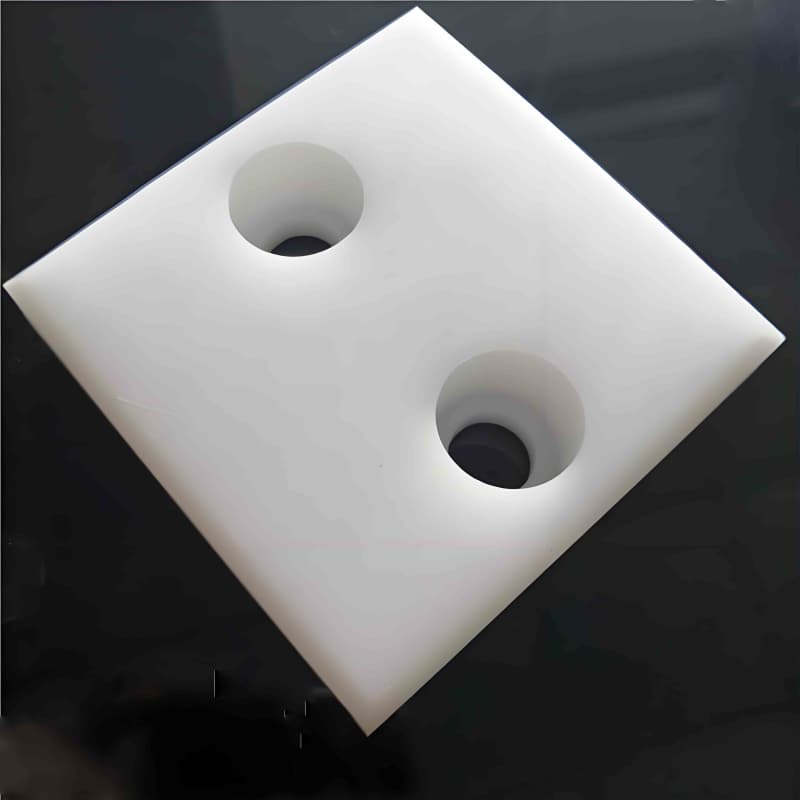
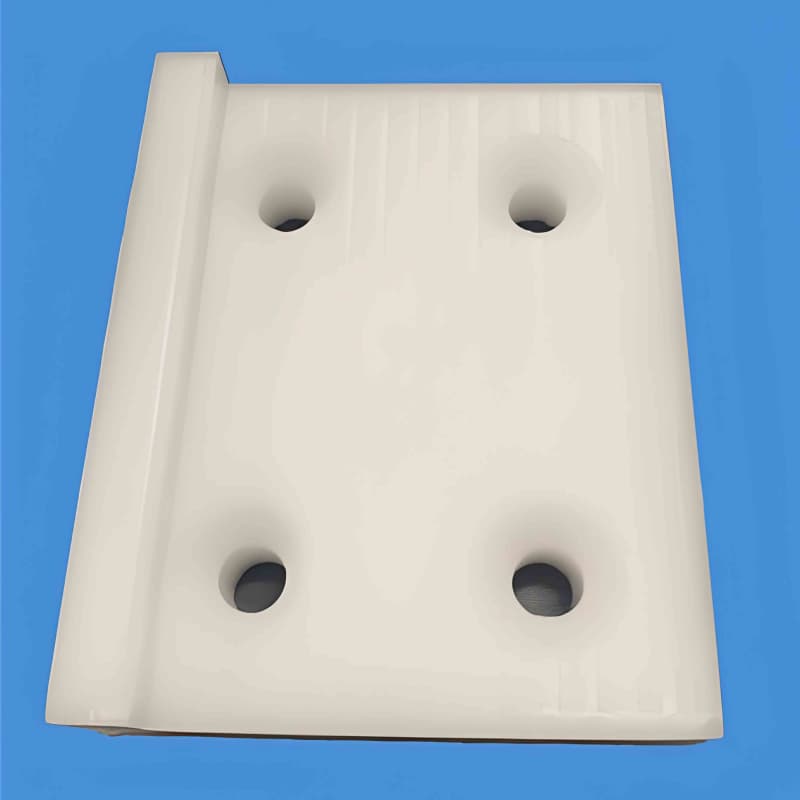
- Flat pads, taper/wedge pads, leveling plates, and equipment mounting pads — thickness and taper as required;
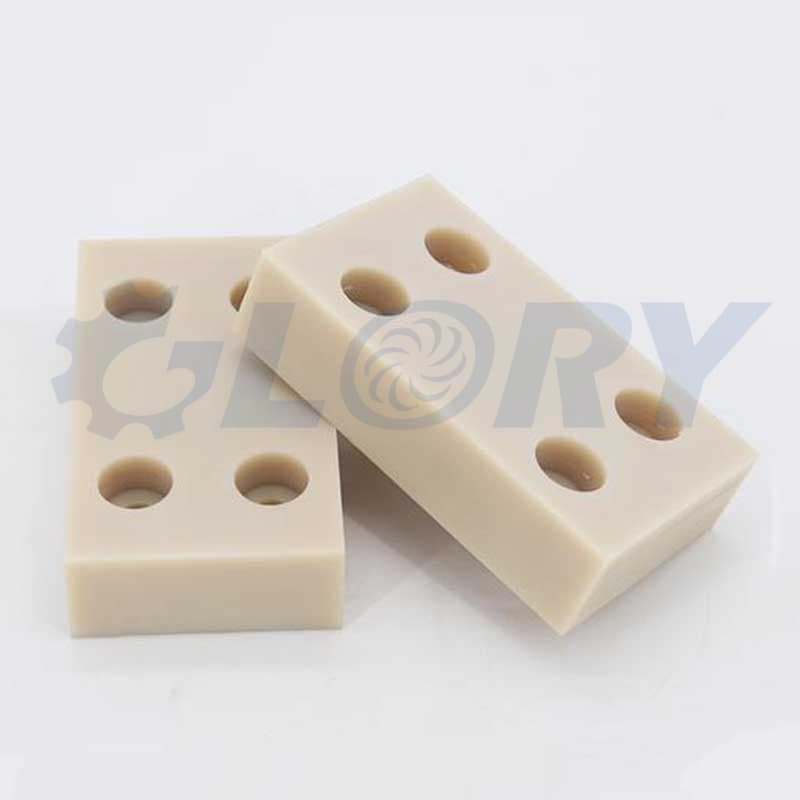
- Blocks with mounting holes — through holes, counterbores, tapped holes, and dowel holes for direct bolting;
- Sliding blocks / guide blocks — with guide slots, oil grooves, and chamfers, matched to rails and telescopic booms;
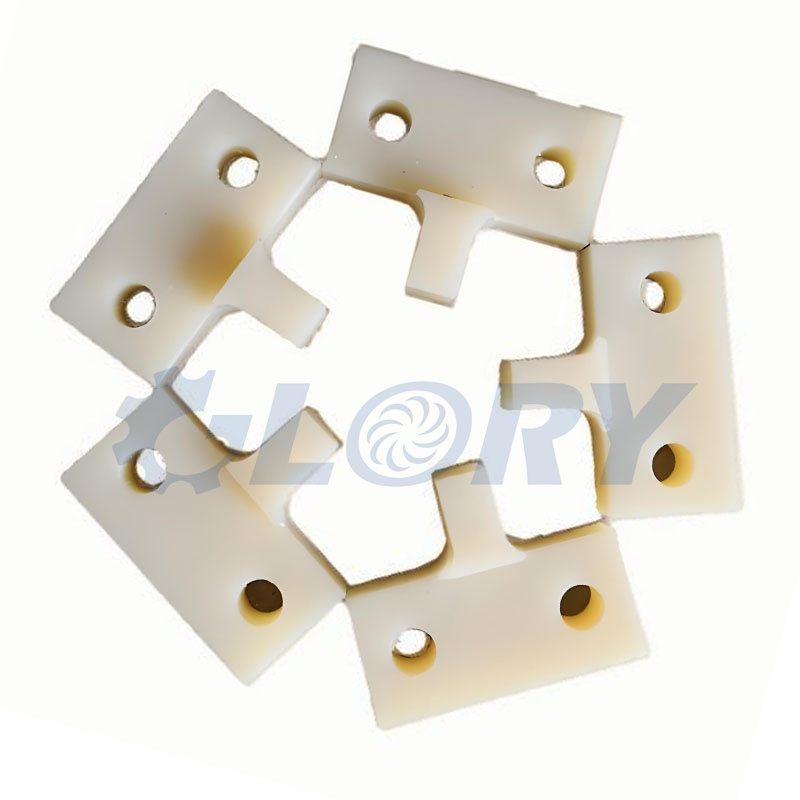
- Limit blocks, locating blocks, stop blocks, and buffer blocks — for travel control and workpiece positioning;
- Support seats, bearing blocks, and shaft supports — with optional pressed-in bushings and caps for rotating parts;
- Irregular support blocks — curved, V-shaped, and contoured welding surfaces and other non-standard structures;
- Large load blocks — machined from MC cast nylon stock for oversized pads and support plates;
- Combination kits — support blocks, shims, bushings, and fasteners supplied together.
Colors are mainly natural (off-white) and black; oil-filled nylon is commonly green/black, modified MC901 is often blue, and custom colors are available.
5. Precision Details That Affect Loading and Service Life
Support blocks look simple, but their flats and holes matter:
- Parallelism and flatness of the top and bottom faces — good parallelism ensures even loading and avoids local stress concentration and crushing;
- Consistent thickness — multiple pads on one machine must be equal in height for proper leveling without tilting;
- Hole positions and counterbore depths — ensuring surfaces stay flat after bolt tightening without protrusions;
- Guide-slot width and straightness — proper clearance between slider and rail for smooth, non-binding travel;
- Contoured profiles — blocks mating with workpieces or curved surfaces require accurate profiles;
- Nylon process control — nylon conducts heat poorly, expands when heated, and absorbs water. We use sharp tools, air or mist cooling, separate roughing and finishing, and inspect dimensions after temperatures stabilize; thick and large parts use low-stress MC cast stock to minimize deformation.
6. Why CNC Machining Instead of Injection Molding?
- No tooling required — single pieces and small batches are viable, saving mold costs for equipment supply and repair spares;
- Better for large and thick parts — MC cast stock is available in large dimensions and only needs finish machining, whereas thick molded parts are prone to shrinkage voids and high internal stress;
- Fast lead times for equipment modification, emergency repairs, and prototyping;
- Flexible with irregular structures — tapers, curves, oil grooves, and multi-row holes can be combined freely, and dimensional changes only require a program edit;
- Good batch consistency — CNC machining ensures equal-height pads and unified hole positions for strong interchangeability.
Injection molding suits a single specification in very large volumes of small standard parts. But where support blocks vary with equipment and workpiece shapes, with diverse specifications and urgent timing, custom CNC machining has clear advantages.
7. Parameters to Confirm When Ordering
- Length, width, and thickness (or overall height and taper);
- Load magnitude and whether impact or vibration is present;
- Whether mounting holes, counterbores, tapped holes, oil grooves, or guide slots are needed;
- Contact-face type (flat / curved / V-shaped / contoured);
- Operating environment (indoor/outdoor, damp or not, contact media, temperature);
- Drawings (STEP/CAD/PDF accepted) or a worn sample part;
- Quantity and color/packaging requirements.
If you only have a worn part and no drawing, we can measure the sample and reverse-engineer it.
8. Our Ordering Process
- Send information — drawing, sample, or operating parameters;
- Selection & quotation — confirm the nylon grade, structure, and quantity for a prompt quote;
- Machining — cutting → CNC milling/turning → drilling/tapping → deburring;
- QC & delivery — inspect parallelism, thickness, hole positions, and contour dimensions;
9. Industries and Equipment Served
Nylon support blocks and matching parts are widely used in:
- Automotive welding and assembly lines, lifting equipment, jigs and fixtures;
- Packaging, conveying, sorting, and warehousing automation equipment;
- Mining, metallurgy, and lifting machinery, plus outrigger load points on pump trucks;
- Sliders and support pads on sluice gates and hoists (replacing bronze);
- Telescopic-boom sliders and limit blocks on construction machinery;
- Anti-vibration leveling pads for air compressors, machine tools, and presses;
- Textile, printing, food, and new-energy (lithium battery) equipment.
About Us
 We provide custom machined parts, 5-axis linkage CNC machining, and the design, production, and assembly of machinery and equipment.