
OEM CNC Machined ABS Plastic in China
Custom CNC machined ABS plastic in China, produced strictly from customer drawings: CNC turning, three-axis, four-axis and five-axis milling, drilling and tapping for prototypes, repeat small batches and large-volume production runs.
Every component is cut from solid ABS bar, plate or block to the dimensions, threads, tolerances and surface requirements defined in your documentation, from a single machined prototype through to series production.
Machining services at a glance
An OEM workshop built around CNC machined ABS plastic in China
Rather than selling catalog items, we machine each ABS part to the exact drawing the customer provides, and we keep every major process under one roof.
Drawing-based OEM production
We are an original-equipment manufacturing workshop focused on CNC machined ABS plastic in China. Production starts from the customer's own 2D drawings and 3D models instead of a standard product list, so dimensions, tolerances, threads and appearance always follow your documentation.
Turning, three-axis, four-axis and five-axis milling, drilling, tapping, deburring and inspection are completed in the same workshop. Most ABS parts therefore move through the whole process without being transferred between outside suppliers, which shortens lead time and keeps dimensional relationships consistent.
How an ABS drawing moves through the floor
- Drawing review: dimensioning, tolerances, wall thickness and internal corners are checked before programming; unclear notes are raised with the customer instead of being guessed at the machine.
- Machining strategy: sharp tooling, controlled chip evacuation and suitable feeds and speeds keep cutting heat low, so ABS does not melt, smear or develop burrs that are difficult to remove.
- Secondary work: deburring, edge breaking, tapping, insert installation and surface finishing follow the main machining operation in a fixed sequence.
- Inspection and packing: critical dimensions are measured, after which parts are cleaned, bagged and packed to survive export transport.
Why ABS is well suited to precision machining
ABS combines toughness, low weight and clean cutting behaviour, which makes it one of the most practical engineering thermoplastics for machined functional parts.
Impact toughness
ABS resists chipping and cracking both during machining and in final assembly. It absorbs the shocks of snap fits, clips and repeated handling better than more brittle rigid plastics.
Low moving mass
With a density around 1.05 g/cm³, ABS is roughly one eighth the density of steel. Machined ABS components reduce inertia in moving assemblies and make manual handling easier.
Predictable machining
With sharp tooling and correct speeds, ABS cuts cleanly into small chips rather than melting back onto the cutter. Its limited moisture uptake also keeps post-machining dimensional movement low.
Finish flexibility
Machined ABS can be left with a fine matte milled finish, or taken through deburring, polishing, bead texturing and painting. Natural ivory, black and pre-coloured stock are all available.
Turning, milling, drilling and tapping in one workshop
The four core processes cover the full geometry range of CNC machined ABS plastic in China, including rotational parts, prismatic housings, precise hole patterns and durable threads.
CNC turning
CNC turning produces rotational ABS parts such as sleeves, bushings, spacers, rollers, pulley blanks, washers and threaded plugs. Facing, outer- and inner-diameter turning, grooving, parting and thread cutting are completed in one setup where the geometry allows.
Parts that also need flats, cross holes or milled slots can be finished with live tooling or transferred to a milling setup on a matched program.
3-axis CNC milling
Three-axis milling handles flat panels, covers, pockets, slots and regular hole patterns on prismatic ABS blocks and plates. It is the most economical route for parts whose features are reached from one or two sides.
Vacuum-style fixturing, soft jaws and double-sided programs are used to keep thin ABS panels flat and free of clamping marks.
4-axis and 5-axis milling
Four-axis indexed milling machines features around a cylindrical part in a single setup, while five-axis simultaneous machining reaches compound angles, curved surfaces and undercuts without re-fixturing.
This keeps a precise relationship between faces that would otherwise accumulate alignment error across several manual setups.
Drilling and tapping
Drilling covers plain holes, stepped holes, counterbores, countersinks and reamed holes, with peck cycles clearing chips from deep holes. Tapping produces internal threads in metric M-series and unified UNC/UNF sizes.
Where a thread must survive repeated assembly, heat-set brass inserts or press-fit bushings replace the cut thread for a longer service life.
From a single machined piece to large-batch production
The same drawing can travel from one prototype to repeated volume campaigns without changing supplier, because programs, fixturing and inspection records are kept.
Single piece and prototype
One machined ABS part is treated as a complete, normal order. A first article confirms fit, function and appearance before any fixturing or volume decision is made, cut directly from bar or plate stock.
Low-volume pilot batch
Pilot batches in the tens of pieces bridge prototype and series production. They support assembly trials and design freeze without committing to large material purchases.
Mid-volume repeat orders
Quantities in the hundreds rely on dedicated soft jaws and saved programs. Monthly or quarterly call-offs are produced against the same documented process, keeping cycle times and appearance stable.
Large-batch production
Campaigns in the thousands spread setup cost across many parts. Planned in-process inspection, batch identification and staged packing keep long production runs traceable from raw material to dispatch.
ABS grades selected to match the application
CNC machined ABS plastic in China is not limited to a single generic sheet. The grade is chosen from the drawing note, the assembly environment and the mechanical load the part will carry.
General-purpose ABS
The standard choice for housings, covers, panels and general machine components. It balances stiffness and impact resistance and is available in natural ivory, black and customer-specified colours.
Flame-retardant ABS
Flame-retardant grades are selected when an enclosure or cover is expected to slow flame spread. The exact grade follows the drawing or the application note supplied by the customer.
Glass-fibre-reinforced ABS
Glass-filled grades raise stiffness and reduce slow deformation under sustained load, suiting structural brackets, locators and parts that position metal components.
ABS / PC blend
Blending ABS with polycarbonate increases impact strength and heat resistance for parts exposed to higher mechanical loads or warmer operating environments, while remaining machinable with standard processes.
Related machined plastic components
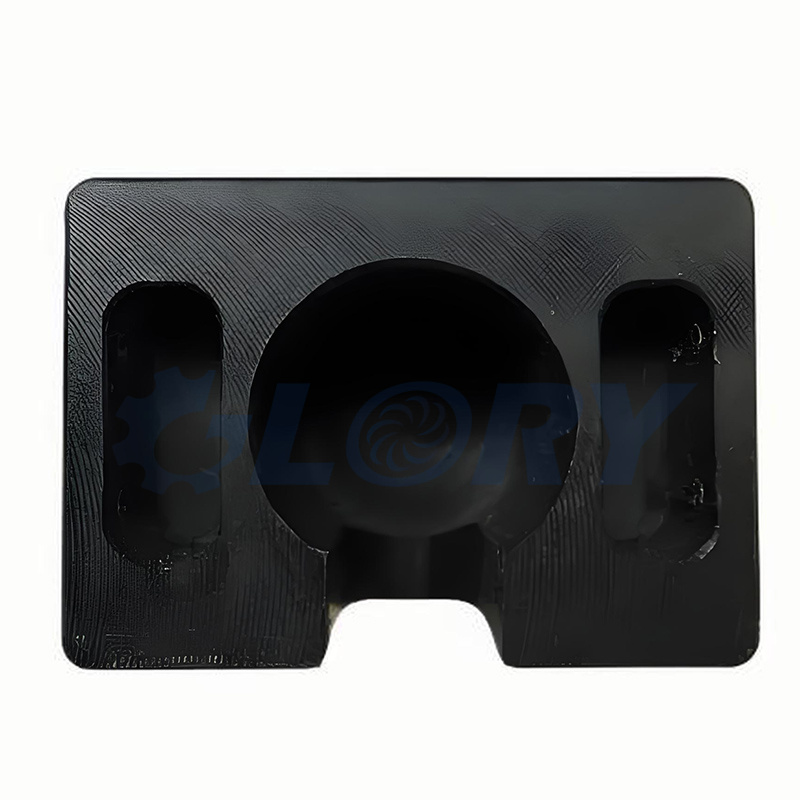
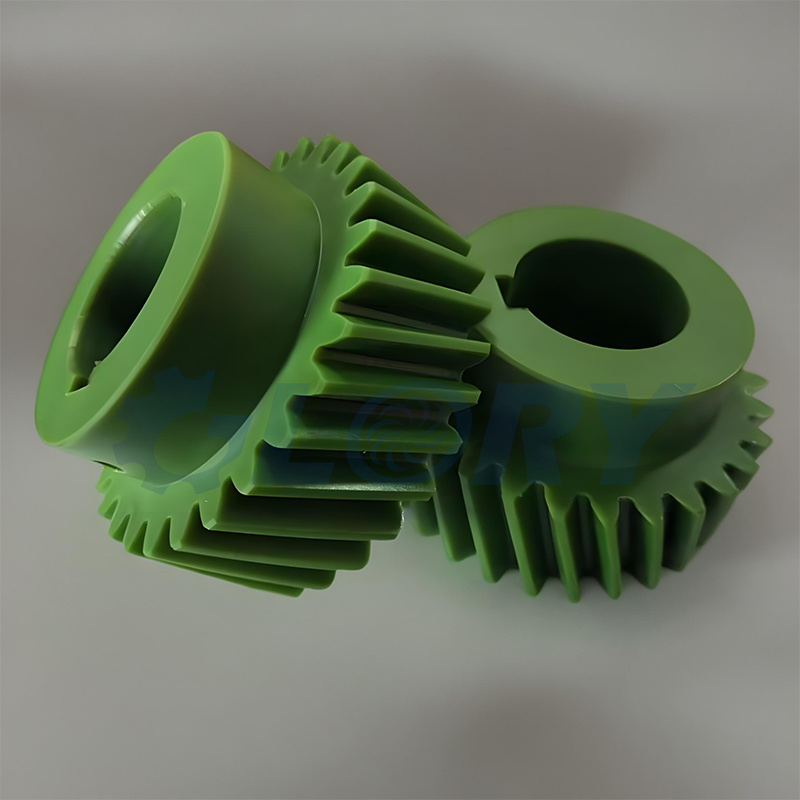
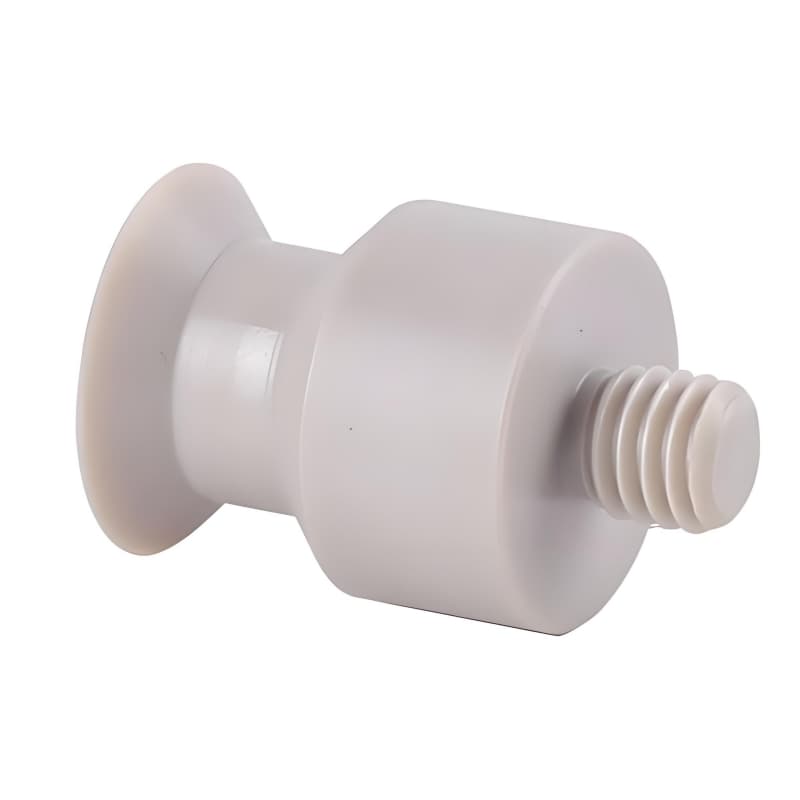
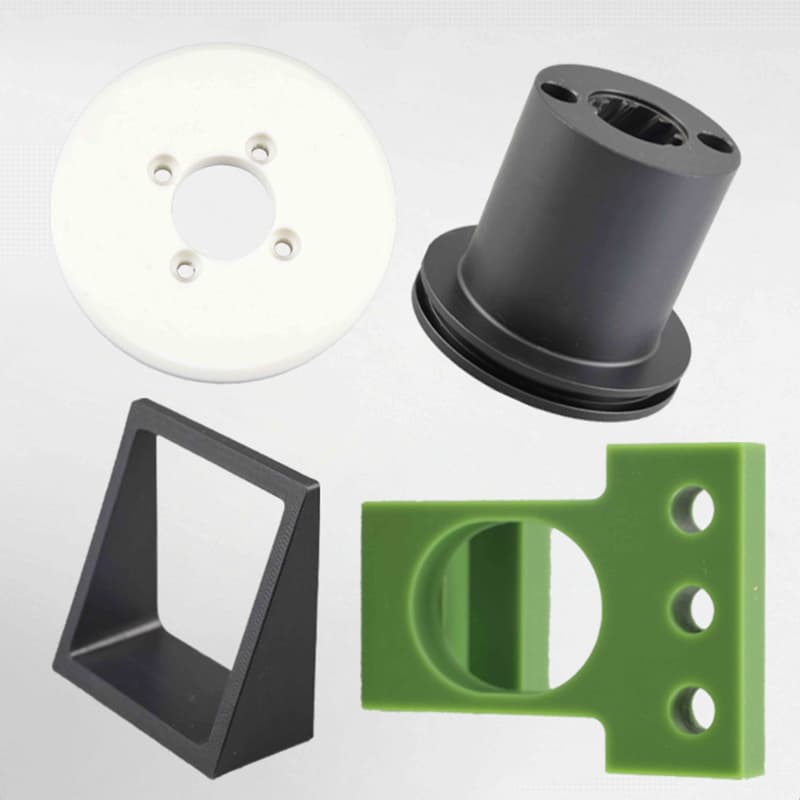
A selection of engineering-plastic parts machined alongside ABS production, showing the range of geometries handled on the same equipment.
Machining and inspection on the shop floor
Production and measuring equipment sit side by side, so every batch of CNC machined ABS plastic in China can be checked against the drawing without leaving the workshop.
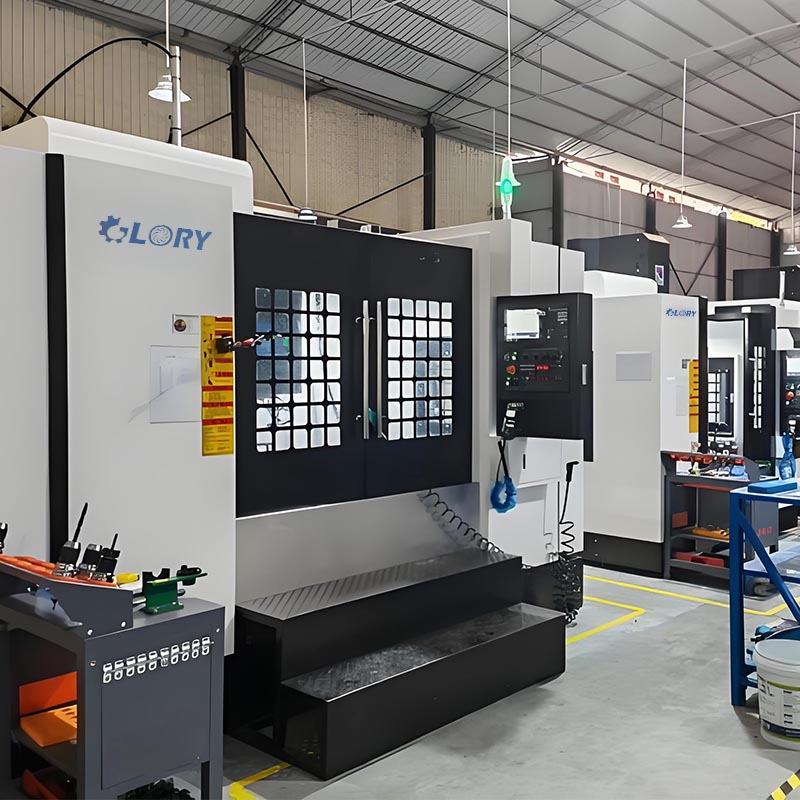
Workshop
Turning, milling and inspection zones are arranged to shorten the path a plastic part travels between operations and reduce waiting time between processes.
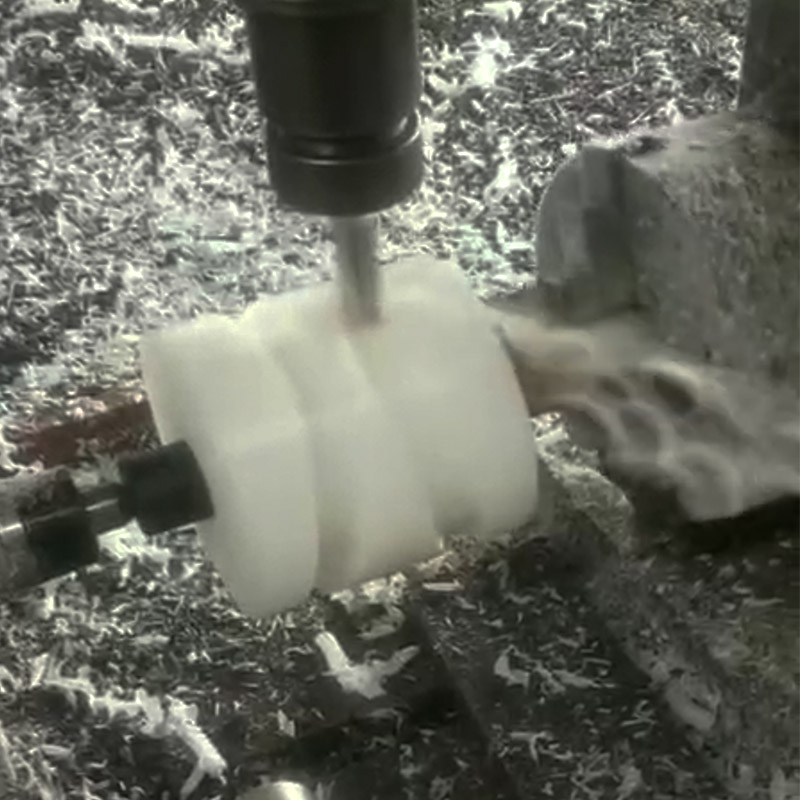
Plastic machining
Dedicated cutting strategies for thermoplastics keep spindle heat and feed forces under control, protecting edge quality and surface appearance.
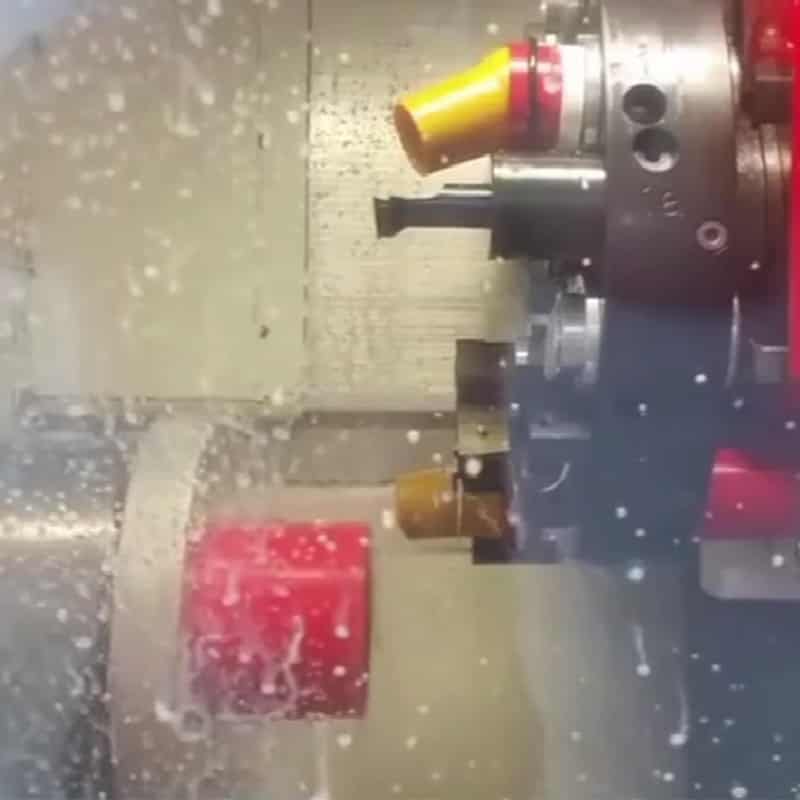
PU turning
Polyurethane turning produces rollers, seals, wear pads and damping elements, using sharp tools and light cuts to avoid tearing the elastic material.
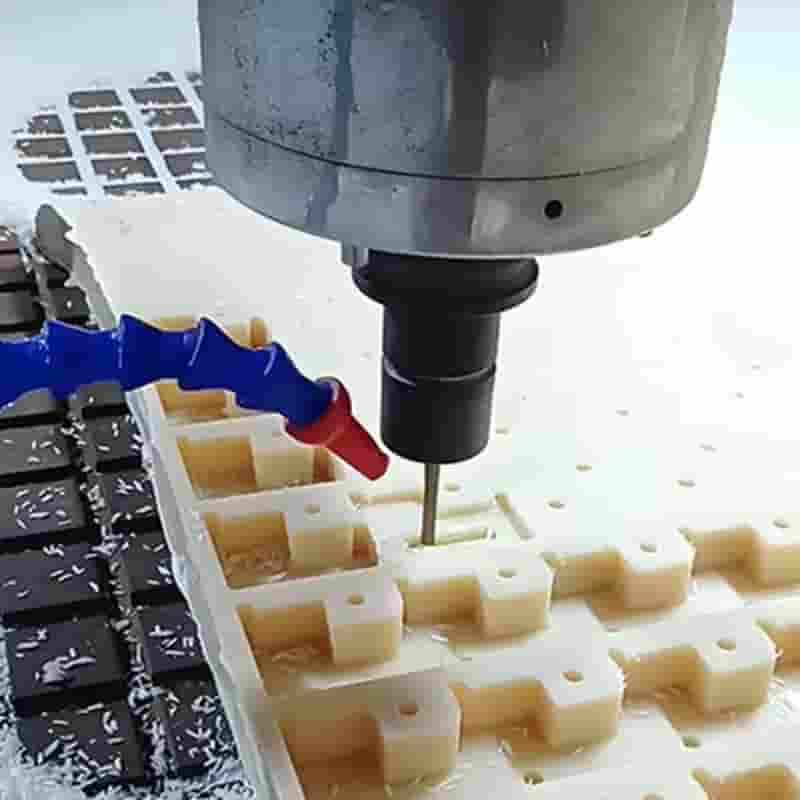
Nylon milling
Nylon milling covers gears, guide blocks, wear strips and slide components, with programs adjusted for the material's characteristic movement after machining.
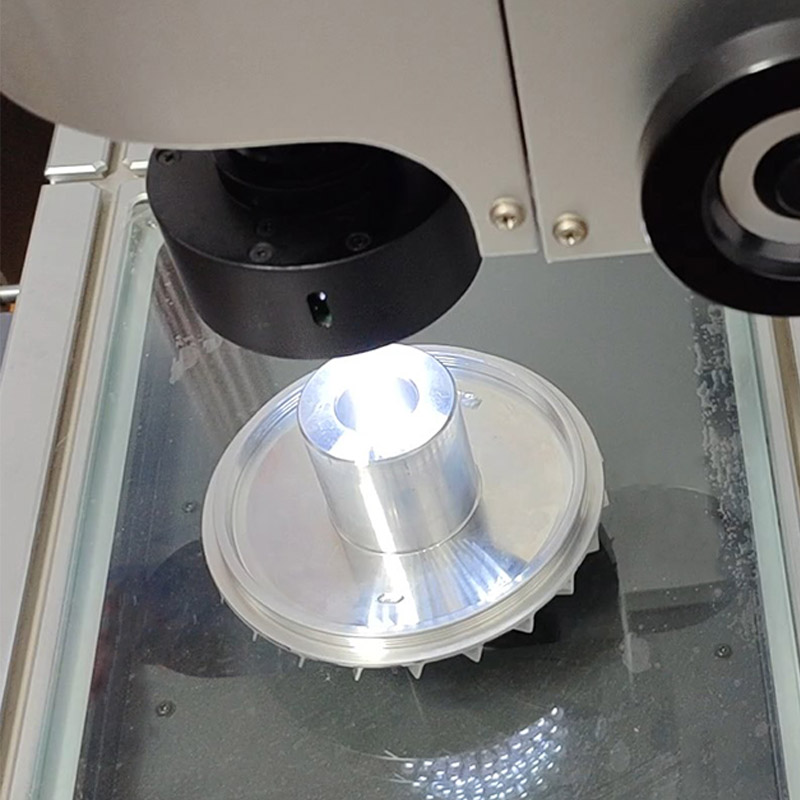
2D measuring
Optical profile projection and vision measurement check 2D profiles, radii, angles and hole positions against the drawing without contacting soft plastic.
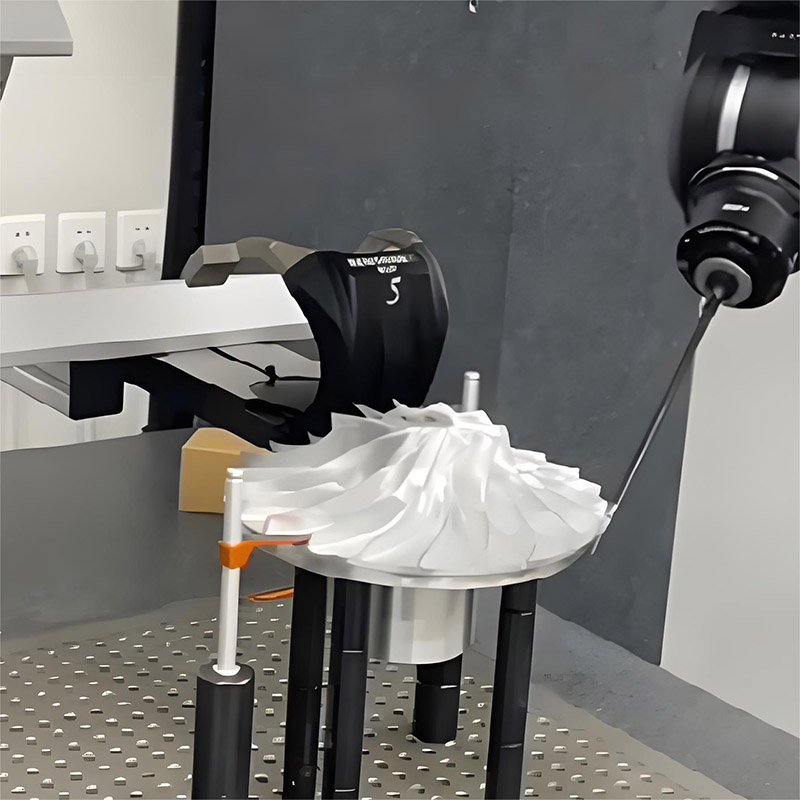
3D measuring
Coordinate measuring captures three-dimensional dimensions and positional relationships between features, confirming the part matches the 3D model in space.
Where machined ABS components are used
Customers order CNC machined ABS plastic in China for any assembly that needs lightweight, non-conductive, impact-resistant parts with controlled dimensions.
Automotive interiors
Brackets, covers, trim retainers, cable guides and test-fixture components for interior and sub-assembly applications.
Electronics enclosures
Housings, panels, mounting plates and insulating spacers milled to match printed circuit boards and metal chassis.
Machinery and automation
Machine guards, sensor mounts, guide blocks, indexing plates and lightweight jig parts for production equipment.
Pneumatic and hydraulic systems
Manifold blanks, valve plates, spacer rings and threaded plugs used alongside metal fittings in fluid systems.
Material handling
Conveyor guide rails, wear strips, rollers, stops and alignment parts that need low friction and low weight.
Consumer appliances
Appliance housings, control panels, knobs, decorative trim and structural inner parts produced in pilot or series volumes.
Network and telecom equipment
Rack components, antenna mounting parts, insulating brackets and equipment panels with precise cut-outs and hole patterns.
Energy equipment
Insulating mounts, covers and positioning parts for renewable-energy installations and related power equipment structures.
How a custom ABS order moves forward
A fixed four-step sequence keeps a one-off prototype and a ten-thousand-piece repeat order equally traceable.
Drawing review and DFM feedback
Drawings and models are checked for dimension completeness, wall thickness, internal corner radii and tool reach; questions are consolidated before programming.
Material and CNC programming
The ABS grade and colour are confirmed, stock is cut to size, and tool paths are programmed with feeds and speeds tuned to thermoplastics.
Machining and finishing
Turning, milling, drilling and tapping run to the planned setup sequence, followed by deburring, edge breaking and any agreed surface finishing.
Inspection and packing
Dimensions are checked with 2D and 3D measuring equipment, then parts are cleaned, bagged and packed in layers suitable for export transport.
Inspection logic from raw stock to packed parts
Quality control is built around the drawing itself: every check references a stated dimension rather than a general impression.
Material confirmation
Grade, colour and batch information are recorded before cutting. Customer-supplied material is accepted, labelled and tracked as a separate stream.
First-article check
The first completed part receives a full dimensional review against the drawing before the rest of the batch continues on the machine.
In-process control
Key dimensions are rechecked after each major operation, and cutter wear is watched closely on long runs to stop drift before it accumulates.
Final inspection and packing
A final visual and dimensional check is followed by cleaning, individual bagging and layered protective packing for transport.
What to provide and what the workshop typically handles
Complete documentation shortens the review cycle, while the capability figures below give a first indication of fit before the drawing is examined in detail.
Information to include with an inquiry
- 2D PDF drawings with tolerances, thread notes, edge requirements and surface notes.
- 3D models in STEP, IGES or X_T format for programming and clash checking.
- Quantity per delivery and any expected annual or repeat volume.
- ABS grade and colour, or permission to propose a grade for the application.
- Thread standard, insert type and any assembly mating conditions.
- Packing expectations, such as individual bagging or labelled batch packing.
Typical machining scope
- Milling envelope commonly up to around 500 mm on the longest axis; larger parts reviewed per drawing.
- Turning from bar and sawn billet across common diameters, confirmed against the part geometry.
- General machining tolerance around ±0.05 mm; critical features in the ±0.01–0.02 mm range where geometry and material behaviour allow.
- Typical as-machined surface finish of Ra 1.6–3.2 µm, with matte or textured finishes on request.
- Metric M-series and unified UNC/UNF threads; special threads taken directly from the drawing.
- Heat-set brass inserts, press-fit bushings and dowel pins installed as secondary operations.
Frequently asked questions about machined ABS orders
Practical questions buyers raise when placing CNC machined ABS plastic in China with a drawing-based OEM workshop.
Do you work only from customer drawings?
Yes. Every part is built to the customer's 2D drawings and 3D models rather than taken from a catalog. PDF drawings paired with STEP or IGES models are the clearest starting point.
Is there a minimum order quantity?
There is no fixed MOQ. A single machined ABS prototype is a normal order, and the same drawing can later move into low-, mid- or high-volume production.
Which ABS grades can be machined?
General-purpose ABS, flame-retardant grades, glass-fibre-reinforced ABS and ABS/PC blends can all be machined. Grade and colour are confirmed before any stock is cut.
Can metal inserts be integrated?
Yes. Heat-set threaded inserts, press-fit bushings and dowel pins can be installed during secondary operations, giving threads and locating points a longer service life.
How are burrs and edges controlled?
Sharp tooling, conservative feeds, controlled spindle speed and systematic hand deburring keep edges clean. Edge breaks and chamfers always follow the drawing notes.
How is consistency kept on repeat orders?
Tool paths, fixturing, material grade and inspection points are recorded for each part, so later batches reproduce the dimensions and appearance of the first approved run.
A single process line for CNC machined ABS plastic in China
When sourcing CNC machined ABS plastic in China, the practical difference is made on the shop floor: sharp tooling, sensible fixturing, disciplined measuring and stable communication around the drawing. This workshop keeps turning, three-axis, four-axis and five-axis milling, drilling, tapping and inspection under one roof.
As a result, a single ABS prototype and a ten-thousand-piece repeat order follow the same drawing logic, the same inspection sequence and the same documented process, from the first cut in solid ABS stock to the final labelled package ready for export.
About Us
 We provide custom machined parts, 5-axis linkage CNC machining, and the design, production, and assembly of machinery and equipment.