
Custom Precision 5-Axis CNC Machining Service in China
We are a custom precision 5-axis CNC machining service in China that turns complex 3D models into tightly toleranced milled and turned components — from a single impeller prototype to repeating production batches. By combining simultaneous five-axis machining centers, simulation-verified CAM toolpaths and in-house dimensional inspection, a custom 5-axis CNC machining service in China such as ours lets engineers and industrial buyers source difficult geometry without splitting one part across several workshops.
Five-axis machining moves the cutting tool along the three linear axes X, Y and Z while the workpiece or spindle rotates around two additional rotary axes. The tool can therefore reach five faces and continuously curved surfaces in a single clamping, which is exactly what integrally bladed wheels, screw rotors, angular port layouts and multi-face housings require. Every project is treated as a custom build: material, fixturing, tool strategy, tolerance plan and surface finish are defined from your drawing rather than pulled from a fixed catalog.
Service at a Glance
- Machining modesSimultaneous 5-axis interpolation and 3+2 indexed machining
- Typical componentsImpellers, screw propellers, bladed wheels, manifolds, housings, valve blocks
- Material rangeAluminum, stainless steel, titanium, alloy and tool steel, brass, copper, engineering plastics
- Order quantityOne-off prototype, small batch and repeat series production
- Accepted filesSTEP, IGES, X_T, SLDPRT and 2D PDF drawings
- Thread systemsMetric M, unified UNC/UNF, BSPP/BSPT and NPT as drawn
- Supporting processesCNC turning, milling, deburring and arranged surface treatment
How a Custom 5-Axis CNC Machining Service in China Works
Understanding the difference between simultaneous five-axis motion and 3+2 indexed cutting helps explain why some parts become cheaper, more accurate and faster to deliver on a five-axis machine, even when their geometry looks ordinary at first glance.
Simultaneous 5-Axis Motion
All five axes interpolate together, so the tool follows ruled and free-form surfaces such as impeller blades and screw flights while holding a controlled contact angle along the entire cut.
3+2 Indexed Machining
The two rotary axes tilt and lock at a fixed angle while X, Y and Z perform the cut. This rigid, fast approach handles angled planes, compound holes and multi-face features efficiently.
Single-Setup Access
Five sides of the workpiece are reached in one clamping. Removing repeated manual re-fixturing cuts lead time and prevents the alignment errors that accumulate across multiple setups.
Optimal Tool Orientation
Short, rigid tool holders can be tilted into deep pockets and undercut walls, reducing tool deflection, chatter and the hand polishing work that long-reach three-axis finishing usually leaves behind.
What Our Custom Precision 5-Axis CNC Machining Covers
The capability list below reflects the feature types that move through our five-axis cells every week. Each item is planned in CAM, simulated for collision and gouging, and then cut with a defined roughing, semi-finish and finishing strategy.
Integrally Bladed Wheels
Impellers, screw propellers and bladed rotors machined from a solid billet, with consistent blade spacing and balanced wall thickness between flow channels.
Ruled & Free-Form Blades
Roughing, semi-finishing and finishing passes for ruled surfaces and sculpted blade profiles, with step-over values tuned to the required surface finish.
Deep Cavities & Thin Walls
Tall thin walls, pocket floors and deep cavities cut with tilted short tools and climb/conventional strategies that control deflection and heat.
Undercut Geometry
Undercut flanges, reverse-angle seats and hooked profiles finished in one setup instead of expensive secondary operations or welded assemblies.
Angled & Cross Holes
Compound-angle hole patterns, cross-drilled galleries and threaded ports machined with correct entry angles to avoid drill wander and burr lift.
Multi-Face Housings
Pump housings, gearbox cases and sensor bodies where faces, bores and sealing surfaces on several sides must stay aligned to each other.
Hard-Metal Cutting
Stable five-axis structures support productive cutting of titanium, austenitic stainless and hardened tool steels where tool pressure is high.
In-Process Verification
Tool presetting, on-machine probing and intermediate dimensional checks keep drift from propagating into a full batch of complex parts.
Materials Routinely Cut on Our Five-Axis Cells
A custom 5-axis CNC machining service in China is only as flexible as its material experience. The following six material families cover the majority of export engineering drawings we receive, and each has its own tool geometry, cutting data and work-holding approach.
Aluminum Alloys
6061, 7075, 2024 and cast plate. High metal-removal rates, stable thin walls and clean surfaces ready for anodizing, chromate conversion or painting.
Stainless Steel
304/304L, 316/316L, 17-4 PH and duplex grades for corrosion-resistant fluid, marine and food-adjacent equipment, with work-hardening aware toolpaths.
Titanium
Commercially pure Grade 2 and Ti-6Al-4V (Grade 5), chosen for high strength-to-weight impellers, load-critical brackets and corrosion-exposed components.
Alloy & Tool Steels
42CrMo and equivalent 4140/4142-class steels, H13, SKD11/D2 and bearing steels, including parts machined in a pre-hardened or hardened state.
Copper, Brass & Bronze
Leaded and lead-free brass, copper electrodes and conductors, tin bronze and aluminum bronze for wear rings, nuts, fittings and bushings.
Engineering Plastics
POM/Delrin, nylon/PA, PEEK, UHMW-PE and PTFE cut with sharp tooling and controlled heat to avoid burrs, stress whitening and dimensional creep.
Industries That Use Custom 5-Axis Machined Components
Five-axis work appears wherever curved surfaces, angular features and tight feature-to-feature relationships meet in one workpiece. The six industry groups below represent the most common drawing types processed by this custom 5-axis CNC machining service in China.
Aerospace & Defense Support
Structural brackets, ducting and adapter hardware, ground-support tooling and prototype components where light weight and aligned features matter.
Turbomachinery & Energy
Compressor and pump impellers, diffusers, blower wheels, shaft sleeves and inducer-style parts for rotating-equipment manufacturers.
Medical & Laboratory
Instrument housings, fixtures, adapters and non-implant precision mechanisms that demand smooth surfaces and repeatable small-batch supply.
Automotive & Motorsport
Intake and fluid components, sensor housings, test-rig fixtures and low-volume performance prototypes developed under short iteration cycles.
Marine & Offshore
Screw propellers, seawater-pump wheels, valve bodies and corrosion-resistant fittings in bronze, duplex stainless and titanium grades.
Fluid Power & Industry
Hydraulic manifolds and valve blocks, gearbox components, custom machine elements and retrofit parts for industrial equipment builders.
From Solid Model to Finished Five-Axis Part
A predictable six-step sequence keeps complex five-axis work transparent. Problems are solved at the engineering and simulation stage, where they cost almost nothing, instead of on the machine or at incoming inspection.
Drawing & Model Review
Geometry, tolerances, wall thickness, internal corners and thread callouts are checked against realistic tool access, with DFM notes returned before any metal is cut.
Quotation & Process Planning
Material choice, machine allocation, fixturing concept and the full operation sequence are defined up front, so quoted lead time and price reflect the real process.
CAM Programming & Simulation
Dedicated five-axis CAM generates roughing and finishing paths; machine simulation checks holder, spindle and fixture collision as well as blade gouging.
Material & Fixture Preparation
Billet sawing, soft jaws, custom clamps and dedicated fixturing are prepared so that delicate curved parts stay rigid and correctly located through every operation.
Machining & In-Process Checks
Rough, semi-finish and finish passes run in the planned sequence, with intermediate measurement of critical dimensions before the final cut is taken.
Inspection, Finishing & Packing
Deburring, edge breaking, arranged surface treatment, final dimensional verification and protective export packaging complete the order.
Featured Five-Axis Machined Products
Representative integrally bladed and rotary components machined on our five-axis centers from solid billet material.
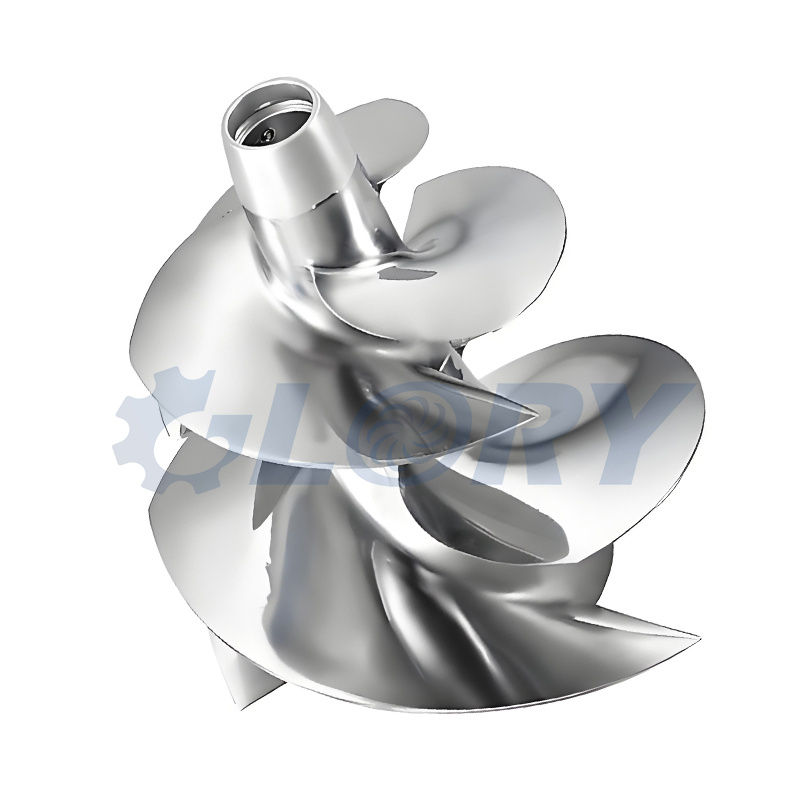
Screw Propeller
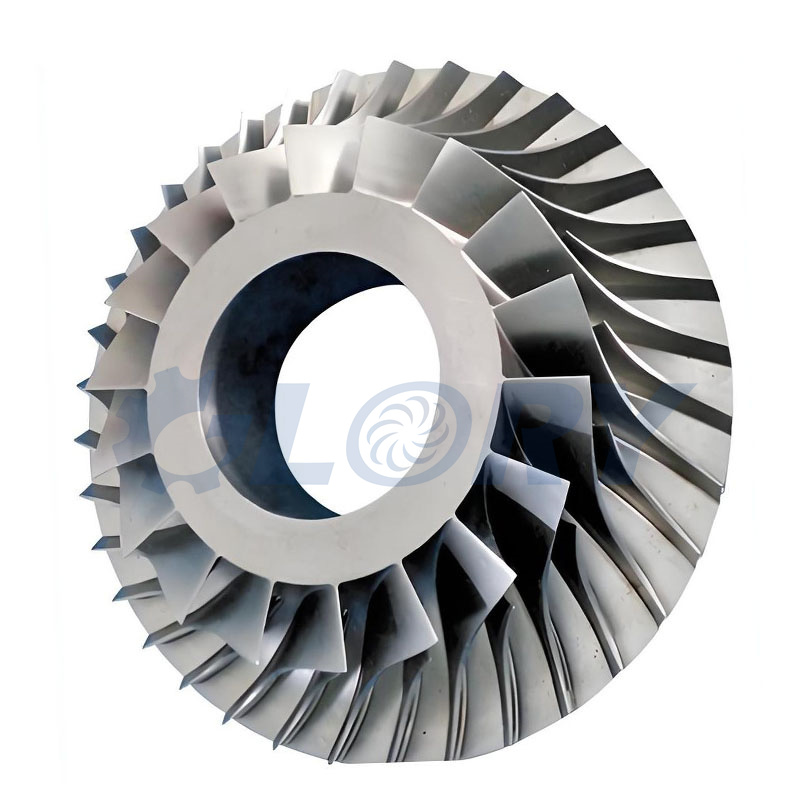
Titanium Compressor Impeller
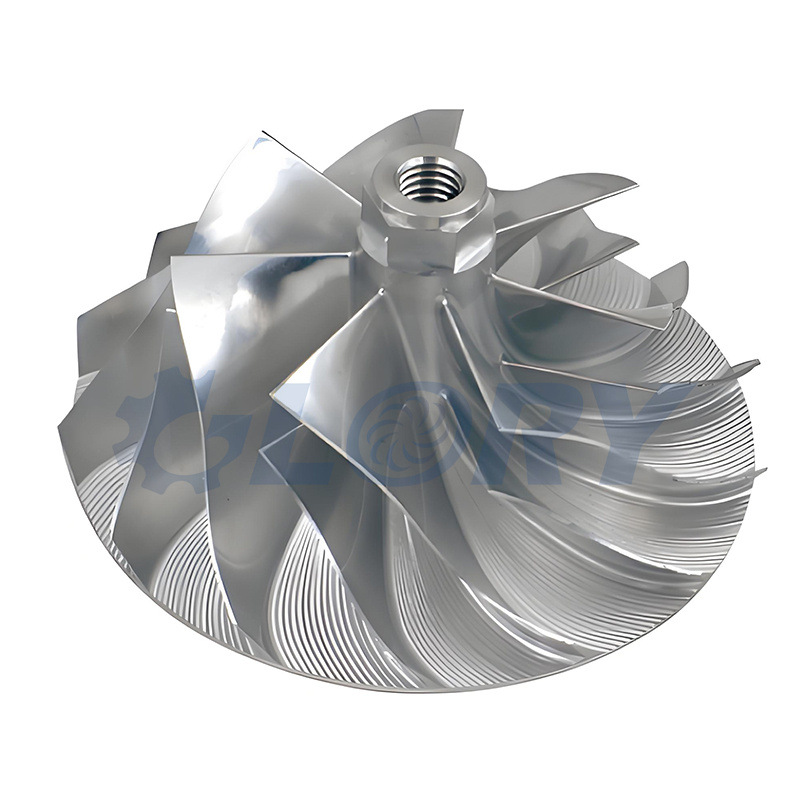
Centrifugal Vane Wheel
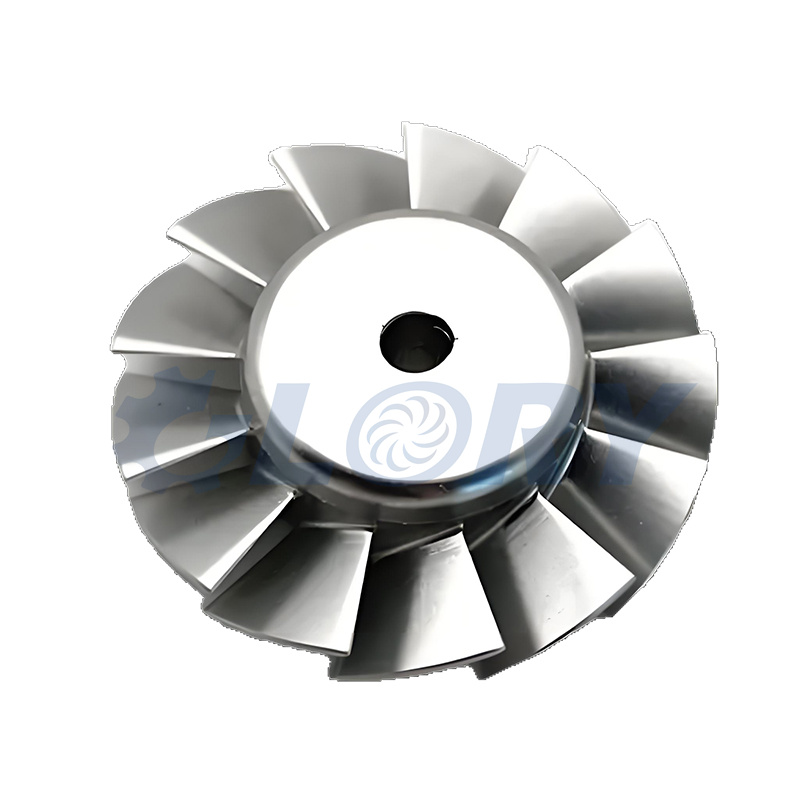
Axial-Flow Impeller
Machining and Inspection Capabilities on the Floor
Production and measurement stay under one roof: five-axis, milling and turning cells feed parts directly to 2D optical and 3D coordinate inspection, so a drawing question never waits on an outside laboratory.
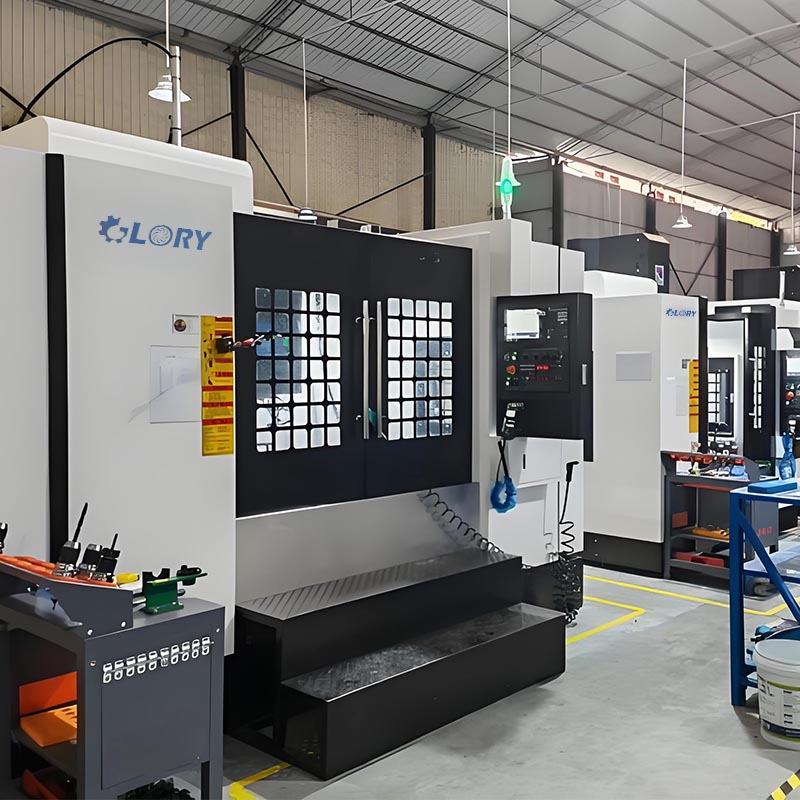
Workshop
Organized machining floor with dedicated five-axis, milling, turning and inspection cells.
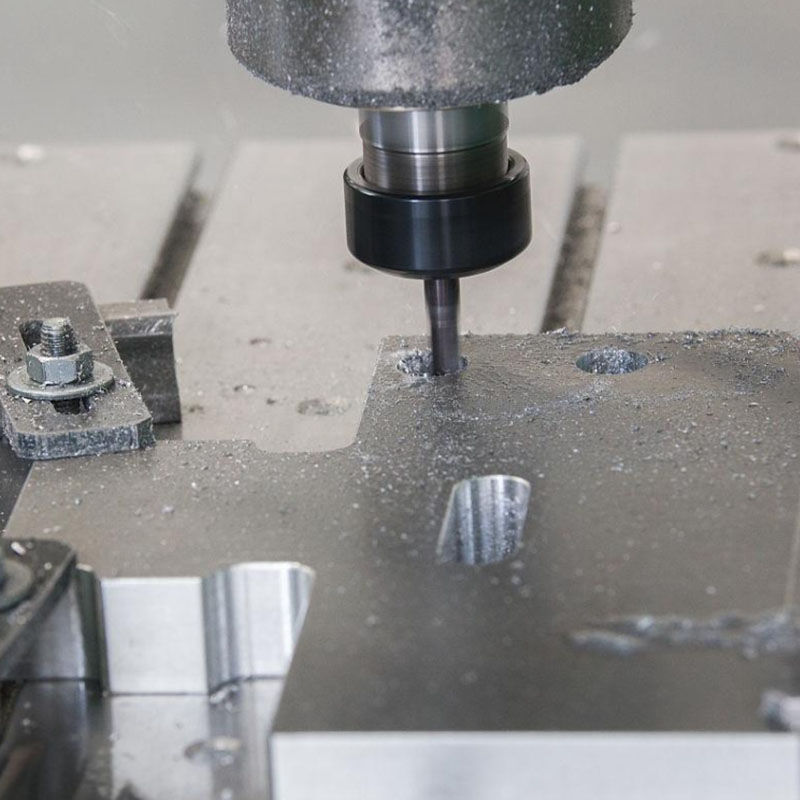
CNC Milling
Three-axis and four-axis prismatic milling of pockets, faces, slots, drilled and tapped hole patterns.
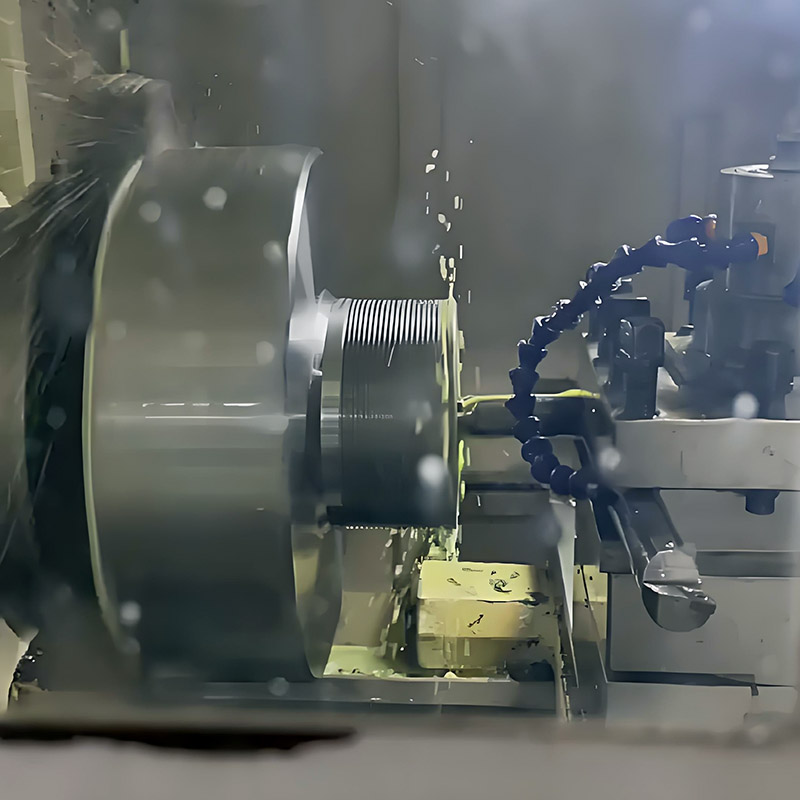
CNC Turning
Turned shafts, sleeves, flanges, sealing surfaces and rotational pre-forms for five-axis finish work.
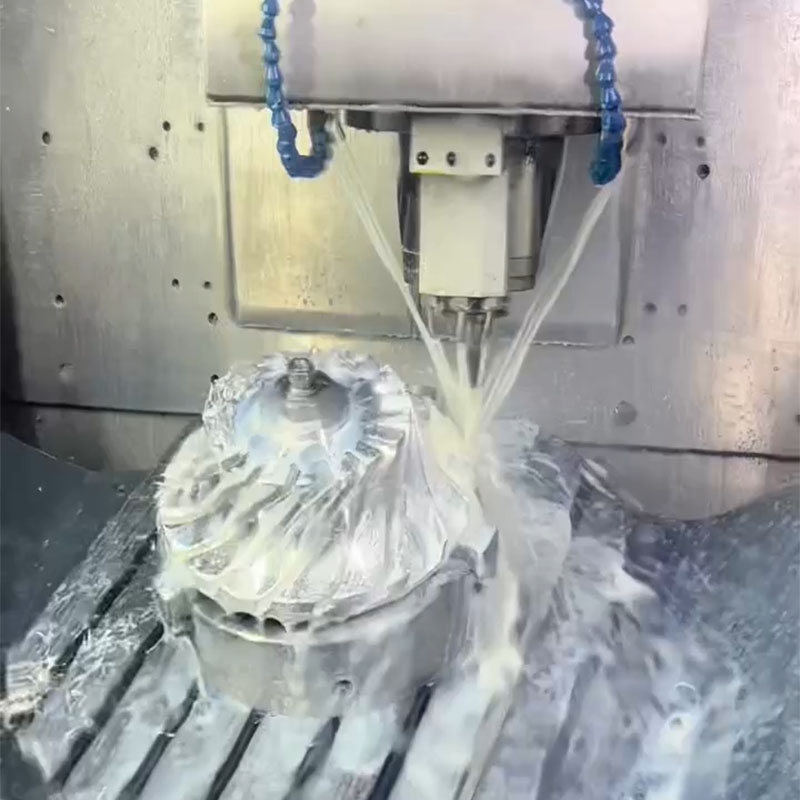
5-Axis Milling
Simultaneous and indexed five-axis machining of sculpted surfaces and multi-face components.
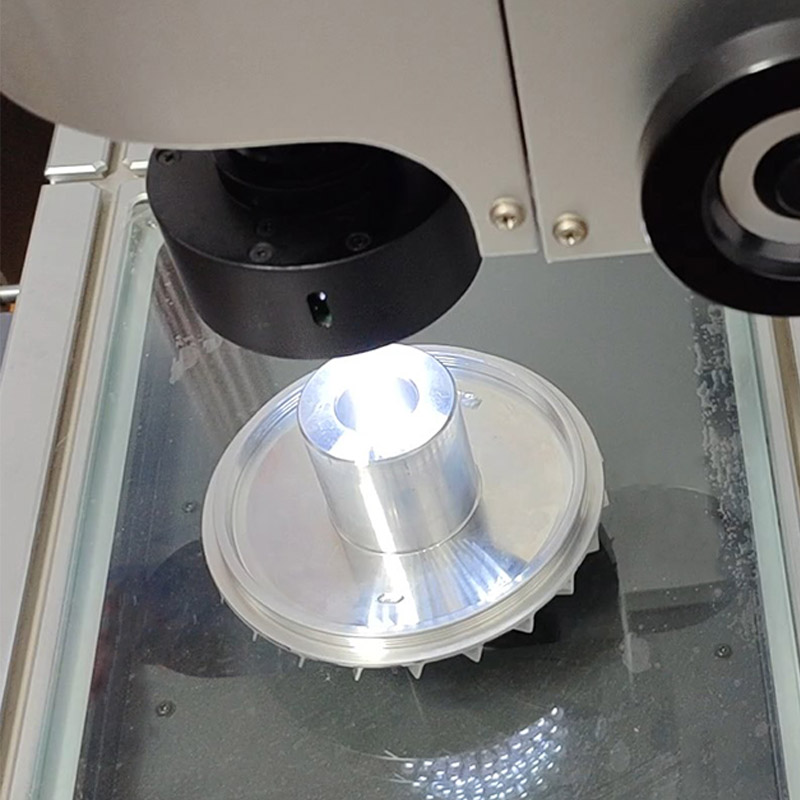
2D Measuring
Optical profile projector checks of radii, angles, blade contours and thread-form geometry.
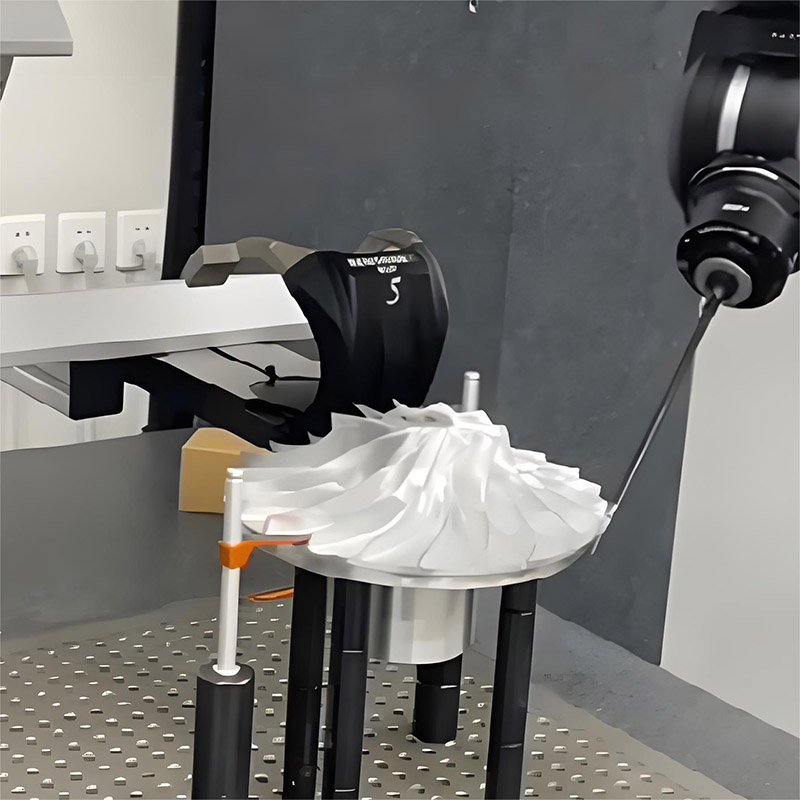
3D Measuring
Coordinate measuring machine verification of spatial dimensions, positions and geometric relationships.
Tolerances, Finishes and Supporting Operations
Every tolerance is ultimately drawing-driven, and achievable values are confirmed during the DFM review so that quoted precision is the precision the process can hold in production.
Precision & Geometry Scope
- Part geometryFive-sided parts, full simultaneous five-axis parts and turned/milled combined components
- Size rangeSmall precision components to medium housings and bladed rotors; work envelope confirmed per model
- Batch rangeSingle prototype pieces, small lots and repeating series orders
- Tolerance approachTight linear, angular and geometric tolerances on critical features, with realistic values agreed during review
- Surface finishFrom standard machined finishes to fine finishes, including Ra 0.8-class surfaces on selected sealing or contact faces
- Threads & fitsMetric, unified and pipe threads; reamed, bored and press-fit bores to drawing class
Supporting Operations
- Combined processingTurned pre-forms transferred into five-axis finish setups under one routing
- Hole makingHelical interpolation, boring, reaming, counterboring and precision tapping
- Edge workControlled deburring, edge break, chamfering and cosmetic cleanup
- Surface treatmentArranged anodizing, black oxide blackening, passivation, polishing, plating and powder coating through partner processors
- MarkingLaser-engraved part numbers, batch marks and orientation references
- Export packingProtective individual wrapping, compartment trays and per-lot packing lists for international shipment
A Four-Layer Dimensional Control Loop
Quality for complex five-axis work is built as a sequence of checks rather than a single final inspection. Written measurement results can be prepared with the shipment whenever the drawing or purchase order requires them.
First-Article Verification
After the first completed part, every critical dimension is measured and compared with the drawing before the remaining batch continues, locking the process early.
In-Process Checks
Operators verify features at each operation boundary, so drift from tool wear or clamping relaxation is caught before the finishing pass, not after it.
2D Optical Inspection
A profile projector compares blade profiles, radii, angles and thread forms against enlarged drawing contours for fast floor-level decisions.
3D Coordinate Inspection
A coordinate measuring machine captures spatial dimensions, feature positions and geometric relationships in three axes, with recorded results available on request.
Why Buyers Choose This Custom 5-Axis CNC Machining Service in China
The advantages below come from how the workshop is organized — around difficult five-axis geometry, flexible quantities and clear English-language engineering communication.
Five-Axis Specialization
Daily focus on impellers, screw surfaces and bladed wheels means blade-path strategy is routine, not an experiment.
Up-Front DFM Feedback
Practical manufacturability notes in plain English arrive before production, covering corners, thin walls and tolerance feasibility.
One Vendor, Fewer Handoffs
Milling, turning, five-axis finishing and inspection share one routing, removing split shipments and vendor-to-vendor blame.
Flexible Quantities
One-piece prototypes, ten-piece validation lots and repeating batches all run through the same engineering process.
Broad Material Library
Experience across aluminum, stainless, titanium, alloy steel, copper alloys and engineering plastics avoids material-specific surprises.
In-House Fixture Design
Soft jaws and dedicated clamps are designed and made internally for thin, curved or otherwise awkward workpieces.
Export Drawing Literacy
Inch and metric drawings, unified and pipe threads, GD&T-style callouts and surface texture symbols are read directly.
Confidential Data Handling
Models, drawings and product design information are treated as customer property and shared only on a need-to-know basis inside the shop.
Frequently Asked Questions About Custom 5-Axis CNC Machining
Answers to the questions engineering and procurement teams most often ask when moving a complex part to a China-based five-axis machining supplier for the first time.
Q1.What is a custom 5-axis CNC machining service in China?
It is an on-demand manufacturing service in which a China-based workshop programs and cuts your parts on five-axis machining centers from your own 3D model and 2D drawing. As a custom 5-axis CNC machining service in China, we build one-off prototypes, complex impeller-type components and repeat batches, with material, tolerance and finish defined by your drawing instead of a fixed product catalog.
Q2.Why choose five-axis over conventional three-axis machining?
Five-axis equipment reaches five faces and continuously curved surfaces in a single setup. It removes repeated re-fixturing, reduces accumulated alignment error, allows shorter and more rigid tools in deep pockets, and produces sculpted surfaces such as blade profiles in one continuous toolpath that three-axis machines cannot replicate.
Q3.Do you offer both 3+2 indexed and full simultaneous machining?
Yes. Angled faces and hole clusters are often cut more efficiently with 3+2 positioning, where the rotary axes lock before the cut. Blades, screw surfaces and continuous contours use simultaneous five-axis interpolation. The strategy is selected feature by feature during CAM programming.
Q4.Which files are needed to quote a five-axis part?
A 3D solid model in STEP, IGES, X_T or native CAD format, plus a 2D PDF drawing showing tolerances, threads, material and surface requirements. Photos, marked sketches or reference samples help when the design is still evolving.
Q5.Can impellers and screw propellers be cut from a solid billet?
Yes. Solid-billet five-axis machining produces integrally bladed wheels with consistent blade geometry and avoids the weaknesses of welded or cast constructions. Roughing, semi-finishing and finishing paths are simulated in advance to control thin-blade deflection and channel clearance.
Q6.How are dimensions verified before shipment?
First-article and in-process checks happen on the floor, profile-type features are measured on a 2D optical projector, and spatial dimensions plus geometric relationships are checked on a 3D coordinate measuring machine. Recorded measurement results can accompany the shipment when requested.
Complex Geometry, Built Around Your Drawing
From a single titanium compressor impeller prototype to repeating batches of multi-face housings and hydraulic components, our custom precision 5-axis CNC machining service in China is structured around difficult geometry, flexible order quantities and drawing-driven accuracy. Milling, turning, five-axis finishing and dimensional inspection operate as one connected process, which keeps lead times realistic and feature relationships consistent. When buyers search for a dependable custom 5-axis CNC machining service in China, what they ultimately need is a workshop that reads the drawing carefully, simulates before cutting and measures what it makes — the working method described on this page.
About Us
 We provide custom machined parts, 5-axis linkage CNC machining, and the design, production, and assembly of machinery and equipment.