OEM CNC Machined PMMA Parts in China

OEM CNC Machined PMMA Parts in China

We manufacture OEM CNC machined PMMA parts in China for buyers who need precise, transparent acrylic components rather than off-the-shelf standard shapes. Every part is cut to a customer drawing from cast or extruded PMMA stock, and the tool paths, fixturing, feeds and finishing are tuned to the way acrylic actually behaves instead of treating it as a soft stand-in for metal. The same workflow supports custom CNC machined acrylic parts in China across clear, translucent, light-diffusing and tinted grades, from one-off prototypes to repeat production batches.

PMMA — poly(methyl methacrylate), universally known as acrylic — delivers glass-like optical clarity at roughly half the density of silicate glass, with much better resistance to impact. When it is machined with sharp geometry, controlled heat and gentle clamping, it cuts cleanly and polishes to an optically clear edge. The modules below explain the material profile, the way national material standards and regional trade names map to one another, our machining and finishing capability, realistic tolerances, and the design rules that keep an acrylic part dimensionally stable long after it leaves the machine.

Stock formats
Clear and colored PMMA sheet, rod, tube and block across a wide thickness range.
Process scope
3- and 4-axis CNC milling, CNC turning, engraving, drilling and edge polishing.
Critical tolerance
Around ±0.05 mm on critical dimensions with stable fixturing and verified tool paths.
Order profile
Engineering prototypes, low-volume custom work and scheduled repeat production.
Material profile

Why designers choose PMMA for machined transparent parts

PMMA is an amorphous, rigid thermoplastic. The values below are typical ranges taken from published PMMA material data; exact numbers move with grade (general-purpose, heat-resistant or impact-modified), production route (cast versus extruded) and color. Understanding these properties is what allows custom CNC machined acrylic parts in China to be designed for clarity, tight dimensions and long-term stability instead of trial and error on the machine.

Optical performance

Clear PMMA transmits roughly 92% of visible light through a 3 mm section, with a refractive index near 1.49 and very low haze. A properly polished edge becomes transparent and lens-like, which is why the material is preferred for light guides, lenses and inspection windows.

Light weight

With a density of 1.18–1.19 g/cm³, PMMA is about half the weight of silicate glass of the same volume. Transparent covers and guards become lighter, easier to mount and less demanding on supporting structures.

Mechanical rigidity

Tensile strength typically lands at 60–77 MPa, flexural strength at 90–120 MPa and flexural modulus near 2.8–3.3 GPa. Elongation at break is only 2–6%, so the material is stiff and dimensionally firm but notch-sensitive — internal radii matter.

Thermal behavior

Glass transition sits near 105–115 °C and heat-deflection temperature at 1.8 MPa is typically 85–100 °C depending on grade. Continuous service is conservative at about −40 to +80 °C; the coefficient of linear thermal expansion is 70–80 ×10⁻⁶/°C, so clearances must allow movement.

Weathering and UV stability

PMMA keeps its clarity, gloss and color unusually well outdoors and resists yellowing under long-term UV exposure, while blocking ultraviolet light below roughly 300 nm. This makes it a natural fit for exterior lamp lenses, glazing and outdoor instrumentation.

Electrical and chemical profile

PMMA is a good electrical insulator and absorbs only about 0.2–0.3% water in 24 hours. It tolerates weak acids, weak alkalis and most neutral detergents, but aromatic or chlorinated solvents, ketones and alcohol can trigger stress cracking — alcohol wipes should never be used on a finished part.

Cast PMMA stock

CELL-CAST / BULK POLYMERIZED

Cast acrylic is polymerized in a mold or cell. It carries very low residual internal stress, offers the best optical clarity and chemical resistance, and behaves predictably under cutting and polishing. It is the preferred starting point for tight-tolerance OEM CNC machined PMMA parts in China that need transparent edges, flatness or thin walls. As a trade-off, raw cast sheet carries a wider as-supplied thickness tolerance.

  • Lower internal stress — fewer surprises after machining
  • Highest clarity and best polishing response
  • Broader available thickness range in sheet and block

Extruded PMMA stock

CONTINUOUSLY EXTRUDED

Extruded acrylic is formed continuously, so it arrives with a more uniform thickness, a lower price point and good thermoforming behavior. Because extrusion freezes in more residual stress, machined extruded parts need gentler clamping, symmetric stock removal and, where geometry demands it, a stress-relief cycle after roughing to stop movement or crazing later.

  • Tighter as-supplied thickness, economical for volume
  • Best when parts are simple and stress is managed
  • Annealing recommended for thin or flatness-critical work
Material designations

PMMA standards and commercial trade names by market

Buyers of custom CNC machined acrylic parts in China often encounter different names for what is chemically the same polymer. PMMA is designated under national material standards, while resin and sheet producers sell it under registered trade names with their own grade codes. The table maps the principal markets, the material designation references used there and the trade names a drawing or bill of materials is likely to quote.

The references below classify the raw resin or sheet we machine — they are material designation systems used to specify stock, not statements about our own company. Naming a producer or grade on a drawing simply tells us which raw material behavior to machine.
Market / region Raw-material designation reference Representative commercial trade names Typical grade coding
International ISO 24026-1:2020 designation system for PMMA moulding and extrusion materials (succeeds the withdrawn ISO 8257-1:1987); ISO 7823 series covers cast sheet Common designation basis adopted by many national systems Classified by flow, thermal and optical behavior
United States ASTM D788 for moulding and extrusion compounds; ASTM D4802 for acrylic plastic sheet ACRYLITE (Americas brand of the Röhm group), LUCITE (originally a DuPont trade name, now with Lucite International) Producer series: general-purpose, high-heat, impact-modified
United Kingdom & Ireland BS EN ISO 24026-1 (ISO text adopted as a British/European standard); legacy BS grades PERSPEX (originally introduced by ICI in the UK, now held by Lucite International) Named by color, finish and grade series
Continental Europe DIN EN ISO 24026-1 in Germany and equivalent NF/EN adoptions in France and neighboring markets PLEXIGLAS (Röhm GmbH, Germany — used across Europe, Asia, Africa and Australia), ALTUGLAS (a French-origin PMMA range) Producer numbers for cast, extruded and optical stock
Japan JIS K 6717-1 for PMMA moulding and extrusion materials SUMIPEX (Sumitomo Chemical), ACRYPET (Mitsubishi Chemical), DELPET (Asahi Kasei), PARAPET (Kuraray) Letter-number series such as HT, IH and IF types
South Korea Korean KS standards that adopt the ISO designation framework LG / LX MMA PMMA resin ranges HP202, IH830, IF850-style grade codes
China GB/T 7134 for cast industrial PMMA sheet; the moulding/extrusion designation series is aligned with ISO 24026 and developed with domestic resin producers ACRYREX (Chi Mei, produced at its Zhenjiang base), plus domestic resin ranges such as Wanhua and Shuangxiang CM-205 / CM-211-style heat-resistant codes and producer-specific codes
South America ABNT NBR adoptions of the ISO PMMA designation in Brazil and neighboring markets ACRILEX (a Brazilian-market PMMA range) Regional producer grade coding
Trade names shown above are the property of their respective producers and are listed only to help engineers cross-reference equivalent raw stock for OEM CNC machined PMMA parts in China.

Why so many names

PMMA, acrylic and “organic glass” describe the same polymer family, while PLEXIGLAS, PERSPEX, ACRYLITE and the rest are regional trademarks. A different name rarely means a different chemistry; it usually reflects the producer and the market.

Grade families

Within each brand, grades split into general-purpose, heat-resistant, impact-modified and optical/extrusion types. The grade changes HDT, flow and impact behavior, so it should be selected before tool paths are planned.

Cast versus extruded naming

Sheet standards such as ISO 7823, ASTM D4802 and GB/T 7134 describe cast or extruded semi-finished sheet, while ISO 24026, ASTM D788 and JIS K 6717 describe moulding and extrusion materials — pellets and compounds.

How to specify stock to us

Name a producer and grade, or simply give property targets — light transmission, heat resistance, color and production route. We then machine the designated stock or a documented equivalent and keep the raw-stock grade record with the batch.

Process capability

How PMMA components are machined

Acrylic rewards a specific cutting strategy: sharp single-flute (O-flute) geometry, climb milling, high spindle speed with a measured feed, compressed-air chip evacuation and absolutely no melting heat built into the cut. The six process blocks below cover the operations used to turn PMMA sheet, rod or tube into finished custom CNC machined acrylic parts in China.

3- / 4-axis CNC milling

Pockets, profiles, cavities, manifolds, curved lens surfaces and multi-face components. Sharp O-flute tooling and climb milling leave a clean, low-stress cut, while air blast clears chips before they can weld to a warm edge.

Roughing + light finish pass, climb milling

CNC turning

Sleeves, bushings, rollers, spacers, light pipes and profiled rings turned from cast or extruded rod and tube. Fine finishing passes kept below roughly 0.1 mm produce a surface that polishes to full transparency.

Rod / tube work, fine finish passes

Engraving and micro features

Fine text, scales, serial marks, logos and micro-fluidic channels cut with small tools at controlled step-downs, so letter bottoms stay crisp and thin webs do not crack under tool pressure.

Controlled shallow step-downs

Drilling, reaming and threading

Bolt holes, reamed precision holes and tapped profiles use peck cycles and backing support to prevent exit-side breakout. Coarse threads are preferred in acrylic; metal thread inserts are recommended where a joint is assembled repeatedly.

Peck drilling, backed breakthrough

Edge and surface polishing

Diamond, flame, vapor and mechanical polishing routes turn a milled or sawn edge transparent. The right route depends on edge geometry, batch size and the optical target, from functional clarity to a display-grade finish.

Clear-edge finishing options

Bonding and sub-assembly

Solvent-cemented joints, stacked light guides, bonded panels and multi-part assemblies. Joint faces are machined to a controlled finish first, then bonded, masked and packed so protected surfaces survive transit scratch-free.

Solvent joining + protective masking
Design engineering

Design rules and realistic machining specifications

Most acrylic failures are drawn into the part before any tool touches it — sharp internal corners, unbalanced walls and over-tight clamping store stress that appears days later as a crack or a drifted dimension. The two panels below pair design guidance with the specification ranges a professional plastic machining cell can realistically hold on PMMA.

Rules for crack-free acrylic parts

  • 01Use an internal corner radius of at least 0.5 mm wherever the design allows it; sharp 90° internal corners are the most common stress riser.
  • 02Keep nominal wall thickness at roughly 1.5 mm or above and balance wall thicknesses so material is removed symmetrically and stress releases evenly.
  • 03For small holes, keep diameter at about 1.0 mm or larger, limit hole depth to roughly 3× diameter without a peck strategy, and leave at least one diameter of material from hole edge to part edge.
  • 04After roughing, leave a finish allowance of 0.1–0.2 mm so the final light pass removes the work-hardened, heat-affected layer.
  • 05Fixture with soft jaws, distributed clamp force and sacrificial support boards; never clamp an acrylic sheet hard enough to bend it before cutting.
  • 06For thin walls or strict flatness, stress-relieve after roughing near 80 °C with a slow, controlled furnace cool, then finish machine.
  • 07Specify edge polishing and surface masking up front, and keep alcohol, aromatic and chlorinated cleaners away from finished PMMA.

Typical achievable specifications on PMMA

General linear tolerance±0.10 mm
Critical-feature tolerance±0.05 mm
Turned diameter rangeIT8 – IT7 by size
As-machined surface roughnessRa 1.6 – 3.2 µm
Polished edgeoptically clear
Flatness after stress relief≈ 0.10 mm / 100 mm
Sheet thickness range≈ 2 – 100 mm
Rod diameter range≈ Ø3 – Ø150 mm
Milling working envelopeup to ≈ 1000 mm
Turning working envelopeup to ≈ Ø200 mm
Figures are typical capability ranges for PMMA; the exact values for a component are confirmed against its geometry, size and inspection plan during the drawing review.
Surface finishing

Finishes and secondary operations for acrylic

The same machined geometry can be delivered with anything from a functional as-cut face to a display-grade transparent edge, and PMMA can also be supplied clear, custom-tinted, translucent or opaque. These six finishes are the standard options quoted for OEM CNC machined PMMA parts in China.

As-machined

Fine, regular mill or turn marks at a typical Ra 1.6–3.2 µm. Suitable for functional faces, bonding surfaces and areas hidden from view, with protective film retained where possible.

Diamond-polished edge

A straight edge machined and polished to a true optical finish with minimal haze. It is the choice for light-guide edges, lenses and high-end display panels where light must cross the edge cleanly.

Flame-polished edge

A quick thermal pass that glosses and clears a simple edge economically. Best for straightforward profiles where the highest optical grade is not required and the edge shape stays simple.

Vapor-polished finish

A controlled vapor process that levels the surface evenly across complex profiles and internal cut-outs, producing a consistent gloss where mechanical polishing cannot reach.

Satin buffed finish

Sanded and buffed to a soft satin-to-clear surface that hides minor tool marks and fingerprints, often used on hand-held components and consumer-facing covers.

Bead-blasted diffusion

A uniform matte texture that scatters light evenly for LED diffusers and back-lit panels, removing hotspots while keeping the part translucent rather than fully clear.

Related products

Machined PMMA product examples

A small selection of the acrylic components produced on the floor. Each is made to customer drawing; the images show representative part types rather than catalog stock.

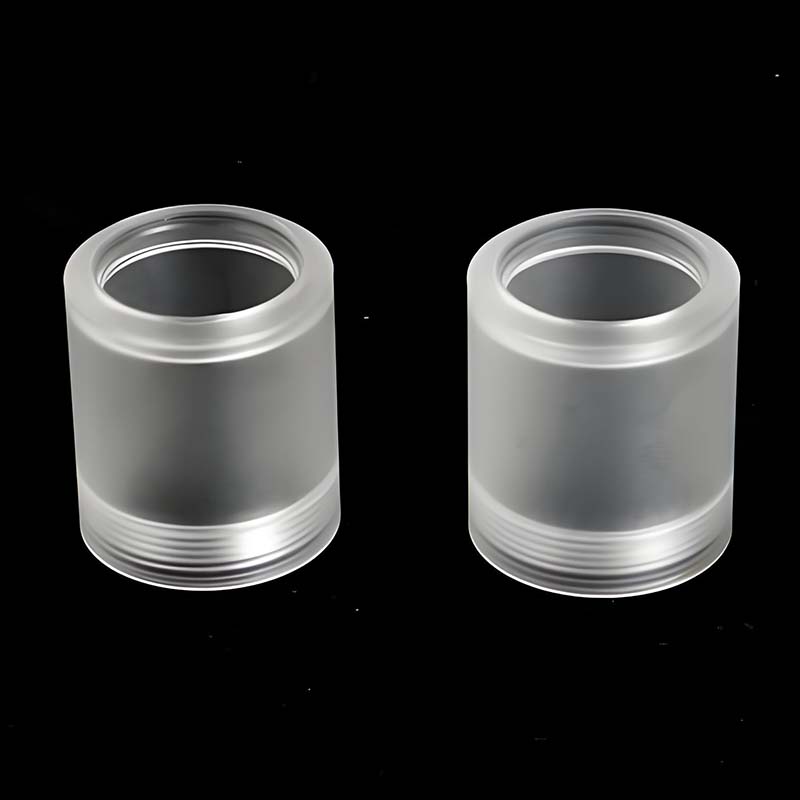
CNC machined acrylic sleeve made from clear PMMA
Acrylic sleeve
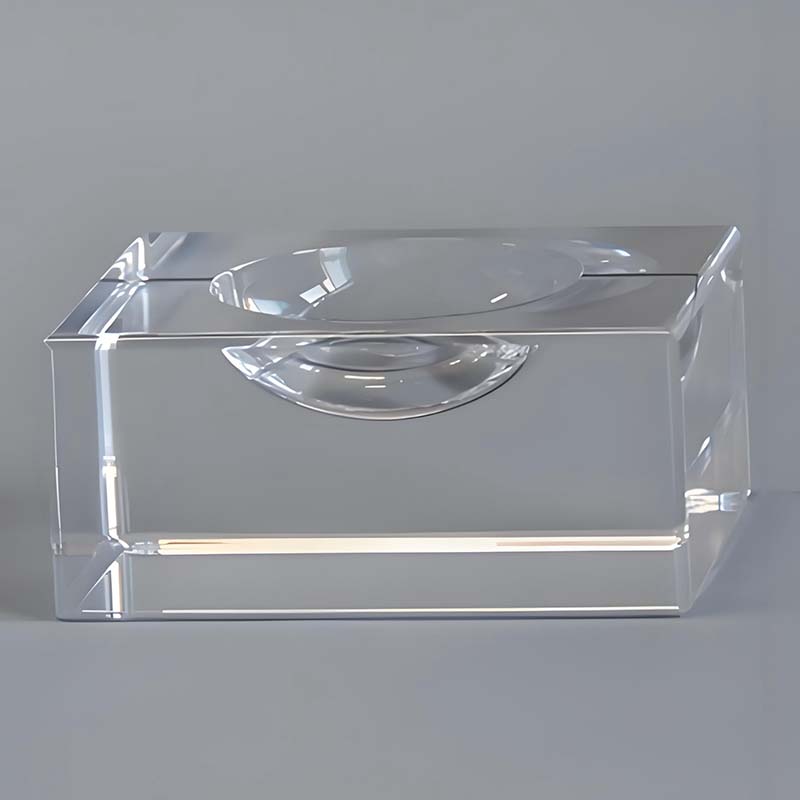
Custom CNC machined PMMA part with polished features
PMMA part
Workshop & inspection

Floor capability and in-process quality control

Plastic parts need a different rhythm from metal work: dedicated tooling, clean fixturing and dimensional checks staged between roughing and finishing. The three floor views show the working environment, and the fourth panel summarizes how dimensions and appearance are checked as custom CNC machined acrylic parts in China move through the cell.

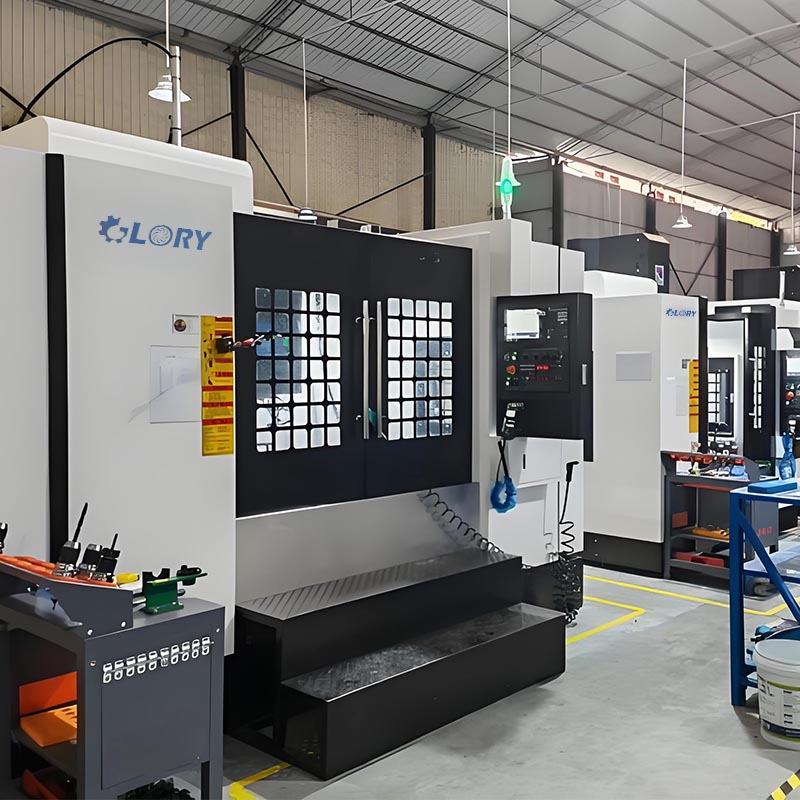
CNC machining workshop floor
WorkshopOrganized CNC cells with dedicated plastic-machining equipment and material staging.
CNC milling of a transparent plastic workpiece
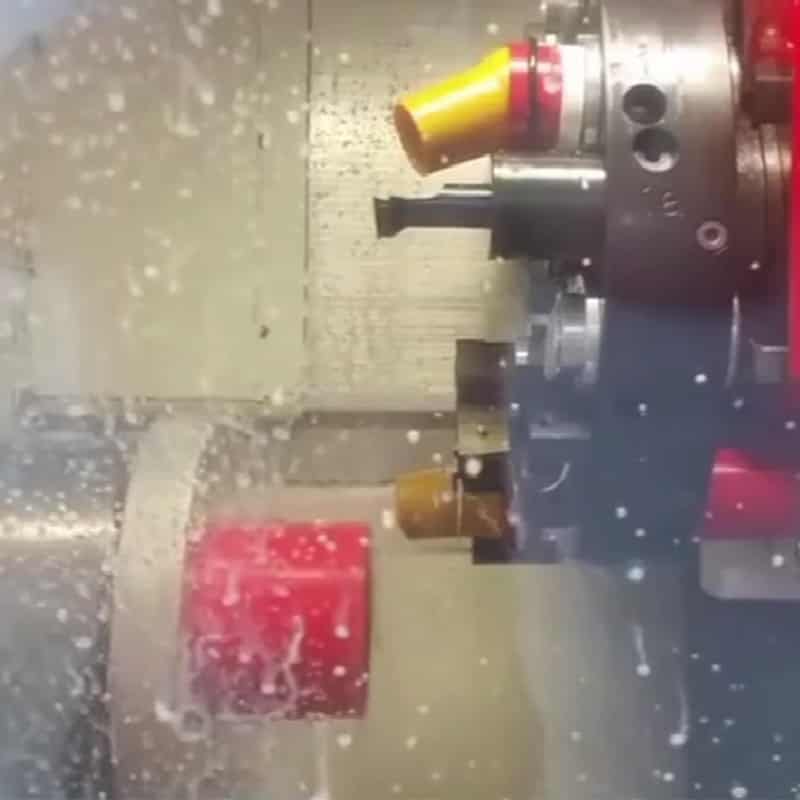
Plastic machiningMilling transparent polymers with sharp tooling, air cooling and controlled fixturing.
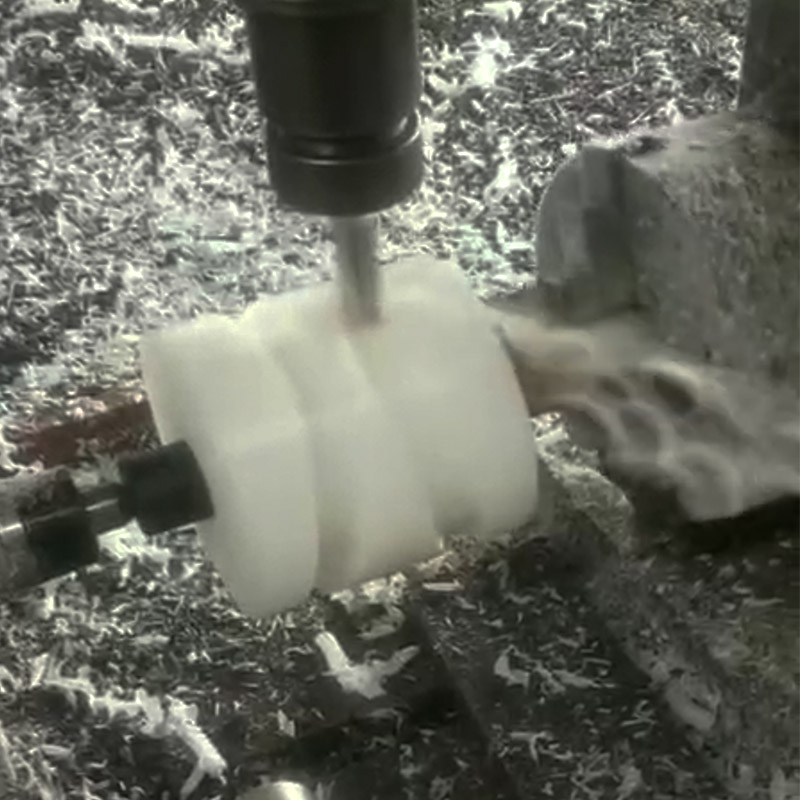
CNC turning of polyurethane plastic stock
PU turningTurning polyurethane and other engineering plastics alongside PMMA rod and tube work.

Inspection at each stage

  • First-article dimensional check before a batch continues
  • In-process measurement after roughing and again after finishing
  • Calibrated hand tools, height gauge, pin and thread gauges, and sampling on a coordinate measuring machine for critical features
  • Surface roughness comparison against the specified Ra range
  • Full visual inspection for clarity, edge chips and polishing consistency
  • Per-batch dimension record kept with the raw-stock grade information
Applications

Where machined PMMA components are used

The combination of clarity, stiffness, weathering behavior and clean machining makes PMMA useful wherever a part must be transparent, protective or light-controlling. These eight sectors account for most repeat demand for OEM CNC machined PMMA parts in China.

Lighting & LED optics

Light guides, diffuser panels, lens arrays and lamp covers that direct or spread light with controlled transmission.

Laboratory & medical devices

Transparent instrument housings, test fixtures, observation windows and trays where visibility of the process matters.

Automotive lighting & trim

Lamp lenses, light pipes, interior trim and gauge covers that must stay clear and dimensionally stable in service.

Consumer electronics

Display windows, indicator lenses, control panels and polished cosmetic parts for handheld and desktop products.

Transport interiors

Glazing, protective screens and interior panels for rail, marine and specialty vehicles where light weight and clarity help.

Food & beverage equipment

Sight glasses, guards and access panels selected in grades suited to repeated washing with neutral detergents.

Signage & retail display

Engraved plates, product stands, display cases and exhibition components with polished edges and custom tints.

Fluid, sensor & instrument parts

Manifolds, inspection blocks, sleeves and spacers where engineers need to watch flow or alignment through the component.

OEM workflow

From customer drawing to packed acrylic part

The production route for custom CNC machined acrylic parts in China follows the same six controlled steps whether the order is a single prototype or a repeating batch. Each step has a defined output before the next one begins.

STEP 01

Drawing review and DFM feedback

Geometry, tolerances, radii, wall balance and finish call-outs are reviewed against acrylic behavior, with manufacturability feedback returned before any metal is cut.

STEP 02

Material selection and stock prep

Cast or extruded PMMA, grade family, color, diffusion target and masking are confirmed, and sheet, rod or tube stock is cut to oversized blanks.

STEP 03

Toolpath and fixture planning

Sharp O-flute tools, climb-milling paths, soft-jaw fixturing and sacrificial support are planned so heat and clamp stress stay out of the part.

STEP 04

Roughing with stress control

Bulk material is removed symmetrically; thin or flatness-critical parts receive a stress-relief cycle and slow cooling before the finish pass.

STEP 05

Finishing and secondary work

Light finish cuts, engraving, selected edge polishing, bonding and tint or texture work bring the component to its specified appearance.

STEP 06

Inspection and protective packaging

Dimensions, roughness and appearance are checked, parts are cleaned without solvents, re-masked and packed to protect polished surfaces in transit.