We manufacture custom CNC machined superalloy components for original
equipment manufacturers and engineering companies that serve demanding
thermal, mechanical and corrosive environments. As a workshop focused on
CNC machined superalloy in China, we take nickel-base, iron-nickel-base
and cobalt-base high-temperature alloys from bar stock, forgings and
investment castings and turn them into finished, drawing-conformant parts.
Superalloys retain strength, creep resistance and surface stability where
ordinary steels and stainless grades soften and oxidize. The same properties
that make them valuable also make them difficult to cut: they work-harden
quickly, generate intense heat at the cutting edge and wear tooling fast.
Our process planning, tooling selection and machining parameters are built
around these difficulties, which is what allows us to deliver a reliable
CNC machined high-temperature alloy in China for both single components and
recurring series production.
Every project starts from the customer's drawing, CAD model and service
requirements. We review geometry, tolerances, material condition and
inspection points before cutting metal, so that difficult features such as
thin airfoil profiles, deep pockets, precision bores and multi-axis port
patterns are produced in a controlled and repeatable way.
Process Capabilities
Complete In-House CNC Machining Capabilities
A superalloy component rarely needs only one operation. Our process chain
combines turning, multi-axis milling, drilling and threading on the same part,
reducing repeated set-ups and the cumulative alignment errors that come with them.
T
CNC Turning
External and internal profiling for rotational superalloy parts made from
bar, forged billet or cast rings.
Rough and finish OD/ID turning
Boring, grooving and face profiling
Single-point and helical threading
Live-tool cross-drilling and milling
M
CNC Milling (3 / 4 / 5 Axis)
Prismatic and contoured geometries are matched to the most suitable axis
configuration instead of forcing every part onto one machine type.
3-axis: pockets, faces, slots and bolt patterns
4-axis: indexed radial features around an axis
5-axis 3+2: tilted work planes for deep cavities
Simultaneous 5-axis: airfoils, blisks and impellers
D
CNC Drilling
Controlled hole-making in heat-resistant alloys, where peck cycles, rigid
set-ups and sharp edges are essential to avoid work-hardened walls.
Straight, angled and intersecting cross-holes
Deep-hole peck drilling with steady chip evacuation
Bore reaming and spot-facing for seat surfaces
Position-critical hole patterns and port arrays
S
Tapping & Threading
Internal threads in hardened superalloys are produced with conservative
loads and thread-milling alternatives wherever a tapped hole is risky.
Metric M-threads and unified UN/UNC/UNF threads
Spiral-flute and spiral-point tapping
Thread milling for hard or thin-walled sections
Pipe and parallel threads for fluid-end components
Materials We Machine
Superalloy Families Routinely Machined
High-temperature alloys are grouped by base element and by the way the blank
is produced. We machine all four groups below, each with its own cutting
strategy, tool wear profile and heat-treatment condition.
Wrought Nickel-Base Alloys
Supplied as rolled or forged bar, plate and ring. This is the largest group
we machine and includes Inconel 718, Inconel 625, Waspaloy and the Nimonic
series. Wrought material is uniform and predictable, but precipitation-
hardened grades such as 718 develop high cutting forces and notch the tool
if feeds are too light.
Cast Nickel-Base Alloys
Investment-cast near-net shapes such as nozzle rings, vane segments and
blade disks in grades like Inconel 713C and Inconel 738LC. Cast skins,
variable case depth and slight draft angles require conservative first
passes and fixturing that follows the casting datum structure.
Iron-Nickel-Base Alloys
Grades such as A-286 and Incoloy 800H offer a balanced combination of
moderate high-temperature strength and oxidation resistance at a lower
material cost. They are commonly used for disks, fasteners, manifolds and
casings operating below the temperature ceiling of full nickel grades.
Cobalt-Base Alloys
Haynes 188, Haynes 25 / L-605 and Stellite-family grades deliver hot
hardness, wear resistance and sulfidation resistance for combustor parts,
wear sleeves and guide vanes. Their abrasive carbide structure calls for
rigid fixturing and wear-resistant cutting edges.
Grade Cross-Reference
Commercial Superalloy Grades Under Different National Standards
The same chemical family often carries different commercial designations in
Chinese (GB), American (UNS / AMS / ASTM) and European (EN / DIN Werkstoff
number) standards. The table below lists grades we regularly machine as a
CNC machined superalloy supplier in China, grouped for engineering comparison.
Alloy Family
China (GB Designation)
USA (UNS / AMS / ASTM)
Europe (EN / DIN, W.Nr.)
Common Trade Name
Nickel, wrought
GH4169
UNS N07718 · AMS 5662 / 5663 · ASTM B637
NiCr19Fe19Nb5 · 2.4668
Inconel 718
Nickel, wrought
GH3625
UNS N06625 · AMS 5666 · ASTM B446
NiCr22Mo9Nb · 2.4856
Inconel 625
Nickel, wrought
GH3600
UNS N06600 · ASTM B166 / B564
NiCr15Fe · 2.4816
Inconel 600
Nickel, wrought
GH4145
UNS N07750 · AMS 5667 / 5671
NiCr15Fe7TiAl · 2.4669
Inconel X-750
Nickel, wrought
GH4738
UNS N07001 · AMS 5708 / 5709
NiCr19Co11MoTi · 2.4654
Waspaloy
Nickel, wrought
GH4080A
UNS N07080 · HR 201 / HR 60
NiCr20TiAl · 2.4952
Nimonic 80A
Nickel, wrought
GH4090
UNS N07090 · HR 503
NiCr20Co18Ti · 2.4632
Nimonic 90
Nickel, wrought
GH3536
UNS N06002 · AMS 5536 / 5754
NiCr22Fe18Mo · 2.4665
Hastelloy X
Iron-nickel, wrought
GH2132
UNS S66286 · AMS 5732 / 5737 · ASTM A638
X6NiCrTiMoVB25-15-2 · 1.4980
A-286 / Incoloy A-286
Iron-nickel, wrought
NS1101 (0Cr20Ni32AlTi)
UNS N08810 / N08811 · ASTM B409
X10NiCrAlTi32-21 · 1.4876
Incoloy 800 / 800H
Nickel, cast
K418
UNS N07713 · AMS 5391
G-NiCr13AlMoNb · 2.4671
Inconel 713C
Nickel, cast
K438
UNS N07738 · cast grade
Closest European cast equivalents selected by chemistry
Inconel 738 / 738LC
Cobalt, wrought
GH5188
UNS R30188 · AMS 5772
CoNiCr22W14Ni · 2.4683
Haynes 188
Cobalt, wrought
GH5605 (GH605)
UNS R30605 · AMS 5759 · ASTM F90
CoCr20W15Ni · 2.4964
Haynes 25 / L-605
Note: cross-references indicate approximate commercial equivalents rather than
identical chemistries. Chemical composition, melt route, heat-treatment condition
(solution treated, aged, or as-cast) and mechanical properties are always
executed according to the drawing and specification supplied with the order.
Additional GB, AMS, ASTM, EN, DIN, BS or JIS designations can be reviewed on
request during the engineering quotation stage.
Engineering Approach
Why Superalloys Are Difficult to Machine — and How We Handle Them
A CNC machined high-temperature alloy in China is only as good as the cutting
strategy behind it. The six issues below define how every superalloy program is
planned on our floor.
Rapid Work Hardening
Nickel-base alloys harden under the cutting edge when a tool rubs instead of
shearing. The hardened skin makes the next pass even harder and can distort
thin walls.
Our approachContinuous engagement, positive rake geometry and depths that cut beneath the previously worked layer.
Intense Cutting-Zone Heat
Superalloys are poor heat conductors, so most machining heat concentrates at
the insert instead of leaving with the chip, accelerating flank and crater wear.
Our approachHigh-pressure coolant directed at the cutting zone, controlled cutting speeds and heat-resistant insert grades.
Abrasive Precipitates and Carbides
Gamma-prime phases, niobium and tungsten carbides abrade the tool edge. Cast
skins and oxide scale are even more aggressive than the base metal itself.
Our approachA dedicated roughing pass removes scale before finishing, with rigid tooling and documented edge-life limits.
High Cutting Forces
Specific cutting forces in aged 718 or Waspaloy are far above stainless steel,
which deflects slender tools, clamps and weak workpiece sections.
Our approachShort, stiff tool assemblies, close support fixturing and operation order designed around part rigidity.
Difficult Chip Control
Tough, stringy chips can weld to the edge, scratch finished surfaces and pack
deep bores and pockets if evacuation is not planned.
Our approachChip-breaker inserts, peck routines for deep features and interrupted clearing cycles before finish passes.
Demanding Geometric Tolerances
Airfoils, seal diameters, bolt-hole circles and mating bores require tight
dimensional and runout control despite high residual stress in the blank.
Our approachSymmetric roughing, stress-relief staging where needed and in-process measurement before the final cut.
Order Volume
From a Single Machined Part to High-Volume Production
The same engineering discipline applies whether we machine one component or
several thousand. Volume changes the fixturing and inspection strategy, not the
attention given to the drawing.
STAGE 01
One-Off & Prototype
1 piece
A single part from bar or a customer-supplied casting, with first-article
dimensional verification and process notes that support future repeats.
STAGE 02
Low-Volume Runs
Small batches
Small development and spare-part batches where tool paths are optimized
after the first piece and set-up time is kept proportional to quantity.
STAGE 03
Repeat Batch Production
Scheduled releases
Recurring orders produced against archived programs, fixture plans and
inspection records so each release matches the previous batch.
STAGE 04
High-Volume Series
Hundreds to thousands
Series manufacturing with dedicated fixturing, balanced cycle times,
scheduled tool replacement and in-process dimensional checks.
Project Workflow
How a Superalloy Order Moves Through the Workshop
A transparent, six-step sequence keeps difficult material programs predictable
from drawing review to packed shipment.
1
Drawing Review and Manufacturability Feedback
Geometry, datums, tolerance stack-up, thread and surface requirements are
reviewed against the selected alloy, with practical feedback before production.
2
Material Planning and Identity Verification
The correct grade, heat-treatment condition and blank form (bar, forging or
casting) are sourced and checked against the ordered specification before release.
3
Programming and Set-Up Design
CAM programs, fixture concepts, clamping sequence and operation order are
planned to protect weak sections and minimize re-clamping errors.
4
Roughing and Precision Finishing
Roughing removes scale and bulk stock; staged finishing passes hold bores,
faces, profiles and threads to drawing on 3-axis to 5-axis equipment.
5
In-Process and Final Dimensional Inspection
Critical dimensions are checked during production and again on the finished
part using calibrated hand tools, height gauges, CMM and surface comparison.
6
Deburring, Finishing and Protective Packaging
Controlled edge breaking, cleaning and any agreed surface treatment, followed
by individual protection so precision surfaces survive transit intact.
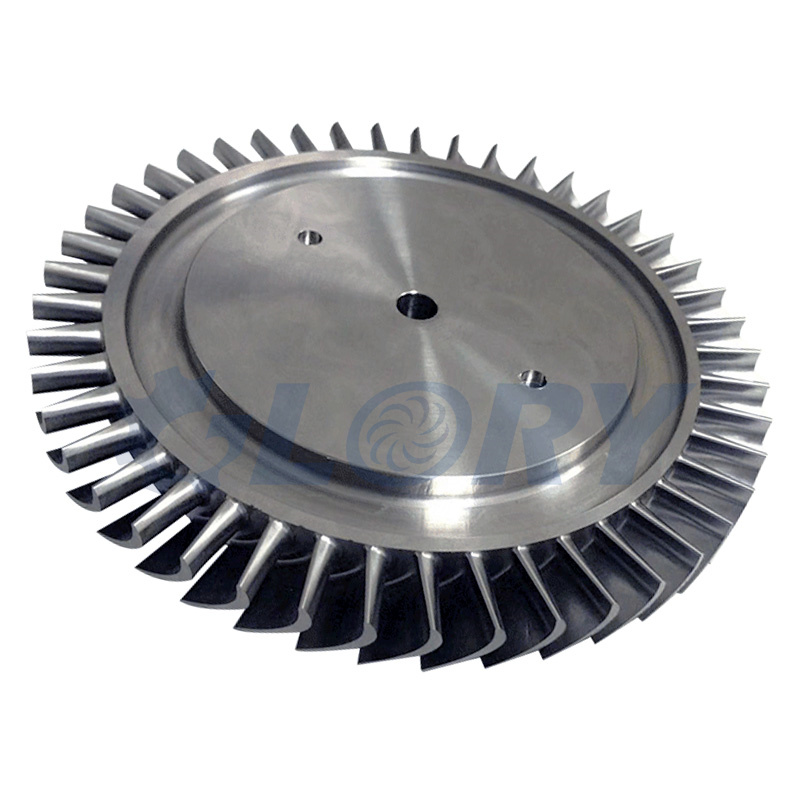
Machined Components
Representative Superalloy Products
A selection of hot-section components produced by multi-axis CNC machining from
superalloy forgings and investment castings.
Nozzle Ring
Blade Disk
Nozzle Ring
Industries Served
Where CNC Machined Superalloy Parts Go to Work
Our components operate in rotating, hot and corrosive environments across six
main equipment categories.
Aircraft Gas Turbines and APUs
Compressor and turbine-section components, seals, housings and auxiliary
power unit parts where creep strength and fatigue life are decisive.
Industrial Gas Turbines
Nozzle rings, vane segments, combustor hardware and fuel-system components
for land-based turbines running long, continuous service cycles.
Turbochargers and Energy Recovery
Turbine wheels, nozzle rings and housings for exhaust-driven rotating
machinery in heavy-duty and high-performance applications.
Oil and Gas Equipment
Valve internals, choke and fluid-end parts, and downhole components that
combine pressure loading with sour and corrosive service conditions.
Power Generation
Boiler and turbine auxiliary hardware, burner components and high-temperature
fixtures for thermal power and heat-recovery systems.
Marine and Chemical Processing
Pump shafts, impellers, mixing and reactor hardware exposed to seawater,
acid media and sustained elevated temperatures.
Frequently Asked Questions
Practical Questions About Machined Superalloy Orders
Common engineering and procurement questions about materials, processes and
order planning for a CNC machined superalloy in China.
Which superalloy grades can be supplied and machined?
The common wrought grades include GH4169 / Inconel 718, GH3625 / Inconel 625,
GH4738 / Waspaloy, GH4080A and GH4090 / Nimonic series, GH3536 / Hastelloy X
and GH2132 / A-286. Cast grades such as K418 / 713C and K438 / 738LC, and
cobalt grades such as GH5188 / Haynes 188 and GH5605 / L-605 are also machined
regularly. Other designations can be reviewed against the drawing specification.
Can you machine investment castings as well as wrought stock?
Yes. We machine both wrought bar, plate and forgings and investment-cast
near-net blanks such as nozzle rings and blade disks. Castings are planned
around the datum structure and machining allowance of the blank, with the
roughing stage removing cast skin before precision finishing.
When is 5-axis machining necessary instead of 3-axis?
3-axis is efficient for prismatic faces, pockets and hole patterns. 4-axis
handles features distributed around a rotational axis. Full 5-axis work is
selected for sculpted airfoils, blisks, deep cavities and compound-angle
holes, where shorter tools and continuous cutter orientation improve both
accuracy and surface quality.
What dimensional accuracy can be achieved?
Achievable accuracy follows the drawing, the alloy condition and feature
geometry. On well-supported turned and milled features, dimensions in the
hundredths-of-a-millimetre range, controlled runout and fine surface finishes
are routine. Critical features are confirmed by in-process and final
dimensional inspection rather than assumed from the program.
What is the minimum and maximum order quantity?
There is no minimum series requirement: a single prototype or spare part is
accepted. At the other end, the process scales through low-volume and repeat
batches to high-volume production of hundreds or thousands of pieces with
dedicated fixturing and scheduled tool management.
What information is needed to evaluate a CNC machined high-temperature alloy in China?
A dimensioned drawing (PDF or DWG), a 3D model in STEP, IGES or Parasolid
format, the grade and material condition, expected quantity, key inspection
dimensions and any surface-treatment requirements. With these inputs, the
machining route, set-up concept and feasibility feedback can be prepared
before any metal is cut.
A Focused Partner for Difficult High-Temperature Alloys
General-purpose machine shops often underestimate how aggressively a
precipitation-hardened nickel alloy will work-harden, or how quickly a cast
superalloy wears tooling. Our workshop is organized around exactly these
materials, so the process knowledge accumulates on every repeat order.
For buyers looking for a stable source of CNC machined superalloy in China,
this means realistic feasibility feedback, predictable cycle times and parts
that match the drawing from the first release through series production.
What Each Finished Order Includes
Parts machined to the supplied drawing, model and grade specification
Turning, 3/4/5-axis milling, drilling and tapping completed under one process plan
Wrought and cast superalloy blanks handled with grade-specific strategies
In-process and final dimensional inspection on critical features
Deburring, edge control and agreed surface finishing
Protective packaging suited to precision machined surfaces
Consistent repeatability from a single prototype to volume batches



 We provide custom machined parts, 5-axis linkage CNC machining, and the design, production, and assembly of machinery and equipment.
