
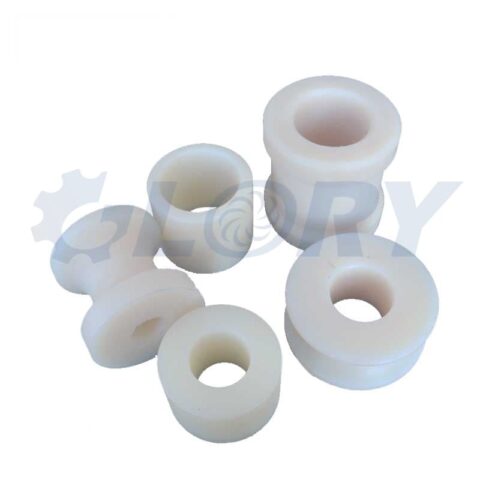
Custom Nylon Guide Wheels | CNC-Machined MC Nylon Pulleys
Precision nylon guide wheels CNC machined from MC cast and oil-filled nylon — U-groove, V-groove and rope-groove sheaves for cranes, elevators, winches, chain, belt and cable. Drawings or sample
Custom Nylon Guide Wheels | CNC-Machined MC Nylon Pulleys & Sheaves from Drawings or Samples
In hoisting, elevator, cable, conveyor, and automation equipment, anywhere wire rope, chain, belt, or cable must change direction or travel along a defined path, you will find a grooved wheel: the guide wheel (guide pulley, sheave). Whether it turns freely and its groove is accurate affects not only running resistance but also the service life of wire rope and cable.
Beyond steel and bronze pulleys, more and more OEMs and end users choose the nylon guide wheel (nylon guide pulley), commonly made from MC cast nylon or oil-filled nylon. It may look like a simple wheel change, but the real savings come from reduced wire-rope replacement and less downtime. We are a specialized CNC machining manufacturer focused on non-standard, custom-engineered plastic components. We routinely machine nylon guide wheels, pulleys, tension wheels, and multi-groove rope sheaves. We work from drawings or samples, accept single pieces and small batches, require no tooling or mold, and offer fast lead times.
1. What Is a Nylon Guide Wheel?
A nylon guide wheel is a grooved wheel machined from nylon (polyamide, PA) rod or cast stock using CNC turning and groove milling. Its typical features include:
- The guide groove — a U-groove, V-groove, H-groove, or round rope groove on the rim, matched to rope, belt, chain, or cable;
- The center bore / bearing seat — for mounting bearings or bushings;
- The rim flanges — single or double flanges preventing rope or belt from slipping out;
- Metal bushing inserts (optional) — pressed into the bearing seat to increase fit strength and wear resistance.
The difference between a guide wheel and a carrier roller is simple: a roller carries load with a smooth surface, while a guide wheel guides with a groove. Common materials include MC cast nylon, oil-filled nylon, PA6/PA66, glass-filled nylon, and food-grade nylon.
2. Why Is Nylon a Popular Material for Guide Wheels?
- Protects wire rope and extends rope life. This is the core value of a nylon guide wheel: hard metal grooves “chew” the rope and break wires, whereas resilient nylon provides a larger contact area and distributes the load evenly, sharply reducing compression and fatigue wear on the rope. Switching to nylon often saves the cost of frequent rope replacement.
- Wear resistant and self-lubricating — no oiling. MC nylon’s wear resistance is roughly 7–10 times that of bronze and 4–5 times that of ordinary steel. Its low friction keeps grooves from wearing into channels and prevents seizing in dusty, outdoor environments.
- Lightweight and easy to install. Nylon weighs about one seventh as much as bronze; at the same line load the wheel is far lighter, making carrying, installation, and replacement easy while reducing equipment weight and rotational inertia for quicker starts.
- Tough and impact resistant. Nylon absorbs start-up, braking, and heavy-load shocks without fracturing, suiting hoisting and winch applications.
- Corrosion resistant and rust-free. Nylon resists oils, weak acids and alkalis, seawater, and solvents; it does not rust or require painting in marine, salt-spray, chemical, and wet outdoor environments.
- Damping and quiet. Nylon wheels run smoothly, absorb vibration, and operate far more quietly than metal wheels.
- Insulating and non-magnetic for applications with insulation requirements or where magnetic interference must be avoided.
- Precision groove machining. CNC turning accurately controls groove-root radius, groove angle, and multi-groove spacing for stable rope and belt tracking.
For even lower friction choose oil-filled nylon; for higher loads choose glass-filled nylon or a metal insert at the bearing seat.
3. Nylon vs. Other Guide Wheel Materials
| Material | Strengths | Limitations | Typical Application |
|---|---|---|---|
| MC cast nylon | Wear resistant, tough, protects wire rope, lightweight, corrosion resistant, available in large sizes | Ultimate load rating slightly below steel | Crane, elevator, winch and marine guide wheels |
| Oil-filled nylon | Lower friction, no oiling, long sliding life | Slightly lower load rating than plain nylon | Continuously running, hard-to-lubricate guide points |
| Glass-filled nylon | Higher rigidity, load capacity, and temperature rating | Slightly more abrasive to rope/belt | Heavy-duty guide wheels and bearing-seat areas |
| POM (Acetal/Delrin) | Dimensionally stable, low water absorption, precise | Less tough, impact resistant, and load capable than nylon | Small precision guide wheels, wet environments |
| UHMWPE | Extremely wear resistant, self-lubricating, zero water absorption, non-sticking | Lower rigidity and load capacity than nylon | High-wear, light-load, sticky-material points |
| Steel / cast iron | High load capacity, heat resistant, mature design | Chews rope, heavy, rust prone, noisy | Extreme heavy-load, high-temperature service |
| Bronze | Traditional pulley, wear resistant | Heavy, costly, needs lubrication | Can be directly replaced by MC nylon |
| PEEK | High strength, high temperature rating, excellent overall performance | High cost | High-end, high-temperature, high-purity applications |
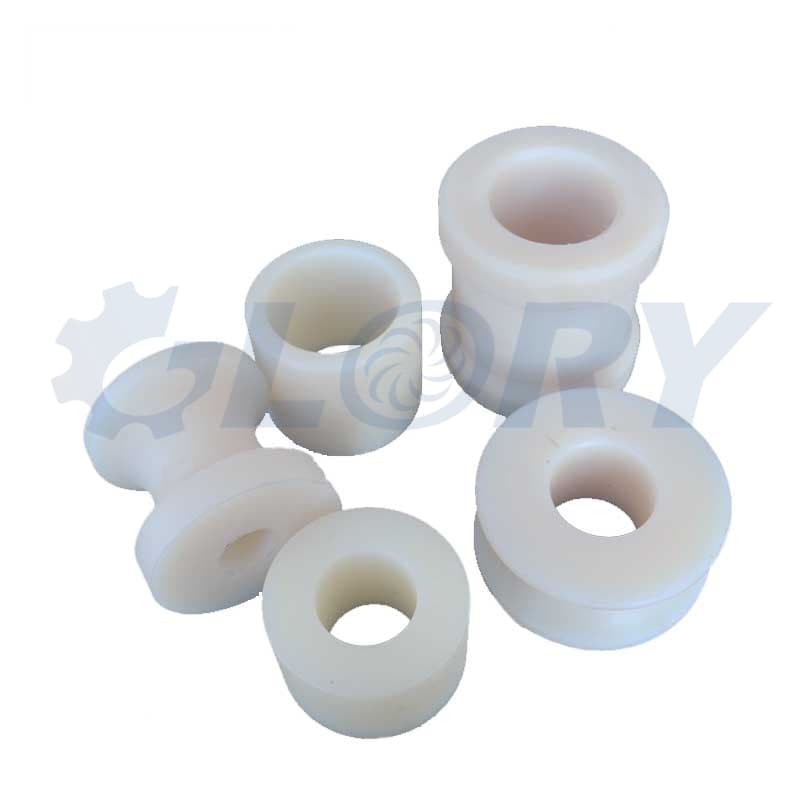
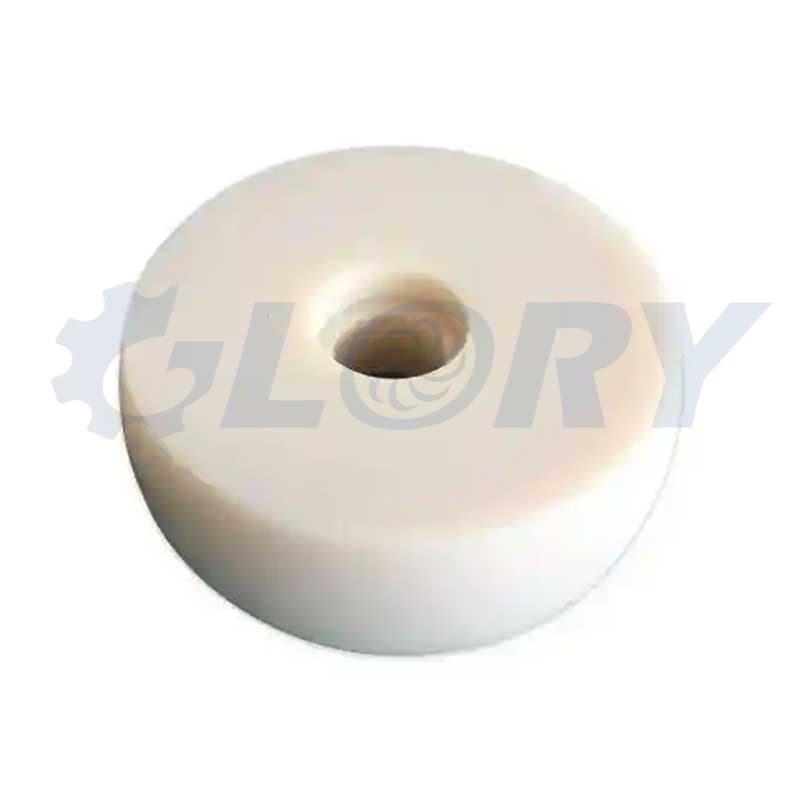
4. What Nylon Guide Wheels Can We Customize?
By groove type:
- U-groove guide wheels — for round rope and cable, with a matching round groove root;
- V-groove guide wheels — 90° V-groove with accurate guidance and a self-cleaning action; can run on V-shaped tracks;
- H-groove / rectangular-groove guide wheels — for flat belts and chain;
- Round (half-round) rope-groove wheels — wire-rope pulleys with a groove-root radius slightly larger than the rope diameter;
- Multi-groove wheels — guiding several ropes or belts simultaneously;
- Single/double flanged wheels — preventing rope or belt from slipping out.
By application:
- Crane sheaves, winch/hoist rope wheels, mining and port guide wheels;
- Elevator guide sheaves, deflector (diverting) sheaves, car-top sheaves;
- Chain guide wheels, belt tension pulleys, wire/cable guide wheels;
- Textile thread guides, printing and packaging film guide wheels;
- Door and automatic sliding-door wheels, parking-system and automation-line guide wheels.
Outer diameter, wheel width, groove type and count, center bore, bearing seats, rim flanges, and metal bushing inserts can all be customized from drawings, samples, or installation dimensions.
5. Groove Profile and Runout Are Critical
A guide wheel is a grooved rotating part, and we focus on controlling:
- Groove-root radius matched to rope diameter — slightly larger than the rope so it supports rather than pinches the rope, avoiding local stress concentration and broken wires;
- Groove angle and multi-groove spacing — consistent groove positions on multi-groove sheaves for even rope loading;
- Concentricity and radial runout between groove root and bearing seat — low groove runout prevents periodic rope vibration and jumping out of the groove;
- Bearing-seat dimensional accuracy — a stable fit with bearings/bushings, with no ring creep or binding;
- Rim and flange dimensions — keeping rope and belt in place;
- Dynamic balancing and surface finish for large wheels — high-speed large wheels control balance and groove smoothness to reduce vibration and noise;
- Nylon process control — sharp tools, air or mist cooling, and separate roughing/finishing; where needed, stress is relieved after roughing and before finishing to reduce deformation.
6. Why CNC Machining Instead of Injection Molding?
- No tooling required — single pieces and small batches are viable, saving mold costs for equipment supply and repair spares;
- Better for large-diameter wheels — MC cast stock is large and low in stress and only needs finish machining, whereas large molded parts easily deform with weld lines;
- Flexible with complex grooves — U/V/H grooves, multiple grooves, flanges, and bushing inserts can be combined freely, and dimensional changes only require a program edit;
- Dense material with no shrinkage voids — machined from solid rod for reliable groove load capacity;
- Good batch consistency — CNC machining unifies groove diameters, bearing seats, and runout for strong interchangeability.
Injection molding suits a single specification in very large volumes of small standard wheels. But where guide wheels vary with rope diameter, belt width, and load, with diverse specifications and urgent timing, custom CNC machining has clear advantages.
7. Parameters to Confirm When Ordering
- Wheel outer diameter, width, and groove count;
- Item being guided (wire rope / chain / belt / cable) and its diameter or width;
- Groove type (U/V/H/round), groove-root radius, and groove angle;
- Center bore, bearing type, or bushing dimensions;
- Whether flanges or metal bushing inserts are required;
- Load, speed, operating environment, medium, and temperature;
- Drawings (STEP/CAD/PDF accepted) or a worn sample part.
If you only have a worn part and no drawing, we can measure the sample and reverse-engineer it.
8. Our Ordering Process
- Send information — drawing, sample, or installation dimensions;
- Selection & quotation — confirm the nylon grade, groove type, and quantity for a prompt quote;
- Machining — cutting → CNC turning of OD/rope grooves → groove milling/drilling → bushing insertion and deburring;
- QC & delivery — inspect groove profile, radial runout, bearing seats, and concentricity;
- After-sales support — assist with adjustment if rope jumping, noise, or fit issues arise during installation.
9. Industries and Equipment Served
Nylon guide wheels and matching parts are widely used in:
- Elevators and escalators (guide sheaves, deflector sheaves);
- Hoisting, winches, mining, ports, and construction machinery;
- Marine and offshore engineering and dock equipment;
- Cable, textile, printing, and packaging machinery;
- Doors, automatic gates, parking systems, and automation lines;
- Agricultural, light-industry, and non-standard equipment guide points.
About Us
 We provide custom machined parts, 5-axis linkage CNC machining, and the design, production, and assembly of machinery and equipment.