
When an original equipment manufacturer needs a transmission gear, a splined shaft, a king pin or a wear-resistant bushing that combines a hard, abrasion-proof surface with a core that will not shatter under shock load, AISI/SAE 8620 is almost always on the shortlist. It is the most widely used nickel-chromium-molybdenum carburizing steel in the world, and it is also one of the most frequently requested materials on our shop floor. If you are looking for reliable CNC machined 8620 steel in China, this page explains what the material is, how it is designated under different national standards, how it behaves during cutting and heat treatment, and exactly how our workshop turns raw 8620 bar into finished, ready-to-assemble OEM parts.
We work from customer drawings, STEP/IGES models and printed samples, and we cover the complete process chain in house: raw material selection, CNC turning, three-axis, four-axis and five-axis milling, drilling, tapping, heat-treatment coordination, grinding and finishing, dimensional inspection and protective packaging. Orders run from a single machined prototype to repeat, high-volume production batches, with the same process discipline applied at every batch size.
What Is 8620 Steel?
8620 is a low-carbon, low-alloy case-hardening steel containing roughly 0.20% carbon together with balanced additions of nickel, chromium and molybdenum. The low carbon content keeps the core soft, ductile and tough in its delivered state, which also makes it pleasant to machine. The Ni-Cr-Mo alloy package gives the steel a strong response to carburizing: after carbon is diffused into the surface and the part is oil-quenched and tempered, the outer case reaches approximately 58–63 HRC while the core remains at roughly 28–40 HRC. Engineers describe this combination as a “hard case, tough core,” and it is precisely the profile that gears, pins, camshafts and bearing races require.
Because the chemistry is formulated for surface hardening rather than through-hardening, 8620 should not be judged as a high-strength structural steel. Its value lies elsewhere: excellent contact-fatigue and wear resistance on working surfaces, high impact toughness underneath, good machinability in the annealed or normalized condition, better weldability than most medium-carbon alloys, and predictable, repeatable behavior in volume heat treatment. That predictable behavior is one reason buyers of CNC machined 8620 steel in China keep returning to the grade program after program.
8620 Equivalent Grades Under Different National Standards
8620 is known by different designations depending on the standards system used on a drawing or purchase specification. The grades below are the commonly cross-referenced equivalents. They are close matches in chemistry and intended use, but they are not always identical in every element limit or hardenability band, so the drawing designation and the required supply condition should always govern procurement.
| Country / Region & Standard | Grade Designation | Notes |
|---|---|---|
| USA — AISI / SAE | 8620, 8620H | The reference grade; 8620H is ordered to a controlled hardenability band for more uniform heat-treatment response. |
| USA — UNS | G86200 | Unified Numbering System code for AISI 8620. |
| USA — ASTM | ASTM A29 / A322 / A519 grades | Common bar and seamless-tubular delivery standards for the same chemistry. |
| China — GB/T 3077 | 20CrNiMo, 20CrNiMoA | The domestic Chinese equivalent; the suffix “A” denotes tighter quality control on residual elements and metallurgical quality. |
| Germany — DIN / Werkstoffnummer | 21NiCrMo2, 1.6523 | Widely used European carburizing designation; the 1.6523 number is the material number. |
| European Union — EN 10084 | 20NiCrMo2-2, 1.6523 | Current European case-hardening steel standard. |
| Japan — JIS G4053 / G4103 | SNCM220 (also SNCM21, SNCM21H) | Ni-Cr-Mo carburizing steel; SNCM220 is the closest routine match to 8620. |
| United Kingdom — BS 970 | 805M20, 805H20 | “M” grades are composition-controlled; “H” grades carry hardenability limits. |
| France — AFNOR | 20NCD2, 22NCD2 | Traditional French designation for the same Ni-Cr-Mo case-hardening family. |
| Sweden — SS | 2506 | Swedish standards institute designation. |
| International — ISO 683-11 | 20NiCrMo2 | ISO case-hardening steel designation. |
Practical note for buyers: if your drawing says SNCM220, 21NiCrMo2 / 1.6523 or 20CrNiMo, our engineering team will treat it as the 8620 family during quotation and process planning, and we will confirm the exact chemistry range, supply condition (annealed or normalized) and hardenability requirement before cutting begins. On request we can source to the AISI/SAE designation directly, or to the local GB/T 20CrNiMo specification, depending on where the final assembly is qualified.
Chemical Composition of 8620
The table below lists the typical chemical composition ranges for AISI/SAE 8620 in weight percent. Exact heat-lot values vary slightly between mills, and tighter limits can be agreed for critical work.
| Element | Symbol | Typical Range (wt %) | Role in the Steel |
|---|---|---|---|
| Carbon | C | 0.18 – 0.23 | Low base carbon keeps the core tough and machinable; surface carbon is raised later during carburizing. |
| Manganese | Mn | 0.60 – 0.95 | Supports strength and hardenability and helps deoxidize the melt. |
| Silicon | Si | 0.15 – 0.35 | Deoxidizer; contributes modest strength without harming toughness. |
| Nickel | Ni | 0.40 – 0.70 | Improves low-temperature and impact toughness of the core — the element most responsible for 8620’s shock resistance. |
| Chromium | Cr | 0.40 – 0.70 | Raises hardenability and promotes a hard, wear-resistant carburized case. |
| Molybdenum | Mo | 0.15 – 0.25 | Deepens hardenability, reduces temper brittleness and helps uniform case response across thick sections. |
| Phosphorus | P | ≤ 0.035 | Residual element kept low to protect toughness. |
| Sulfur | S | ≤ 0.040 | Residual element; controlled to balance chip breaking against fatigue performance. |
| Iron | Fe | Balance | The remaining matrix, roughly 96.8–98%. |
Key Characteristics That Define 8620
Hard wear-resistant case over a shock-absorbing core
The defining feature. After carburizing, quenching and tempering, working surfaces reach 58–63 HRC and resist abrasion, pitting and contact fatigue, while the interior stays ductile enough to absorb sudden torque spikes, vibration and repeated impact without brittle fracture. This is why the grade dominates gear and pin applications.
Good machinability before hardening
In the annealed or normalized condition, 8620 machines at roughly 65% of the free-machining reference AISI 1212. That is meaningfully better than medium-carbon alloys such as 4140: cutting forces are moderate, chips are controllable, tool life is predictable and tight tolerances are achievable on standard CNC equipment. This directly lowers the unit cost of CNC machined 8620 steel in China compared with harder, more abrasive alloys.
Controllable heat-treatment response
With Ni-Cr-Mo hardenability, the grade forms a uniform martensitic case during oil quenching with lower distortion risk than plain-carbon carburizing steels. Case depth can be specified from light-duty 0.5 mm layers up to heavy-duty 1.5–2.0 mm layers, matched to tooth size and contact load.
Better weldability than most alloy steels
The low carbon content minimizes weld cracking. Thin sections can often be welded without preheat in the annealed or normalized condition; sections above roughly 25 mm benefit from 150–200°C preheat. The standard production route is to weld first, then carburize the whole assembly. Case-hardened surfaces in service are not welded.
Forgiving and versatile
8620 is ferromagnetic, responds well to magnetic work-holding, machines with conventional coated-carbide tooling and standard cutting fluids, and accepts a wide range of secondary finishes. It is available as round bar, flat bar, plate, block and seamless tube, which gives designers freedom in blank selection.
Limitations to design around
8620 is not corrosion resistant — the chromium level is far below that of stainless steel, so bare parts will rust in moisture and need oiling, black oxide, phosphate, plating or paint for storage and service. It also cannot through-harden to high hardness: quench-and-temper alone tops out near 33 HRC because of the low carbon. If a part needs uniform high strength through the whole cross-section rather than a hard skin, 4140 or 4340 is usually the better starting point.
Physical and Mechanical Property Reference
| Property | Typical Value | Condition / Remark |
|---|---|---|
| Density | 7.85 g/cm³ (0.284 lb/in³) | Typical low-alloy steel density. |
| Ultimate tensile strength | Approx. 530 – 635 MPa (77 – 92 ksi) | Annealed / normalized; rises strongly after case hardening. |
| Yield strength | Approx. 385 – 425 MPa (56 – 62 ksi) | Annealed / normalized core. |
| Elongation | Approx. 26 – 31% | Indicates the high core ductility. |
| Modulus of elasticity | Approx. 205 GPa (29.7 Msi) | Stiffness for deflection calculations. |
| Bulk hardness | Approx. 149 – 183 HB | Annealed / normalized stock for machining. |
| Surface hardness after carburizing | 58 – 63 HRC | Oil-quenched and tempered case. |
| Core hardness after treatment | Roughly 28 – 40 HRC | Keeps impact toughness. |
| Rotating-beam fatigue strength | Approx. 280 MPa (41 ksi) at 10⁷ cycles | Core value; carburized and shot-peened teeth perform considerably higher. |
| Thermal conductivity | Approx. 47 W/m·K | Supports even temperature during quenching. |
| Coefficient of thermal expansion | 11 – 12 × 10⁻⁶ /°C | Comparable to most carbon steels. |
| Electrical conductivity | Approx. 8% IACS | Standard for alloy steel. |
| Magnetic behavior | Ferromagnetic | Allows magnetic chucking and fixturing. |
| Machinability rating | Approx. 65% (vs AISI 1212 = 100%) | Annealed / normalized condition. |
| Recommended service temperature | Up to roughly 425°C (800°F) | The carburized case begins to over-age above this range. |
Heat Treatment and How We Plan Machining Around It
Heat treatment is not an afterthought in an 8620 part; it is a design stage that determines the entire machining sequence. The canonical route we plan for is:
- Rough and semi-finish machine the part in the annealed or normalized condition, leaving a controlled allowance for distortion and final stock removal.
- Carburize at roughly 900–925°C in a carbon-rich atmosphere to build the specified case depth — commonly 0.5 mm for light-duty gears, around 1.0 mm for medium industrial gears, and 1.5–2.0 mm for heavy reducer and mining-duty teeth.
- Oil-quench to transform the high-carbon surface into hard martensite while keeping the core tough.
- Temper at roughly 150–200°C to relieve quenching stress and stabilize toughness.
- Finish critical surfaces by grinding, honing or hard machining to remove the small phase-change distortion and reach final tolerance and surface finish.
Because the austenite-to-martensite transformation causes a slight, repeatable volume change, experienced planning matters. On tight-tolerance programs we run a small pilot batch, measure the actual growth or shrinkage behavior of that heat lot, and then apply a reverse compensation value to the pre-heat-treatment tool paths. Grinding allowance is specified per surface, and features that must stay precise after treatment — bores, journal diameters, spline profiles, bearing seats — are always reserved for post-treatment finishing. Vacuum or low-pressure carburizing can be coordinated for cleaner cases and reduced distortion on high-end work, while conventional gas carburizing remains the economical choice for high-volume automotive-type parts.
Once a carburized case climbs above roughly 60 HRC, conventional milling and turning become impractical; grinding, honing and CBN hard finishing are the production processes. We design the route around that reality from the first quotation rather than discovering it on the shop floor.
Our CNC Machining Capabilities for 8620 Steel
Our workshop is set up to machine 8620 across the full geometry range customers actually need — rotational transmission parts, prismatic housings and brackets, and complex five-axis components — under one roof. This single-source flow is one of the practical advantages of sourcing CNC machined 8620 steel in China from a workshop that handles both the cutting and the heat-treatment coordination.
CNC turning
Our CNC lathes handle outside- and inside-diameter turning, facing, boring, grooving, parting and single-point threading on 8620 bar, tube and pre-forged blanks. Bar-fed machines run unattended for volume orders, while larger chucks accommodate flanged and stepped shafts. For transmission work we routinely control journal diameters, concentricity and runout to drawing requirements, and we can turn, mill and cross-drill a shaft in a single setup on turn-mill centers to eliminate refixturing error. Soft-state turning uses TiAlN-coated carbide at roughly 100–200 surface feet per minute with feeds in the 0.005–0.020 inch-per-revolution range, adjusted to the operation and the machine; post-treatment journals go to cylindrical grinding.
Three-axis CNC milling
Three-axis vertical and horizontal machining centers produce planar faces, pockets, steps, slots, keyways, bolt-hole patterns and general prismatic geometry on 8620 blocks, plates and fixtured bars. This is the cost-effective choice for brackets, adapter plates, simple housings and any part whose features can be reached from one or a small number of setups. Rigid fixturing and conservative radial engagement keep tool life stable on this alloy.
Four-axis CNC milling
Adding a rotary axis lets us index around a part to machine cross-holes, radial features, helical slots, spline-like profiles, flats around a circumference and multi-sided geometry without manual re-clamping. Four-axis work is especially common on 8620 shafts, bodies, valve-type components and parts where angular hole patterns or around-the-part features would otherwise accumulate setup error. Fewer setups means better feature-to-feature relationship and lower cost per part.
Five-axis CNC milling
For genuinely complex 8620 components — contoured bodies, parts with compound angles, closely packed features accessible only at a tilt, and gear-like or cam-like 3D geometry — simultaneous five-axis and 3+2 positioning machines reach every working surface in minimal setups. Five-axis capability also lets us use shorter, stiffer tools by presenting the cutter at the optimal angle, which improves finish and dimensional accuracy on deep pockets and tall walls. Customers designing compact, high-feature-density 8620 assemblies benefit most here.
Drilling
We drill straightforward holes, precision reamed holes, cross-holes, angled holes and deep holes in 8620, using peck cycles and appropriate coolant delivery to manage chips in this ductile alloy. Hole location, diameter tolerance and perpendicularity are controlled against the datum scheme on the drawing, and tight bores are finished by reaming or boring after the drill operation.
Tapping and threading
We produce internal threads in metric, UNC, UNF and other specified pitches by tapping or, for difficult or large threads, by thread milling or single-point threading on the lathe. Because normalized 8620 is ductile and tends to stretch rather than crumble, we select tap type and hole class carefully — often favoring spiral-flute or forming taps in the right condition — to avoid torn threads and to guarantee clean, gauge-able threads in production. External threads are turned or rolled to match.
Beyond these core processes we coordinate broaching of keyways and internal splines, gear cutting, cylindrical and surface grinding, honing, shot peening and the full range of protective and cosmetic finishes, so a part can arrive complete rather than half-finished.
From a Single Prototype to High-Volume Production
Batch size should never force a compromise in how an 8620 part is made, and our capacity is structured to scale smoothly with a program’s maturity.
- One-off and prototype work: single pieces and first-article builds for design verification, fit checks and test rigs, with fast turnaround and direct engineering feedback on manufacturability, corner radii, accessible tool geometry and heat-treatment allowances.
- Low-volume and pilot batches: tens to a few hundred pieces for product launches, spares and qualification builds, using soft tooling and optimized fixturing.
- Medium-volume repeat orders: hundreds to low thousands, where dedicated fixtures, preset tooling and stable cycle times begin to drive unit cost down.
- High-volume production: thousands of pieces per release on bar-fed lathes and palletized machining centers, with balanced cycle times, in-process checks at defined intervals and consistent packaging for assembly-line delivery.
The same datum strategy, tooling logic and inspection plan carries from the first prototype to the latest production release, so parts remain interchangeable as volumes grow. Heat-lot records are kept by batch, and first-piece approval, periodic patrol inspection and final inspection are applied proportionally to order quantity. Buyers searching for CNC machined 8620 steel in China frequently tell us that this smooth transition — without redesigning the process every time volume changes — is what makes a supplier genuinely easy to scale with.
Typical 8620 Parts We Machine for OEM Customers
The “hard case, tough core” profile maps directly onto a recognizable family of components. Parts we regularly produce include:
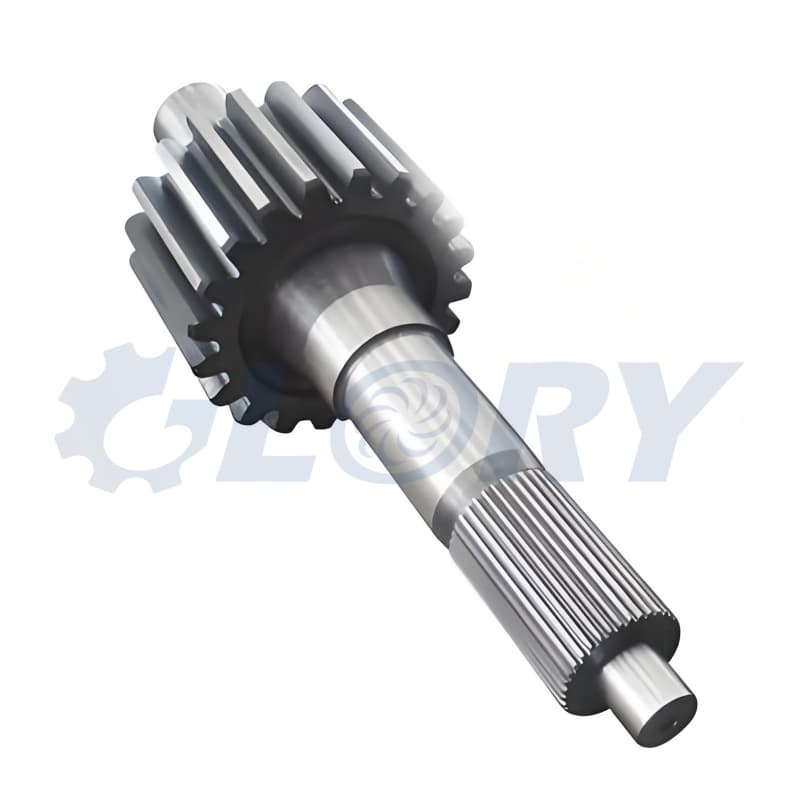
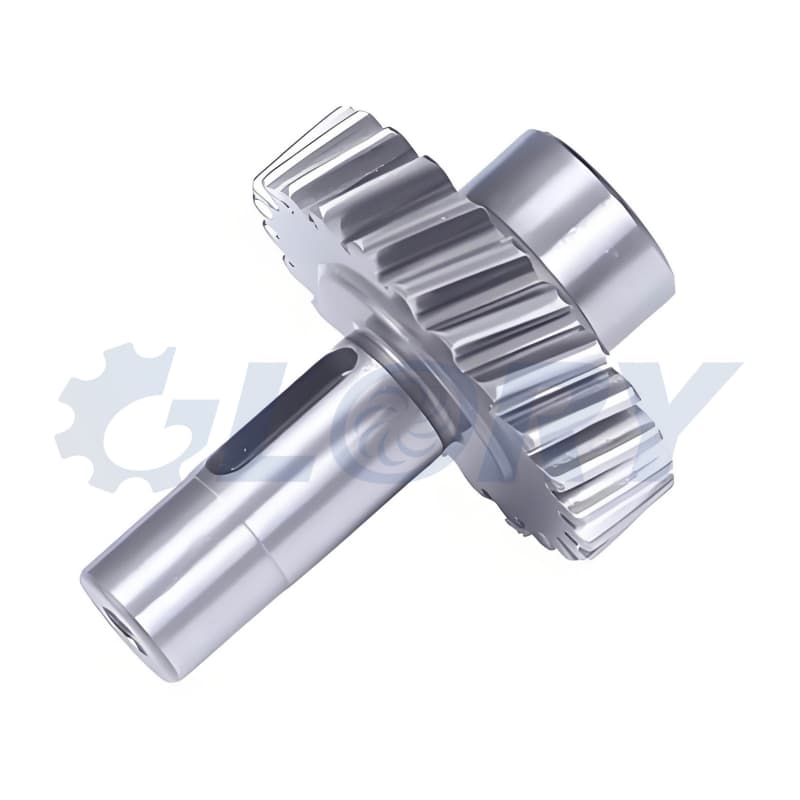
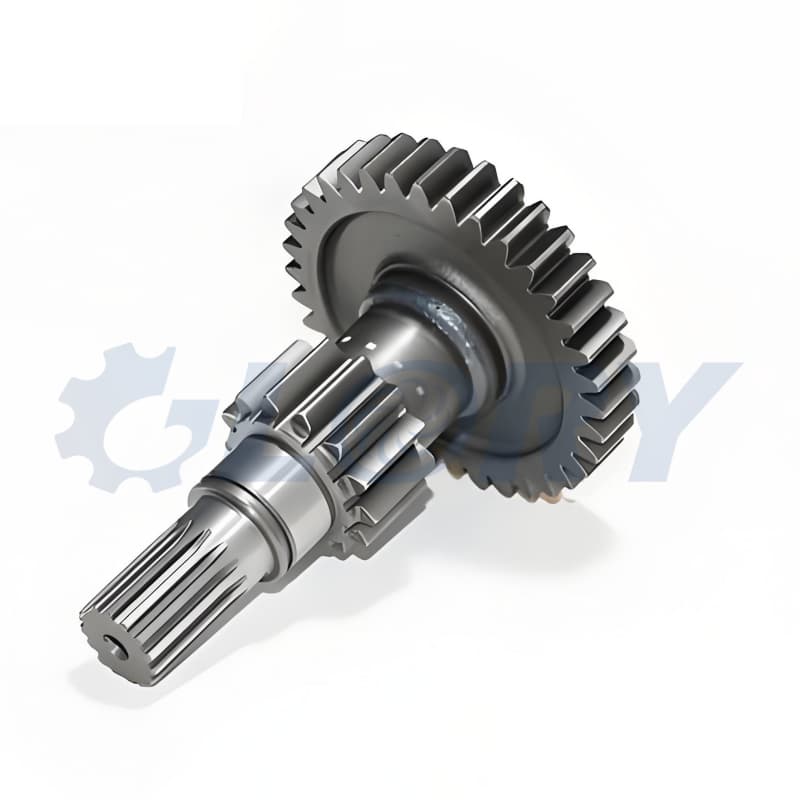
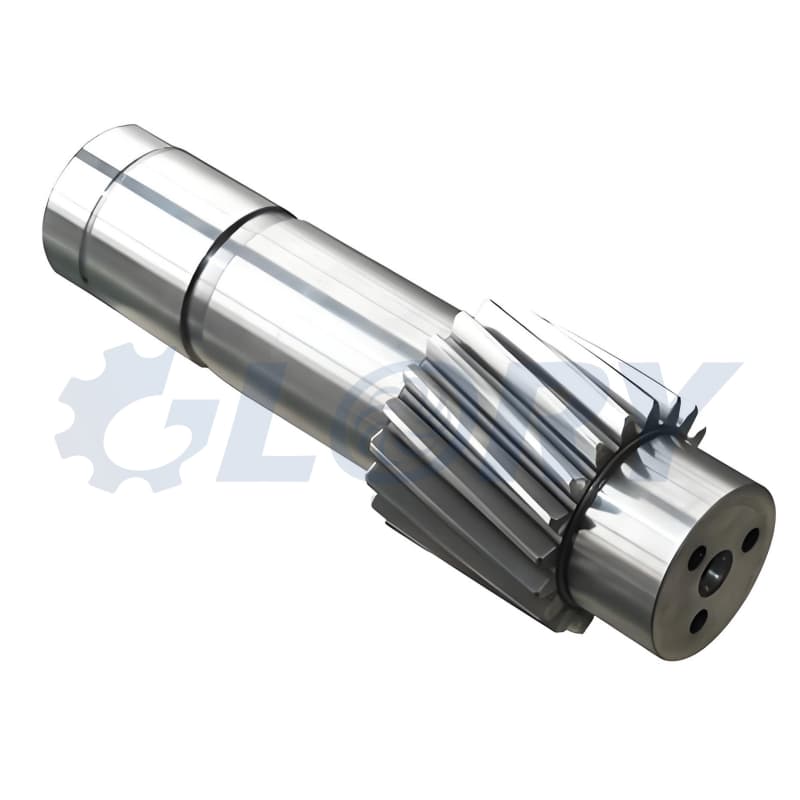
- Transmission, differential, planetary, spur, helical and bevel gears and pinions
- Spline shafts, input and output shafts, axle pinions and worm-type drive components
- Camshafts, cam followers and indexed cam bodies
- King pins, piston pins, pivot pins, track pins, bucket pins and chain pins
- Bushings, wear sleeves, spacers, collars and bearing races
- Universal-joint crosses, clutch hubs, couplings and sprockets
- Chuck jaws, collets, tool holders and gripping components
- Reducer and gearbox internals for automation, robotics and industrial drives
- Actuator parts, pump and valve components, and high-torque hand-tool internals
These parts appear across automotive and drivetrain systems, agricultural and construction machinery, industrial gear reducers, energy and drilling equipment, marine propulsion, automation and robotics, and general precision engineering. If your component combines sliding or rolling contact on its surface with shock or cyclic load underneath, 8620 is very likely a sound material choice.
8620 vs 4140: A Quick Selection Guide
Designers sometimes weigh 8620 against 4140 because both are common, affordable low-alloy steels. They solve different problems, and the table below summarizes where each one belongs.
| Comparison Point | 8620 | 4140 |
|---|---|---|
| Carbon level | Low, about 0.20% | Medium, about 0.40% |
| Hardening route | Case hardening by carburizing | Through hardening by quench and temper |
| Finished profile | Hard 58–63 HRC surface, tough 28–40 HRC core | Uniform hardness and strength through the section, commonly around 50–55 HRC when hardened |
| Core impact toughness | Higher; absorbs shock well | Moderate to high, but less ductile |
| Machinability (soft state) | Better, roughly 65% rating | Slightly lower, around 57% rating |
| Weldability | Good | More demanding; preheat and post-heat often required |
| Best fit | Gears, pins, camshafts and parts needing wear resistance plus impact toughness | Shafts, axles, bolts, rods and structural parts needing high torque and load capacity throughout |
As a rule of thumb, choose 8620 when the working surface wears and the part also sees shock; choose 4140 when the entire cross-section must carry high continuous load. Our engineering team is happy to review a drawing and recommend which route gives the better balance of performance and finished cost.
Finishes and Secondary Operations for 8620 Parts
Because 8620 has no meaningful atmospheric corrosion resistance, a protective finish is part of most programs. We coordinate and apply the options the application calls for:
- Oil or corrosion-inhibitor film for internal gearbox parts that run in lubrication
- Black oxide for a thin, dimension-neutral cosmetic finish with light protection
- Phosphate conversion (parkerizing), often as a base for paint or for running-in wear behavior
- Zinc, zinc-nickel or nickel plating where a more durable barrier is required, with attention to hydrogen-bake practice on high-hardness conditions
- Powder coating or wet paint on non-functional external surfaces and housings
- Grinding, honing and lapping on journals, bores, races and teeth for final precision after heat treatment
- Shot peening to introduce compressive surface stress and extend gear-tooth fatigue life
- Vapor-corrosion-inhibitor packaging and controlled export packing for overseas shipment
Why Source CNC Machined 8620 Steel in China From Our Workshop
Material knowledge is only half of a good 8620 program; the other half is disciplined execution. Customers choose our workshop for a set of concrete reasons:
- A complete process chain under one roof — turning, three-, four- and five-axis milling, drilling and tapping, plus coordinated gear cutting, grinding, heat treatment and finishing — so a single supplier owns the finished part.
- Genuine familiarity with 8620 and its equivalents (20CrNiMo, 21NiCrMo2 / 1.6523, SNCM220, 805M20), including heat-treatment distortion compensation and the correct soft-state-to-hard-state machining sequence.
- Flexible volumes, from a single prototype to repeat high-volume production, without changing the datum scheme or the part’s interchangeability.
- Engineering review before cutting: we flag thin walls, inaccessible features, unrealistic radii, hardenability concerns and tolerance stacks early, when changes are still cheap.
- Dimensional inspection against the drawing, with measured reports available for critical dimensions and first-article builds, so overseas buyers can approve parts remotely with confidence.
- Stable, export-experienced communication in English, with clear lead times, milestone updates and packaging built for long-distance freight.
For purchasing teams and design engineers comparing suppliers of CNC machined 8620 steel in China, the practical difference is usually not who owns a machine — it is who understands that an 8620 gear is a heat-treatment project as much as a machining project, and plans every operation in the correct order.
How to Request a Quote
Send us your 2D drawing (PDF or DWG) and a 3D model (STEP, IGES or X_T), together with the material designation — 8620, 8620H, 20CrNiMo, 21NiCrMo2 / 1.6523 or SNCM220 are all familiar to us — the required quantity, the target case depth and surface hardness, the surface-finish and coating requirements, and any critical or tight-tolerance dimensions.
We will come back with a manufacturability review, a clear unit price and tooling assessment, a realistic lead time and a recommended process route, including how we plan the heat-treatment stage. Whether you need one machined 8620 prototype to validate a design or a steady production flow of finished transmission components, our team is ready to machine 8620 to your exact specification and keep quality repeatable batch after batch.
Contact us today with your drawings and discover how straightforward sourcing CNC machined 8620 steel in China can be when the workshop truly understands the material.
Frequently Asked Questions
Can 8620 be hardened without carburizing?
Not to a high hardness. With only about 0.20% carbon, plain quench-and-temper hardening reaches roughly 33 HRC at most. The high 58–63 HRC surface that 8620 is known for requires carburizing first to add carbon to the case, followed by quenching and tempering.
What is the difference between 8620 and 8620H?
Standard 8620 is ordered mainly to chemical composition, while 8620H is produced to a defined hardenability band. The “H” version responds more predictably and uniformly during heat treatment, which makes it preferable for high-precision, high-volume gear and pin work where distortion must stay tightly controlled.
Which national grade should appear on our drawing?
You can specify the designation used in your own market — AISI/SAE 8620, JIS SNCM220, EN/DIN 21NiCrMo2 or 1.6523, BS 805M20, or GB/T 20CrNiMo. We recognize the full family and will confirm chemistry, supply condition and hardenability expectations before production. When in doubt, specify AISI 8620 or 8620H and note the required case depth and hardness.
What tolerances and finishes are realistic on machined 8620?
In the soft state, standard CNC turning and milling comfortably achieve general precision tolerances and fine machined surfaces; tighter requirements are met by finishing operations after heat treatment, when grinding and honing bring bores, journals and races to their final dimensions and remove quenching distortion. Tell us the critical dimensions and we will build the correct sequence to hold them.
Do you support both prototypes and ongoing production?
Yes. We machine single prototypes and first articles, pilot batches and full high-volume releases of CNC machined 8620 steel in China, keeping the process and fixturing consistent as quantities grow so that every batch remains interchangeable with the first approved part.
 We provide custom machined parts, 5-axis linkage CNC machining, and the design, production, and assembly of machinery and equipment.