
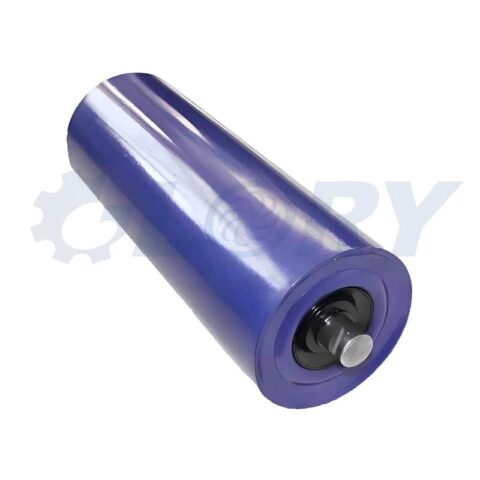
Custom Nylon Carrier Rollers | CNC-Machined MC Nylon Conveyor Idlers
Precision nylon carrier rollers CNC machined from MC cast and oil-filled nylon — troughing, flat, impact, return and training idlers with shafts, bearings and seals. Drawings or samples; single pieces & small batches
Custom Nylon Carrier Rollers | CNC-Machined MC Nylon Conveyor Idlers from Drawings or Samples
On belt conveyors and all kinds of roller conveyors, the most numerous components — and the ones that most affect running resistance and belt life — are the carrier rollers (carrying idlers, conveyor rollers). They support the belt and the material on it, and over 70% of a belt conveyor’s running resistance comes from its idlers. Whether rollers turn freely, have low radial runout, and resist wear directly determines belt life, energy consumption, and maintenance workload.
Beyond traditional steel idlers, more and more wet, corrosive, noise-sensitive, and belt-protective applications are turning to the nylon carrier roller (nylon idler), commonly made from MC cast nylon or oil-filled nylon. We are a specialized CNC machining manufacturer focused on non-standard, custom-engineered plastic components. We routinely machine nylon carrier rollers, conveyor rollers, guide rollers, and matching bearing housings and end caps. We work from drawings or samples, accept single pieces and small batches, require no tooling or mold, and offer fast lead times.
1. What Is a Nylon Carrier Roller?
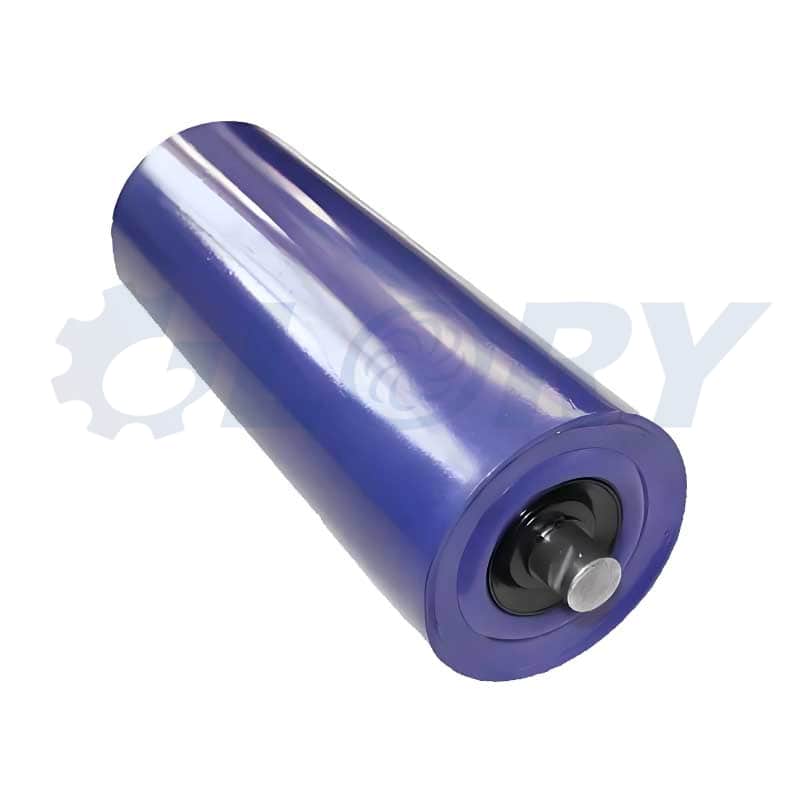
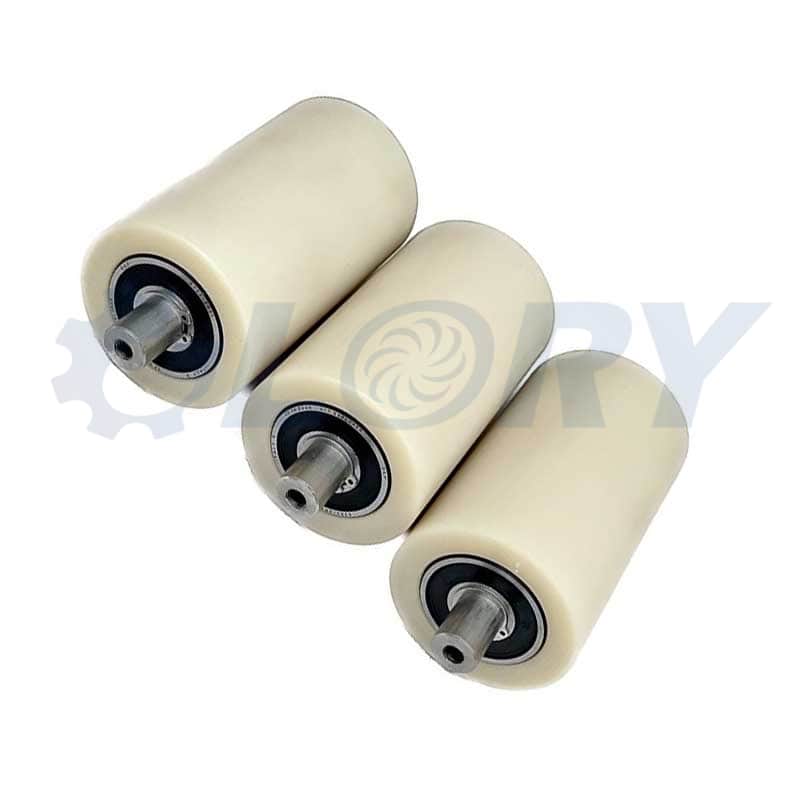
A carrier roller generally consists of a roller body (tube), a shaft, bearings, bearing housings, a sealing system, and end caps. A nylon carrier roller uses nylon (polyamide, PA) tube, rod, or cast stock: CNC turning machines the outer diameter, bearing seats at both ends, and seal grooves, after which the shaft, bearings, and seals are assembled.
Common nylon materials include:
- MC cast nylon — high crystallinity, wear resistant, low internal stress, available in large diameters and lengths; the main material for roller bodies;
- Oil-filled nylon — better self-lubrication and lower friction for continuously running points where lubrication is impractical;
- PA6 / PA66 — tough and wear resistant for general-purpose conveyor rollers;
- Glass-filled nylon — higher rigidity and load capacity for heavy-duty rollers and bearing housings;
- Food-grade nylon — for grain and food conveying.
2. Why Is Nylon a Popular Material for Carrier Rollers?
- Extremely wear resistant — no surface grooving. MC nylon’s wear resistance is roughly 7–10 times that of bronze and 4–5 times that of ordinary steel. When conveying abrasive materials such as ore, coke, gravel, or grain, the roller surface stays smooth over long service.
- Low friction and self-lubricating — protects the belt. With a friction coefficient as low as about 0.2, the roller produces little wear on the belt and extends belt service life. Even if a roller stops turning, the smooth nylon surface will not wear through the belt the way a steel roller quickly does.
- No oiling and no seizing in harsh conditions. Nylon is self-lubricating, and together with sealed bearings it resists seizing in dusty and muddy environments, reducing “dead rollers” and the belt damage they cause.
- Lightweight and energy saving. With a density of only about 1.1–1.2 g/cm³ — roughly one sixth that of steel — each roller is significantly lighter, easy to carry and install, and has low rotational inertia, making conveyor start-up and operation more energy efficient.
- Impact resistant and damping. Tough nylon absorbs the impact of falling material and running vibration; impact idlers at the loading section reduce shock damage to the belt.
- Very quiet operation. Nylon idlers run smoothly with noticeably lower noise than steel rollers — several decibels less — improving workshop and plant environments.
- Corrosion resistant and rust-free. Nylon resists weak acids, weak alkalis, organic solvents, oils, and seawater; it does not rust or corrode in salt works, chemical plants, wastewater treatment, and wet outdoor environments, and it ages slowly.
- Non-sticking and non-magnetic. The smooth surface resists material buildup; nylon is non-magnetic for applications where magnetic interference must be avoided; special formulations can also provide anti-static and flame-retardant rollers.
3. Nylon vs. Other Idler Materials
| Material | Strengths | Limitations | Typical Application |
|---|---|---|---|
| MC cast nylon | Wear resistant, tough, self-lubricating, corrosion resistant, quiet, available in large sizes | Ultimate load rating slightly below steel | Wet/corrosive, noise-sensitive, belt-protective conveyors |
| Oil-filled nylon | Lower friction, no oiling, long sliding life | Slightly lower load rating than plain nylon | Continuous duty, dusty, hard-to-maintain points |
| UHMWPE | Extremely wear resistant, self-lubricating, zero water absorption, non-sticking | Lower rigidity and load capacity than nylon | High-wear, sticky-material, light-load conveying |
| POM (Acetal/Delrin) | Dimensionally stable, precise, low water absorption | Less tough, impact resistant, and load capable than nylon | Small precision rollers, wet environments |
| Steel idlers | High load capacity, heat resistant, mature design | Heavy, rust prone, noisy, wear the belt when seized | Very long, heavy-duty, high-temperature dry sections |
| PVC | Low cost, corrosion resistant | Brittle, low strength, ages | Light-load, ambient-temperature, low-cost applications |
| Rubber-lagged rollers | Cushioning, anti-slip, good traction | Rubber ages and can peel off | Loading/impact points and friction drive |
Selection rule of thumb: for corrosive/wet, noise-sensitive applications emphasizing belt protection and minimal maintenance, choose nylon first; for sticky materials choose UHMWPE; for very long heavy-duty dry sections compare steel idlers or reinforced nylon. If unsure, tell us the conveyed material, belt width, roller diameter, speed, and how previous rollers failed — our engineers will recommend a material.
4. What Nylon Carrier Rollers Can We Customize?
With CNC turning, mill-turn equipment, and machining centers, we produce from drawings, samples, or reverse measurement:
- Troughing idlers — three-roller sets on the carrying side with 35°/45° trough angles to support bulk materials;
- Flat / parallel idlers — for horizontal conveying and carrying/return sections;
- Impact idlers — cushioning falling material at the loading section to protect the belt;
- Return idlers and V-return idlers — for the conveyor’s lower run;
- Training / self-aligning idlers — preventing and correcting belt mistracking;
- Comb idlers, spiral idlers, and transition idlers — anti-sticking, cleaning, and transition sections;
- Logistics/packaging conveyor rollers — individual drive rollers, driven rollers, guide rollers, and tension rollers, optionally with sprockets, timing pulleys, or keyways;
- Matching parts — nylon bearing housings, end caps, seal sleeves, spacing sleeves, and bushings; shafts, bearings, and labyrinth seals can also be supplied.
Roller diameter, length, shaft diameter, bearing type, sealing arrangement, and roller surface (smooth/grooved/lagged) can all be customized to the equipment.
5. A Small Loss of Roller Precision Means Mistracking and Noise
A roller is a rotating part, and its precision directly determines how freely it turns and how long it lasts. We focus on controlling:
- Roller-body cylindricity and radial runout — low runout keeps the belt running smoothly without periodic vibration, noise, or mistracking;
- Concentricity of the bearing seats at both ends — this is critical: concentric seats keep bearings from binding for light rotation and long life;
- Bearing-seat dimensional accuracy — a stable transition fit with the bearing, with no outer-ring creep and no crushed bearings;
- Seal-groove and end-cap fits — protecting bearings from dust and moisture;
- Roller-surface roughness — a smooth surface reduces friction and material buildup; grooving and lagging patterns can be added where needed;
- Nylon process control — nylon conducts heat poorly, expands when heated, and absorbs water. We use sharp tools, air or mist cooling, separate roughing and finishing, and inspect dimensions after temperatures stabilize; long rollers use low-stress MC cast stock to reduce bending deformation.
6. Why CNC Machining Instead of Injection Molding?
- No tooling required — single pieces and small batches are viable, saving mold costs for equipment supply, modification, and repair spares;
- Better for large diameters and long rollers — MC cast tube/rod stock is large and low in stress and only needs finish machining, whereas molded long rollers easily deform with uneven wall thickness;
- Fast lead times for roller replacement during downtime and new-line prototyping;
- Flexible with non-standard structures — bearing seats, seal grooves, keyways, sprockets, and lagging patterns can be combined freely, and dimensional changes only require a program edit;
- Good batch consistency — CNC machining unifies roller diameters, bearing seats, and runout for strong interchangeability.
Injection molding suits a single specification in very large volumes of small standard rollers. But where idlers vary with belt width, roller diameter, and load, with diverse specifications and urgent timing, custom CNC machining has clear advantages.
7. Parameters to Confirm When Ordering
- Roller outer diameter and roller length (effective length / overall length);
- Belt width, conveyed material, and throughput;
- Shaft diameter and length, and shaft-end type (flats / keyway / thread);
- Bearing type and sealing arrangement (labyrinth / lip seal);
- Idler type (troughing / flat / impact / return / training) and trough angle;
- Surface requirements (smooth / grooved / lagged), operating environment, and temperature;
- Drawings (STEP/CAD/PDF accepted) or a worn sample part.
If you only have a worn part and no drawing, we can measure the sample and reverse-engineer it.
8. Our Ordering Process
- Send information — drawing, sample, or conveyor parameters;
- Selection & quotation — confirm the nylon grade, bearings, and quantity for a prompt quote;
- Machining — cutting → CNC turning of roller body/bearing seats → groove milling → shaft and bearing assembly;
- QC & delivery — inspect radial runout, bearing-seat concentricity, dimensions, and freedom of rotation;
- After-sales support — assist with adjustment if mistracking, noise, or fit issues arise during installation.
9. Industries and Equipment Served
Nylon carrier rollers and matching parts are widely used in:
- Bulk material handling in mining, ports, cement, steel, power plants, and coking;
- Grain, food, and salt conveying (food-grade nylon available);
- Corrosive, wet environments in chemicals and wastewater treatment;
- Packaging, logistics, warehousing, and sorting roller conveyors;
- Rubber recycling, light industry, and all kinds of non-standard conveying equipment.
About Us
 We provide custom machined parts, 5-axis linkage CNC machining, and the design, production, and assembly of machinery and equipment.