
As a leading manufacturing hub for precision metal components, China has established a robust ecosystem for producing OEM CNC machined H13 alloy steel in China, serving global clients across tooling, automotive, aerospace, and general industrial sectors. H13, classified as a chromium-molybdenum-vanadium hot-work tool steel, stands as one of the most widely specified materials for high-temperature tooling applications due to its balanced combination of hardness, toughness, and thermal fatigue resistance. Chinese machining facilities leverage advanced CNC equipment, skilled engineering teams, and cost-effective production workflows to deliver custom H13 steel components with tight dimensional tolerances, consistent material properties, and scalable output volumes. Whether clients require single prototype parts for product validation or high-volume production runs for assembly lines, CNC machined H13 alloy steel in China provides a reliable solution that meets international quality benchmarks at competitive price points.
International Standard Equivalents of H13 Alloy Steel
H13 alloy steel is recognized under multiple designation systems worldwide, each corresponding to nearly identical chemical composition and mechanical performance within the same hot-work tool steel family. Understanding these cross-references is essential for global procurement and engineering specification alignment.
Under the American ASTM/SAE standard system, the material is officially designated as H13, cataloged under UNS number T20813. In Europe, the equivalent material number per DIN standard is 1.2344, also referenced as X40CrMoV5-1 under EN ISO 4957 nomenclature. The Japanese JIS standard lists the corresponding grade as SKD61, which shares nearly identical alloying element ranges with its American and European counterparts. In China, the national GB/T 1299 standard designates the domestic equivalent as 4Cr5MoSiV1, which is the primary raw material grade used for producing CNC machined H13 alloy steel in China. Additional regional equivalents include BH13 under British BS 4659 standard and Z40CDV5 under French AFNOR NFA35-590 specification.
While these grades are generally considered interchangeable for most tooling applications, subtle differences in published chemical ranges may exist for specific elements such as carbon, molybdenum, and vanadium. Professional Chinese machining partners work with raw material suppliers that maintain tight composition control, ensuring that CNC machined H13 alloy steel in China delivers performance consistent with any of the international grade designations required by client specifications.
Core Properties and Performance Characteristics
H13 alloy steel derives its exceptional performance from a carefully balanced alloying system that creates a unique combination of mechanical and thermal properties ideal for demanding manufacturing environments.
The material exhibits excellent hardenability through air, oil, or water quenching, achieving typical hardness levels between 42 and 54 HRC after proper heat treatment, with exact values adjustable through tempering temperature selection. This hardness retention persists even at elevated operating temperatures up to approximately 600°C, a property known as red hardness, which distinguishes hot-work steels from cold-work alternatives. Chromium content ranging from 4.75 to 5.50 percent contributes significantly to both hardenability and oxidation resistance at high temperatures, forming a protective oxide layer that resists surface degradation during thermal cycling.
Molybdenum and vanadium additions further enhance the material’s performance profile. Molybdenum improves secondary hardening during tempering and increases creep resistance at elevated temperatures, while vanadium forms stable carbides that boost wear resistance and maintain grain structure refinement. The resulting material delivers tensile strength in the range of 1200 to 1550 MPa and yield strength between 1000 and 1300 MPa in fully hardened condition, paired with impact toughness values of 15 to 35 J/cm² that prevent catastrophic failure under mechanical and thermal shock loads.
In terms of machinability, annealed H13 steel typically measures 200 to 230 HBW, providing a workable hardness for conventional and CNC machining operations before final hardening. This characteristic allows efficient material removal during roughing and semi-finishing operations, making CNC machined H13 alloy steel in China both technically feasible and economically practical for complex part geometries.
CNC Machining Capabilities for H13 Alloy Steel
Producing precision CNC machined H13 alloy steel in China requires specialized equipment, tooling, and process knowledge tailored to the material’s unique characteristics. Chinese manufacturing facilities employ a full spectrum of CNC machining technologies to handle H13 steel across all production stages.
5-axis CNC milling centers represent the primary capability for producing complex three-dimensional geometries such as mold cavities, die profiles, and contoured tool surfaces. These machines enable simultaneous multi-axis cutting that reduces setup times, improves dimensional accuracy across compound angles, and achieves superior surface finish on deep cavity features commonly found in die casting tooling. For rotational components, CNC turning centers with live tooling capabilities produce shafts, sleeves, mandrels, and cylindrical die components with concentricity tolerances as tight as 0.005 mm.
Additional secondary operations complement primary milling and turning processes. Gun drilling creates precision cooling channels within mold blocks and die components, maintaining straightness and surface finish over deep bore lengths critical for effective thermal management. Wire EDM and sinker EDM processes handle intricate internal features, sharp corners, and complex profiles that would be difficult or impossible to achieve with conventional cutting tools, particularly on fully hardened H13 steel. Surface finishing operations include precision grinding, lapping, and polishing that achieve surface roughness values down to Ra 0.4 μm or better for high-gloss mold applications.
Process optimization is a key advantage of CNC machined H13 alloy steel in China. Machining parameters including cutting speeds, feed rates, and tool selection are carefully calibrated based on material condition – whether annealed for roughing or fully hardened for finish machining. Coated carbide tools, ceramic inserts, and CBN cutting tools are selected appropriately to maximize tool life and machining efficiency while maintaining tight tolerance control. Many facilities also implement in-process quality inspection using coordinate measuring machines and optical comparators to verify dimensional accuracy at each production stage.
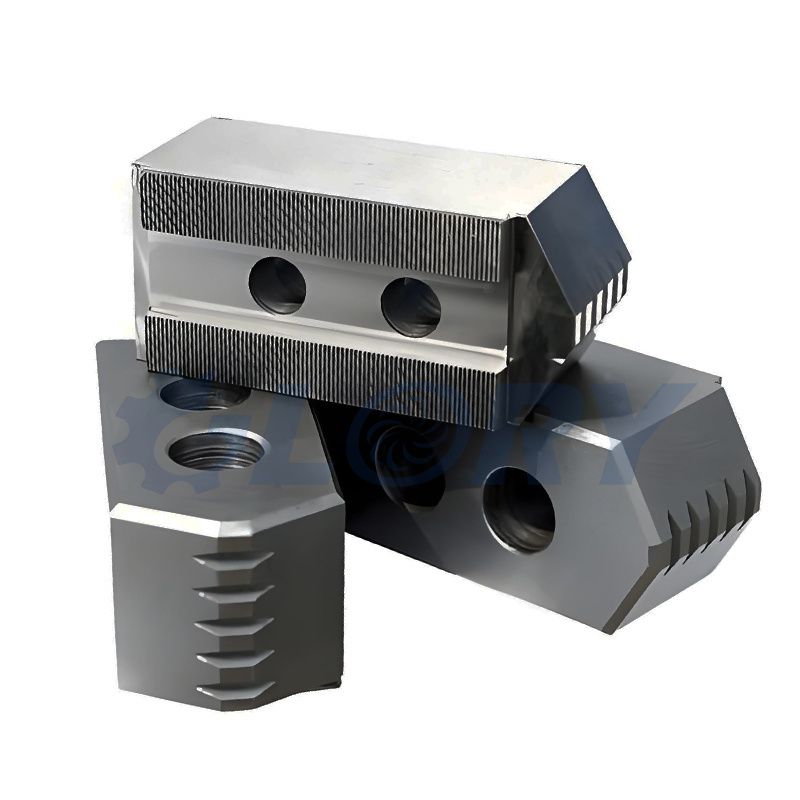
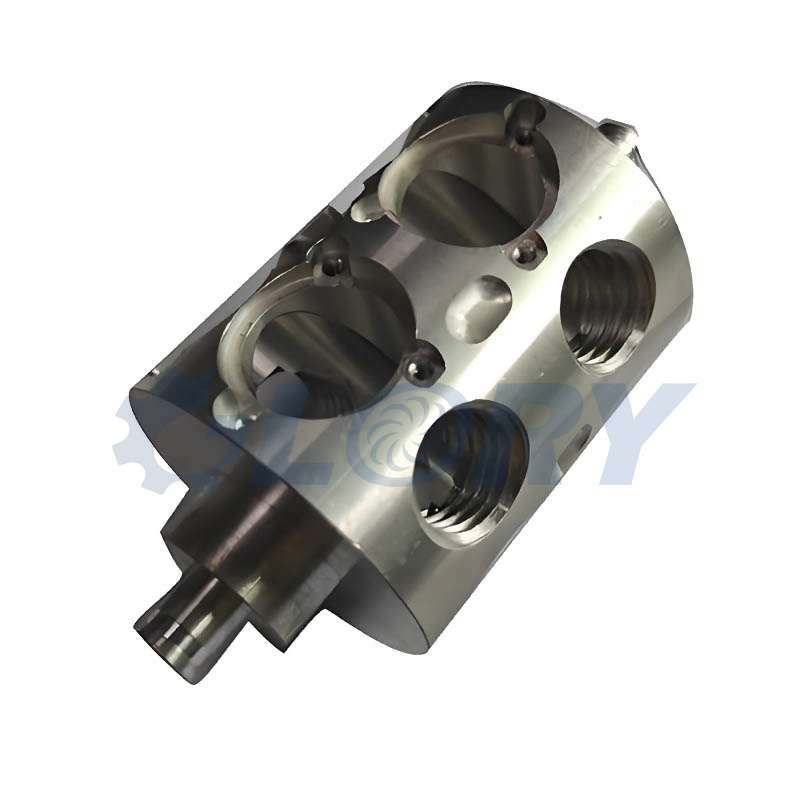
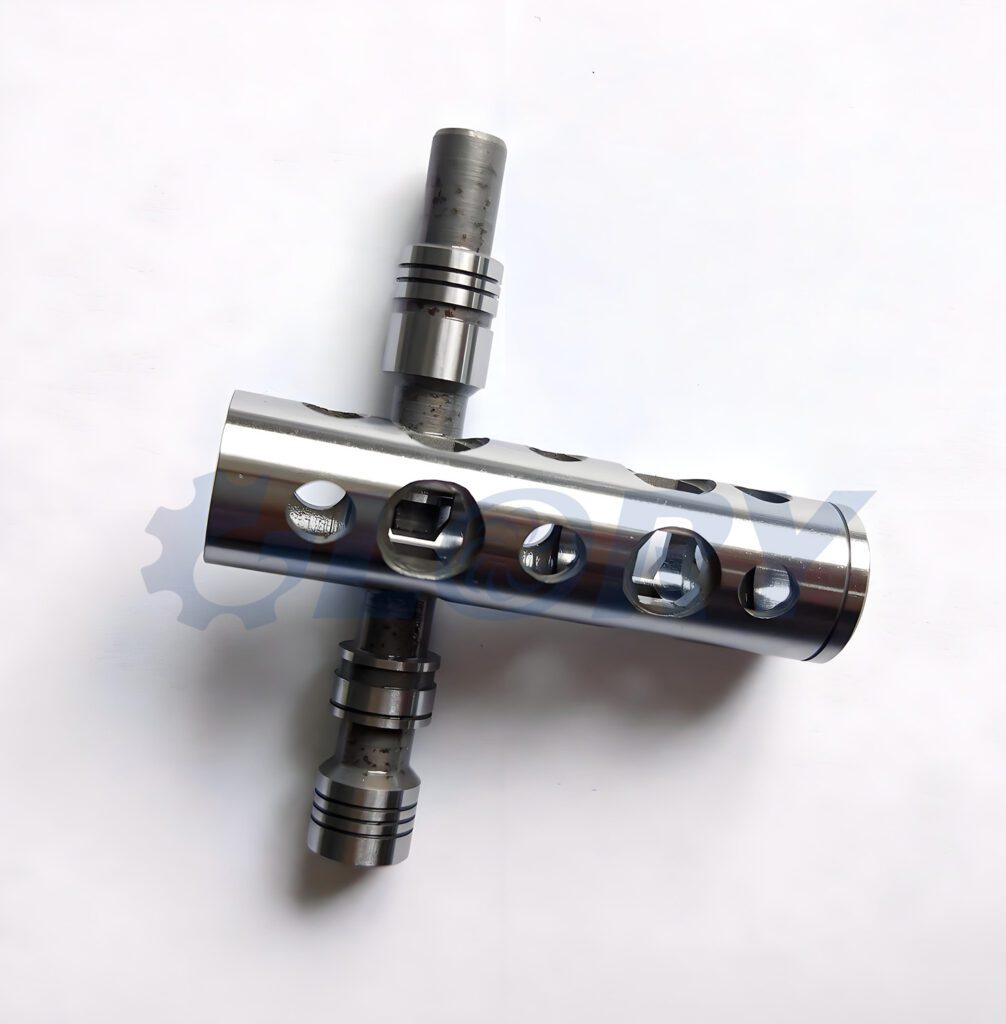
Common Machined Parts and Industry Applications
The versatility of H13 alloy steel leads to its use across a wide range of industrial components, with CNC machined H13 alloy steel in China serving numerous sectors that demand high performance under elevated temperature and mechanical stress conditions.
The die casting industry represents the largest application area for H13 steel components. Common parts include aluminum and zinc die casting dies, mold cores, cavity inserts, ejector pins, core pins, and slide mechanisms. These components experience repeated thermal cycling from molten metal injection and cooling, making H13’s thermal fatigue cracking resistance indispensable for extended service life. Automotive die casting parts such as engine block dies, transmission housing dies, and structural component molds are among the highest-volume applications for CNC machined H13 alloy steel in China.
Hot forging and extrusion industries also rely heavily on H13 steel tooling. Hot forging dies, forging punches, trim dies, and extrusion mandrels all require the combination of high-temperature strength and impact toughness that H13 provides. Aluminum extrusion dies, in particular, benefit from the material’s ability to maintain hardness and resist wear while shaping heated aluminum billets into complex profiles for construction, automotive, and consumer product applications.
Plastic injection molding represents another significant application segment, especially for high-performance engineering resins. CNC machined H13 alloy steel in China produces injection mold cores, cavities, hot runner components, and mold inserts for processing glass-filled plastics, high-temperature polymers, and abrasive resin formulations that would rapidly wear conventional mold steels like P20. Medical device components, automotive interior parts, and electronic housing molds frequently specify H13 steel for long production runs with challenging materials.
Additional industry applications include aerospace component tooling, metal stamping dies, form rolling tools, shear blades, and industrial knife blades. The energy sector uses H13 steel for valve components, pump parts, and drilling tool elements that operate under high temperature and pressure conditions. Even the consumer goods industry benefits from CNC machined H13 alloy steel in China for production tooling used to manufacture everything from household appliances to sporting goods equipment.
Production Scalability: From Single Pieces to High Volume
One of the defining strengths of CNC machined H13 alloy steel in China is the ability to scale production seamlessly from one-off prototype parts to full high-volume manufacturing runs, adapting to client needs at every product lifecycle stage.
For prototype and low-volume requirements, typically ranging from one to fifty pieces, Chinese machining shops offer fast turnaround production using flexible CNC workcells. Single-piece H13 steel components are commonly produced for product development testing, tooling trials, replacement parts, and custom equipment builds. These low-volume orders benefit from streamlined setup procedures, direct machining from solid bar stock or forged blanks, and rapid programming that minimizes lead times. Even for single complex components with multiple features and tight tolerances, CNC machined H13 alloy steel in China can typically be delivered within two to four weeks depending on part complexity and heat treatment requirements.
Medium volume production, generally from fifty to several hundred pieces, leverages optimized machining fixtures, standardized tooling setups, and batch processing techniques to reduce per-unit costs while maintaining consistent quality. This production range is typical for secondary tooling sets, spare part inventories, and medium-run production tooling for niche product lines. Many Chinese manufacturers implement cellular manufacturing configurations for these volumes, grouping complementary machines and operations to reduce material handling and improve production flow efficiency.
High-volume production, encompassing thousands to tens of thousands of pieces annually, utilizes dedicated production lines, automated machining cells, and advanced process controls to achieve maximum efficiency and repeatability. For high-volume CNC machined H13 alloy steel in China, manufacturers may employ palletized CNC systems, robotic part loading and unloading, and in-line automated inspection to minimize labor costs and maintain round-the-clock production. Batch heat treatment operations, coordinated material sourcing, and optimized cutting strategies further drive down per-unit pricing for large quantity orders, making Chinese H13 steel components highly competitive in global supply chains.
Regardless of production volume, all orders receive consistent attention to quality control. Material traceability, first article inspection reports, and dimensional verification are standard practice across production scales, ensuring that every batch of CNC machined H13 alloy steel in China meets the same precision and performance standards, whether the order is for one prototype or ten thousand production parts.
Advantages of Sourcing CNC Machined H13 Alloy Steel from China
Choosing Chinese manufacturing partners for CNC machined H13 alloy steel in China offers multiple strategic advantages for global industrial clients beyond competitive pricing.
First, China’s mature tool steel supply chain ensures ready access to high-quality H13 raw material in various forms including round bars, flat bars, forged blocks, and plate materials. Domestic steel producers manufacture 4Cr5MoSiV1 (the Chinese equivalent of H13) in large volumes with consistent quality, while imported material from international mills is also readily available for clients requiring specific mill certifications or origin requirements. This material availability translates to shorter lead times and lower material costs compared to many Western manufacturing locations.
Second, the depth of machining infrastructure in China means that virtually any CNC process required for H13 steel components is available under one roof or through closely integrated supplier networks. From initial sawing and rough machining through precision finishing, heat treatment, and surface coating, clients can consolidate their entire production process with a single source, reducing logistics complexity and management overhead. Many Chinese machining companies also offer complementary services such as design for manufacturability feedback, material selection guidance, and prototype testing support.
Third, skilled labor availability and technical expertise continue to improve across China’s precision machining sector. Engineers and machinists experienced in working with H13 tool steel understand the material’s specific machining characteristics, heat treatment requirements, and quality critical points. This expertise directly translates to fewer production defects, better surface finish, more accurate dimensional control, and longer tool life for the end-use components produced as CNC machined H13 alloy steel in China.
Finally, flexible production scheduling and responsive customer support make Chinese suppliers well-suited for dynamic market demands. Many facilities operate multiple production shifts and can expedite orders to meet tight project deadlines, while maintaining clear communication channels with international clients through English-speaking sales and engineering support teams. This combination of technical capability, production capacity, and customer service makes CNC machined H13 alloy steel in China a preferred choice for companies worldwide seeking reliable, cost-effective precision metal components.
For businesses seeking a dependable manufacturing partner for custom H13 steel components, the Chinese machining industry delivers comprehensive solutions that balance quality, performance, and value across every production volume and application requirement.
 We provide custom machined parts, 5-axis linkage CNC machining, and the design, production, and assembly of machinery and equipment.