
A practical engineering guide to 4130 chrome-moly parts — from material chemistry and heat treatment to machining workflow, single-piece prototypes, mass production, and the international grades of its case-hardening cousin 8620.
Buyers around the world choose CNC machined 4130 steel in China when they need strong, weldable, fatigue-resistant components at a cost that makes sense for production. 4130 — often called chrome-moly — is a low-alloy chromium-molybdenum steel that sits between plain carbon steel and the higher-alloy engineering steels. It machines easily in the annealed state, hardens predictably by quench-and-temper, and welds far better than most medium-carbon steels. For OEM parts such as brackets, fittings, valve bodies, shafts, adapters, frames and firearm components, it is one of the most balanced choices a designer can specify.
This article explains what 4130 actually is, how it is machined from a single prototype to mass production, which heat treatment and finishing routes are available, and how 8620 — the case-hardening grade customers most often compare with 4130 — is designated under different national standards. If you are sending drawings to China for the first time, this is the background you need to write a clear specification and get accurate quotes.
What Is 4130 Steel?
4130 is the SAE/AISI designation for a chromium-molybdenum alloy steel, listed as UNS G41300 and covered by standards such as ASTM A29/A29M and SAE J404. The “41” in the designation identifies the chromium-molybdenum family, which carries about 1% chromium, and the “30” refers to a nominal carbon content of 0.30%. In practice the carbon range is 0.28–0.33%, which puts it in the medium-carbon class.
Chromium and molybdenum are added for specific reasons. Chromium improves hardenability, strength and resistance to softening at moderate temperatures. Molybdenum improves hardenability further, adds toughness, and reduces the risk of temper embrittlement during heat treatment. Together they give 4130 a much better strength-to-weight ratio than plain carbon steel, good fatigue behaviour, and a predictable response to heat treatment — the combination that made it the default alloy steel for aircraft structures in the 1930s and still makes it a staple of motorsport roll cages, bicycle frames and OEM industrial parts today.
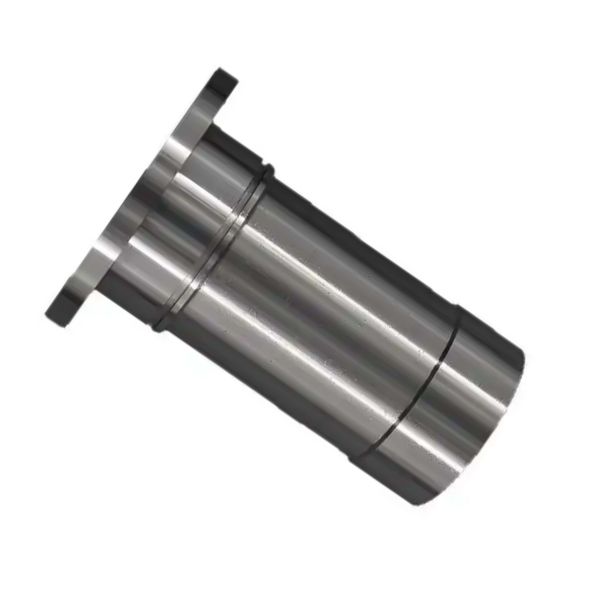
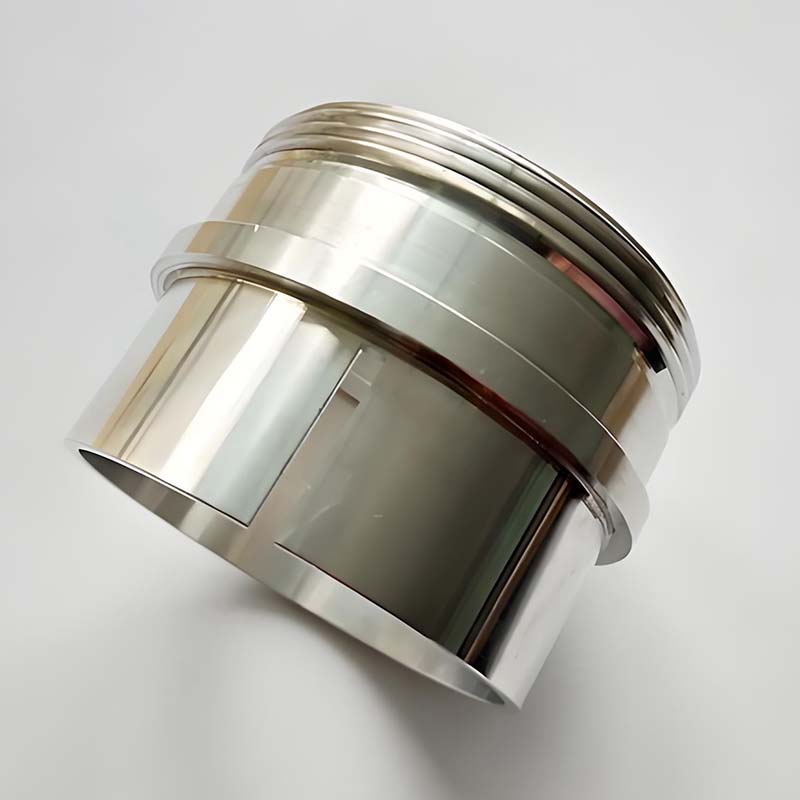
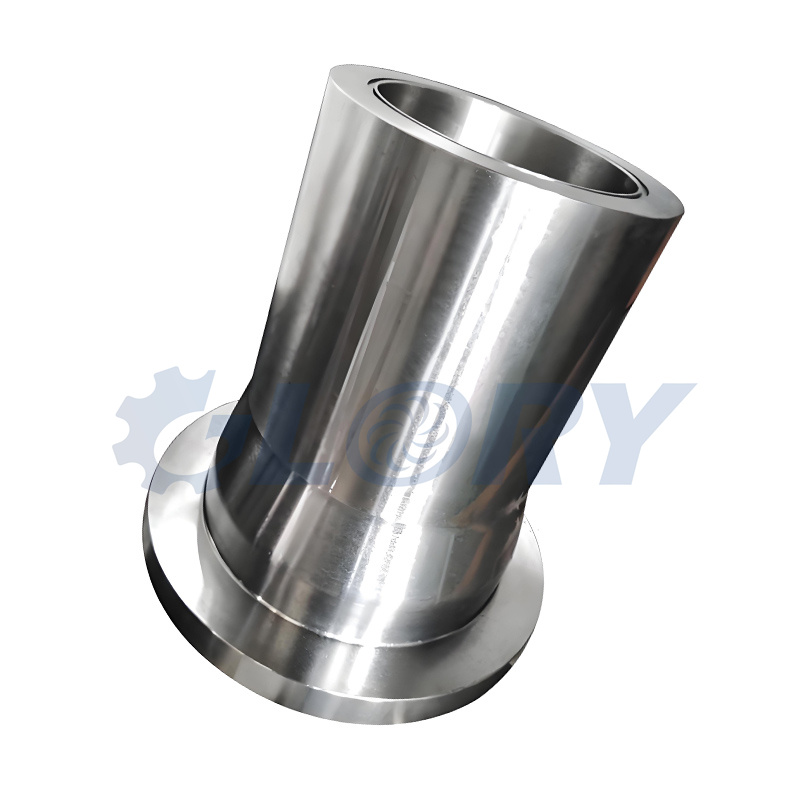
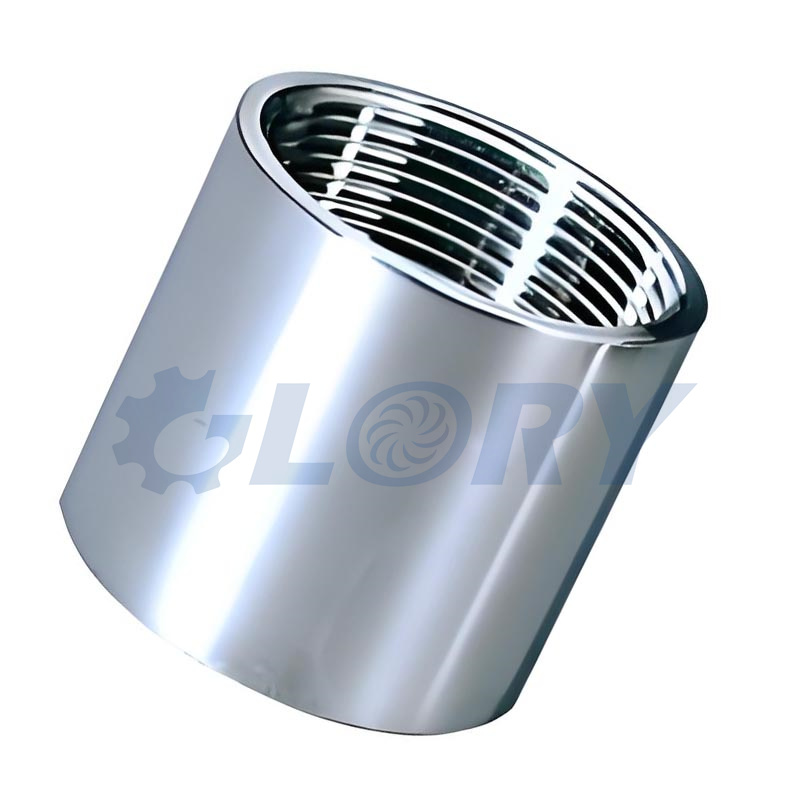
4130 is available in round bar, hex bar, flat bar, plate, tube and forging stock, so nearly any OEM component can be cut from a suitable raw form.
Chemical Composition of AISI 4130
The typical composition of AISI 4130, as specified by ASTM A29/A29M, is:
| Element | Range (wt%) | Role |
|---|---|---|
| Carbon (C) | 0.28 – 0.33 | Core strength and hardenability; the “30” grade |
| Manganese (Mn) | 0.40 – 0.60 | Hardenability, hot workability, surface quality |
| Silicon (Si) | 0.15 – 0.35 | Deoxidation, solid-solution strengthening |
| Chromium (Cr) | 0.80 – 1.10 | Strength, hardenability, tempering resistance |
| Molybdenum (Mo) | 0.15 – 0.25 | Hardenability, toughness, temper resistance |
| Phosphorus (P) | ≤ 0.035 | Impurity, kept low for ductility |
| Sulfur (S) | ≤ 0.040 | Impurity, kept low for ductility and weldability |
| Nickel (Ni) | ≤ 0.30 (residual) | Not an intentional addition in 4130 |
| Copper (Cu) | ≤ 0.30 (residual) | Not an intentional addition in 4130 |
The composition is deliberately balanced: enough carbon to harden, enough chromium and molybdenum to make that hardening reliable in sections up to moderate thickness, and low enough residual elements to keep welding practical.
Mechanical Properties and Heat Treatment States
The mechanical properties of 4130 depend almost entirely on the heat treatment condition. Across the annealed, normalized and quenched-and-tempered states, typical values fall in these ranges:
| Property | Typical range (across conditions) |
|---|---|
| Tensile strength (ultimate) | 530 – 1040 MPa |
| Yield strength (proof) | 440 – 980 MPa |
| Elongation at break | 13 – 26% |
| Brinell hardness | roughly 200 – 300 HBW |
Three conditions matter in everyday OEM work:
- Annealed or normalized bar. This is the state we usually receive and machine. At around 200 HBW it cuts cleanly with carbide tooling, holds tolerances well, and produces good chip control. Machining first, heat treating afterwards, is the standard sequence for most parts.
- Quenched and tempered. Austenitized around 845–870 °C, quenched in oil or polymer, then tempered between roughly 250 °C and 650 °C, 4130 can be brought to almost any hardness in the 28–42 HRC band. A common structural target is 28–32 HRC, which combines strength with enough toughness for load-bearing parts. Higher tempering temperatures trade some hardness for ductility and impact resistance.
- Stress-relieved. Welded assemblies and heavily machined parts are stress-relieved around 450–650 °C before final machining to hold dimensional stability.
Because final properties depend on section size, quenching medium and the exact tempering cycle, we always work to the hardness range written on the drawing rather than assuming a standard value.

International Equivalents of 4130
Customers outside North America often specify the same steel under a local designation. The common equivalents are close but not always identical, so the grade on your drawing is the one we machine:
| Country / Region | Standard | Designation |
|---|---|---|
| USA | ASTM A29 / SAE J404 | 4130 (UNS G41300) |
| China | GB/T 3077 | 30CrMo |
| Germany / EU | DIN EN 10083 | 25CrMo4 (1.7218) |
| Japan | JIS G4105 | SCM430 |
| France | AFNOR | 25CD4 |
| United Kingdom | BS 970 | 708A25 / 708M25 |
| Russia | GOST | 30KhMA (30ХМА) |
One example of the small differences: 25CrMo4 carries 0.22–0.29% carbon against 0.28–0.33% for 4130, while SCM430 runs slightly higher manganese and chromium. Chemically similar, mechanically close, but not a mathematical clone — which is exactly why we confirm the exact standard before quoting.
Why 4130 Is Specified for OEM Parts
Machined 4130 parts appear in almost every engineered product category where weight, strength and reliability matter:
- Aerospace and aircraft: brackets, engine mounts, structural fittings and small landing-gear parts.
- Motorsport and automotive: roll cages, suspension arms, brackets, driveshaft components.
- Firearms: receivers, frames and barrel components.
- Hydraulics and pneumatics: fittings, adapters, valve bodies and manifolds.
- Oil and gas: downhole tooling, subs, housings and connectors.
- General machinery: shafts, couplings, spindles and machine elements.
- Sports equipment: bicycle frames and components.
Designers pick 4130 for four reasons. First, strength-to-weight: it reaches high strength after heat treatment while staying lighter than equivalent carbon-steel sections. Second, weldability: with reasonable preheat and stress relief it produces sound welds, which is rare for medium-carbon steels. Third, fatigue resistance: chrome-moly handles cyclic loading much better than mild steel. Fourth, machinability and cost: it machines readily in the soft state and costs far less than higher-alloy steels such as 4340, while covering the majority of structural applications.
The CNC Machining Workflow for 4130 Parts
When you order CNC machined 4130 steel in China from our shop, every job follows the same disciplined route, whether it is one piece or ten thousand:
- Drawing and specification review. We check material grade, tolerances, threads, hardness and finish before quoting, and flag anything that cannot be made as drawn.
- Design-for-manufacturing feedback. If a feature is expensive to machine or likely to distort in heat treatment, we tell you before you commit, not after.
- Material sourcing. Bar, plate, tube or forging stock is procured to the specified standard and heat, with each batch tracked for traceability.
- Blank preparation. Material is cut to size by sawing or, for larger parts, parted from forging stock or cut from plate.
- CNC machining. Turning, milling, drilling, tapping and thread work are carried out on the correct machine for the geometry — 3-axis, 4-axis or 5-axis as required.
- Heat treatment. Parts are hardened, tempered or stress-relieved to the drawing’s hardness range, with distortion allowances planned in the machining stage.
- Hard machining and grinding. Precision bores, seats and bearing surfaces are finished after heat treatment where tolerances demand it.
- Surface finishing. Plating, coating or other surface treatment is applied per specification.
- Dimensional inspection. Every critical feature is checked against the drawing; results are recorded and sent with the shipment.
- Cleaning, protection and packing. Parts are cleaned, oiled or otherwise protected, then packed for the destination market.
The same program and fixtures used for a prototype can carry straight into production, which removes the most common source of quality drift between sampling and volume orders.
From a Single Piece to Mass Production
We treat quantity as a variable, not a barrier. Because CNC machining is program-driven, the difference between a one-off and a high-volume run is mostly economics — and we structure every step so the transition is smooth.
| Quantity band | Typical approach |
|---|---|
| Prototype, 1 – 5 pcs | Full CNC machining from the final program; you get production-representative parts for fit, function and field testing |
| Small batch, 5 – 50 pcs | Same programs, shared fixtures, efficient setup; ideal for pilot builds and early sales |
| Medium series, 50 – 500 pcs | Optimized toolpaths, batch heat treatment and batch finishing; unit price drops noticeably |
| Large series, 500 – 5,000 pcs | Dedicated fixtures and tooling, multi-part set-ups, cycle-time optimization |
| Mass production, 5,000+ pcs | Fully optimized cells, automatic cycles, forged or cast near-net-shape blanks where they reduce machining cost, and in-process statistical checks to hold consistency |
Cost in CNC machining is dominated by programming, setup, fixtures and tooling on the one hand, and by actual cutting time on the other. At low quantities the fixed costs dominate, so per-piece prices are higher; as quantity rises, those costs are spread over more parts and the per-piece price falls steadily. This is why we never force a large MOQ. If you need two pieces to validate an assembly, you order two. If the same part later goes to 20,000 pieces per year, we run it in batches and manage stock for you.
For mass production we also look beyond the machining itself: near-net-shape forgings reduce material waste and cycle time, batch heat treatment lowers per-part cost, and multi-cavity fixtures let one operator run several parts per cycle. The same engineering discipline that makes one perfect prototype is what keeps ten thousand parts identical.
Machining Capabilities and Typical Tolerances
Our equipment covers the full range of CNC machined 4130 steel in China geometries, from small precision components to larger structural parts:
| Capability | Typical performance |
|---|---|
| CNC turning | OD/ID turning, facing, grooving, threading, boring |
| CNC milling | 3-axis, 4-axis and 5-axis machining of complex geometries |
| Drilling and tapping | Through, blind, stepped and deep holes; standard and special threads |
| Grinding | OD, ID and surface grinding for hardened parts and tight fits |
| Slots, keyways and splines | Wire-cut and milled features for shaft work |
| Standard tolerance | ± 0.05 mm |
| Precision tolerance | ± 0.01 mm where the design requires it |
| Fits | H7/g6, H7/h6 and similar ISO fits on bores and shafts |
| Surface finish | Ra 3.2 µm standard; Ra 0.8 µm milled; Ra 0.4 µm ground |
These are typical workshop capabilities. Final tolerance and finish always depend on the geometry, the material condition and the heat treatment step, and we confirm feasibility during the drawing review.
Heat Treatment Services
Heat treatment is a core part of machining 4130 correctly, and we run it in-house or with long-term partner plants so the process chain stays short:
- Normalizing and annealing before machining, to give a stable, uniform starting structure.
- Quenching and tempering to the hardness range on your drawing — commonly 28–32 HRC, 32–36 HRC or 36–40 HRC for structural parts.
- Stress relieving after welding or heavy machining to hold dimensional stability.
Distortion is planned for from the start: we leave grinding or hard-machining allowances on critical bores and seats, then finish them after heat treatment. For long, slender shafts and thin-wall parts we discuss the risks with you before production begins.
Surface Finishing Options
4130 is a low-alloy steel, so it needs corrosion protection on the finished part unless it is painted, oiled or plated. Common options:
| Finish | Typical use |
|---|---|
| Black oxide (blackening) | Cosmetic dark finish, mild corrosion resistance, low dimensional change |
| Zinc plating (yellow, blue, black) | Cost-effective corrosion protection for fasteners and brackets |
| Nickel plating | Better corrosion and wear resistance, brighter appearance |
| Hard chrome plating | Wear-resistant surfaces on shafts and cylinders |
| Phosphating | Paint base or running-in surfaces |
| Powder coating | Durable, decorative or functional coating for structural parts |
| Epoxy or polyurethane paint | Heavy-duty outdoor and industrial protection |
| Bead blasting | Uniform matte surface before coating |
Two practical notes. Threaded holes and precision bores are masked before plating so the coating does not alter the thread fit. And hardened parts that go through acid-based plating baths should be baked out afterwards to avoid hydrogen embrittlement — a detail we handle automatically on high-hardness work.
ams, splines and similar contact-loaded parts — and you can accept the extra carburizing step. A shop that machines both, as we do, will give you an honest recommendation rather than pushing whichever grade happens to be in stock.
Design for Machinability: Notes for 4130 Parts
A few drawing decisions have an outsized effect on cost and quality. Applying them before quoting keeps your parts cheap to make and easy to hold:
- Internal corner radii. Specify a radius of at least 0.5–1.0 mm in inside corners. Sharp internal corners force slow, expensive tooling paths or leave stress raisers.
- Wall thickness. Thin walls distort during quench-and-temper. If a thin-walled part must hold tight tolerances after hardening, plan the machining sequence to balance the distortion or allow a finishing pass.
- Hole depth. Keep hole depth-to-diameter ratios within standard tooling limits where possible, or specify deep-hole drilling and accept the extra cycle time.
- Threads. Thread depth should follow standard engagement ratios; plating add-on affects thread fit, so masked or oversized threads are better specified up front.
- Tolerances. Only apply tight tolerances to features that truly need them. Every ±0.01 mm callout adds inspection time and reject risk.
- Datums and GD&T. A clear datum structure on the drawing lets us hold the same reference frame through machining and inspection.
- Hardness plus machining. If the drawing asks for 36+ HRC and tight bores, we plan a grind or hard-turn operation after heat treatment — flag this in the specification so the allowance exists.
- Part marking. Laser marking or dot peening needs a marked, flat, coating-free area — note it on the drawing if required.
RFQ Checklist — What We Need to Quote Accurately
To give you a fast, realistic price for CNC machined 4130 steel in China, please send:
- 2D drawing in PDF, DXF or DWG with dimensions, tolerances, threads and surface finish notes.
- 3D model in STEP or IGES where available.
- Material specification — for example AISI 4130 per ASTM A29, or GB 30CrMo, or DIN 25CrMo4.
- Raw material form if you have a preference (bar, plate, tube, forging).
- Quantity and whether you plan repeat orders.
- Heat treatment and hardness range required.
- Surface finish requirement.
- Any special processes — plating, marking, special packaging.
- Destination country and port so we can quote freight and terms correctly.
- Target delivery date, and optionally your target unit price.
With those details we confirm feasibility, machining route and price breakdown, and the first article matches the drawing — whether you are buying one piece or commissioning a production line.
Start Your 4130 Project in China
CNC machined 4130 steel in China is a mature, well-understood supply route, and the shop you choose makes the difference between a smooth program and a painful one. We machine 4130 from single prototypes to mass production, handle heat treatment and finishing in the same chain, keep the material heat traceable, and answer drawings with honest engineering feedback. Send us your drawings and quantity — we will come back with a clear quote, a machining plan and a delivery date you can plan around.
 We provide custom machined parts, 5-axis linkage CNC machining, and the design, production, and assembly of machinery and equipment.