
OEM CNC Machined Brass Part in China
We are a China-based precision machining workshop focused on brass components made to customer drawings and samples. From a single CNC machined brass prototype to recurring high-volume programs, every order of CNC machined brass in China is built around the same priorities: the correct alloy, tight and repeatable tolerances, clean threads, and a surface finish that is ready for assembly or further plating.
Our equipment covers turning, multi-axis milling, drilling and tapping under one roof, which keeps lead times short and makes us a practical partner for OEM buyers who need dependable CNC machined brass parts without managing several suppliers at once.
Why Brass Is Such an Efficient Alloy to Machine
Brass has remained a default engineering alloy for fittings, valves and precision hardware for good reason. Understanding how the alloy behaves on a machine is what turns a drawing into a stable, cost-controlled CNC machined brass part.
Free-Cutting Machinability
Free-cutting leaded brasses such as C36000 and CuZn39Pb3 form short, broken chips at high spindle speeds. The result is faster cycle times, clean cutting action, long tool life and a smooth as-machined finish on turned and milled surfaces.
Broad Corrosion Resistance
Brass stands up well to water, steam, fuels, oils and many mild chemical environments, and selected grades resist dezincification. That makes it a natural choice for valve bodies, fittings, pump parts and plumbing hardware expected to serve for decades.
Natural Wear Resistance
The alloy carries inherent sliding lubricity, so brass components run smoothly against steel shafts and seats. Bushings, guide sleeves, valve cores and moving contacts frequently use brass for exactly this reason, often with no extra surface treatment.
Electrical & Thermal Conductivity
Brass combines useful conductivity with genuine mechanical strength. Terminals, connector pins, sensor bodies, earth contacts and heat-transfer components are routinely produced as CNC machined brass parts where pure copper would be too soft.
Non-Magnetic and Non-Sparking
Brass does not attract magnets and will not strike sparks on impact, properties valued in measuring instruments, electrical enclosures, tooling components and equipment operating near flammable gases or liquids.
Finish Options and Recyclability
As-machined brass takes tumbling, brushing, mirror polishing, lacquering and nickel, chrome, tin or silver plating. Turnings and off-cuts are fully recyclable, which also helps keep raw material waste and part cost under control.
CNC Machining Processes for Brass Components
Most brass parts combine several operations. Keeping turning, milling, drilling and tapping in the same workshop means a CNC machined brass in China project moves between processes without repeated transport, re-fixturing or lost alignment.
CNC Turning
Slant-bed CNC lathes with automatic bar feeders produce shafts, inserts, nipples, ferrules, spacers, bushings and threaded fittings from continuous bar. Live-tool turning centers add cross-drilling, flats and milled features in a single clamping, protecting concentricity and shortening the process route.
3-Axis CNC Milling
Vertical machining centers cut flats, pockets, slots, hex profiles, port cavities and face patterns from sawn brass blanks, extruded profiles or plate. Three-axis milling is the cost-effective default for straightforward prismatic brass components and simple brackets.
4-Axis CNC Milling
A rotary fourth axis indexes or continuously rotates the workpiece, so cross-holes, angular faces, radial ports, circumferential grooves and multi-side features can be completed in one setup. Fewer setups mean less accumulated position error on complex brass bodies.
5-Axis CNC Milling
Simultaneous five-axis machining reaches compound angles and continuous contoured surfaces on intricate brass manifolds, housings and impeller-style parts. The tool can approach every face at the optimum angle, reducing fixture count, secondary handling and overall lead time.
CNC Drilling
Precision hole-making covers straight and cross-drilled holes, deep holes, stepped holes, counterboring, countersinking and spot-facing on turned or milled brass workpieces. Hole position, diameter and surface condition are held to the callouts on the drawing.
Tapping and Threading
Internal and external threads are produced by machine tapping, thread milling or single-point threading. We routinely cut metric M threads, unified UNC/UNF threads and pipe threads including NPT, BSPP (G) and BSPT (R/Rc), including fine-pitch and sealing forms.
Brass Grades We Machine Under Different National Standards
Brass carries different commercial designations in the American, European, Japanese and Chinese standard systems. The table below lists the grades we work with most often and their typical cross-references, so an OEM drawing from any of these markets can be matched to the right stock.
| Alloy Family | ASTM / CDA (USA) | EN (European Union) | JIS (Japan) | GB (China) |
|---|---|---|---|---|
| Free-cutting leaded brass bar | C36000 | CW614N · CuZn39Pb3 (former BS CZ121) | C3604 | HPb59-1 |
| Cartridge brass, 70/30 | C26000 | CW505L · CuZn30 | C2600 | H68 |
| Yellow brass, approx. 65/35 | C27200 | CW508L · CuZn37 | C2720 | H65 |
| Naval brass (tin-bearing) | C46400 | CW712R · CuZn38Sn1 | C4640 | HSn62-1 |
| Aluminum brass | C68700 | CW702R · CuZn20Al2As | C6870 | HAl77-2 |
| Lead-free free-cutting (eco) brass | C69300 | CW724R · CuZn21Si3P | C6803 | Per drawing specification |
The designations above are typical near-equivalents used for workshop reference; exact chemistry always follows the standard named on your drawing. Beyond these common grades, we also machine brass tube, rolled plate, extruded profiles and cast billets, and can work from customer-supplied stock when a project specifies a less common alloy or temper.
From a Single Prototype to High-Volume Production
Batch size should never force a compromise in quality. The same programming discipline and inspection routine apply whether we are making one engineering sample or a repeating monthly release of CNC machined brass parts.
Single Piece & Prototype
One-off CNC machined brass prototypes and first articles for fit checks, flow tests, thread verification or design validation, cut from standard bar with no dedicated tooling investment for ordinary geometry.
Low-Volume Batches
Runs from a handful to a few hundred pieces for spare parts, aftermarket service, pilot builds and product launches, with repeatable setups so later reorders match the first batch dimensionally.
Mid-Volume Repeat Orders
Recurring batches in the thousands, planned against a customer forecast. Bar-fed turning and fixture-grouped milling keep cycle time and unit cost stable as the program matures.
High-Volume Mass Production
Long-run programs assigned to dedicated machines with automatic bar feed, in-process gauging and batch traceability for steady, repeatable delivery of CNC machined brass in China to an OEM schedule.
Representative Machined Brass Products

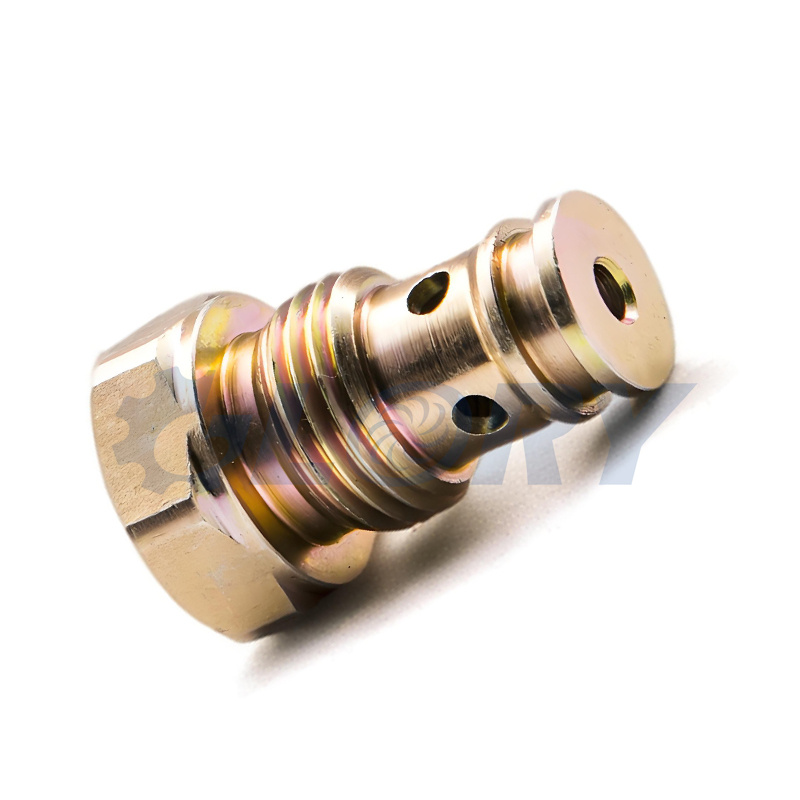
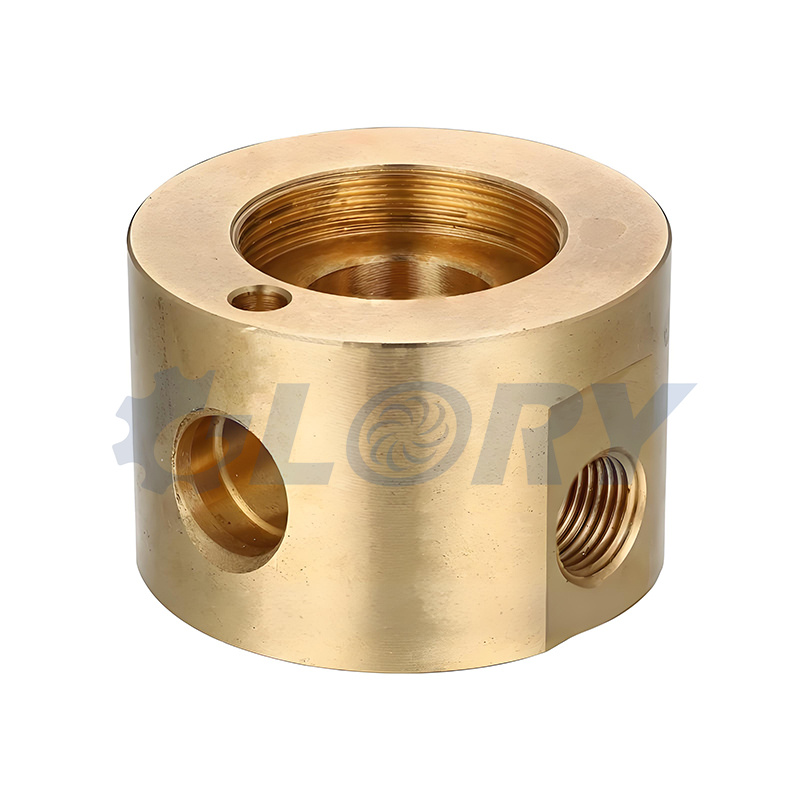
A small selection of the brass component types that pass through our turning and milling cells every month.
A Controlled Six-Step Production Route
A predictable process is what allows tight tolerances to be repeated batch after batch. Every CNC machined brass in China order follows the same route from drawing review to packed goods.
Drawing Review
We review tolerances, thread callouts, wall thicknesses, corner radii and alloy choice, and return practical manufacturability feedback before any metal is cut.
Material Preparation
Stock is selected against the ordered grade and standard, then sawn to blank length or fed continuously from bar, with grade and batch information recorded for the job.
Programming & Setup
Tool paths are prepared offline, fixtures and cutting tools are staged, and a first article is run through a complete dimensional check before batch release.
CNC Machining
Turning, 3/4/5-axis milling, drilling and tapping are combined across optimized setups so critical datums stay aligned throughout the operation sequence.
Deburring & Finishing
Vibratory tumbling, hand deburring, brushing, polishing or preparation for external plating follows the drawing, with sharp edges broken to the agreed edge standard.
Inspection & Packing
Final dimensional checks, clean and dry packaging, labeled batches and protective separation ensure threaded and sealing surfaces arrive fit for immediate assembly.
Industries That Use Our Machined Brass Parts
Brass appears wherever machined parts must combine precision, corrosion behavior and long service life. The six fields below account for most of the brass components we produce.
Plumbing & Sanitary Hardware
Fittings, couplings, nuts, inserts, adapter bodies and sealing seats for water and gas systems.
Hydraulics & Pneumatics
Valve internals, port connectors, fittings, sleeves and small manifold-style brass bodies.
Electrical & Electronics
Connector shells, contact pins, terminal posts, earth lugs and sensor housings.
Automotive & Transportation
Fuel and fluid fittings, sensor bodies, threaded adapters and custom small hardware.
Marine & Instrumentation
Naval and aluminum brass components, meter bodies, adjusting screws and precision sleeves.
Industrial Machinery
Bushings, spacers, lock nuts, nozzles, guide parts and custom machine elements.
What Buyers Usually Ask About Brass Machining
Short answers to the questions that come up most often when a new brass drawing is sent in for a CNC machined brass in China quotation.
Which brass grade should I select?
Free-cutting C36000 or CuZn39Pb3 is the economical default for most machined components. Lead-free silicon brass is chosen where drinking-water or low-lead rules apply, while naval and aluminum brasses are preferred for harsher water environments. We can suggest a grade once the application and working medium are known.
Which drawing formats can be quoted from?
STEP, IGES and Parasolid (X_T) models work best for geometry, supported by a PDF, DWG or DXF drawing that states tolerances, threads, surface requirements and the target brass grade. A clear sample with measured notes is also enough to start.
How long is a typical lead time?
Single prototypes and simple samples can be completed within a matter of days. Batch lead time depends on quantity, complexity and any external finishing such as plating, and a firm schedule is confirmed when the order is released.
Can you reproduce an existing part?
Yes. From a physical sample we measure the geometry, identify a matching brass grade, rebuild a drawing for confirmation and then machine production parts that interchange with the original, including its thread and sealing dimensions.
A Steady Source for CNC Machined Brass in China
Brass looks simple to machine, but repeatable brass components depend on the right alloy, sharp tooling strategy, correct thread form and disciplined first-article control. Our workshop is built around exactly those details.
Whatever shape the project takes — a single turned bushing, a five-axis milled brass valve body or a monthly high-volume release — OEM CNC machined brass parts can be produced to drawing, packed cleanly and released on a predictable schedule.
 We provide custom machined parts, 5-axis linkage CNC machining, and the design, production, and assembly of machinery and equipment.